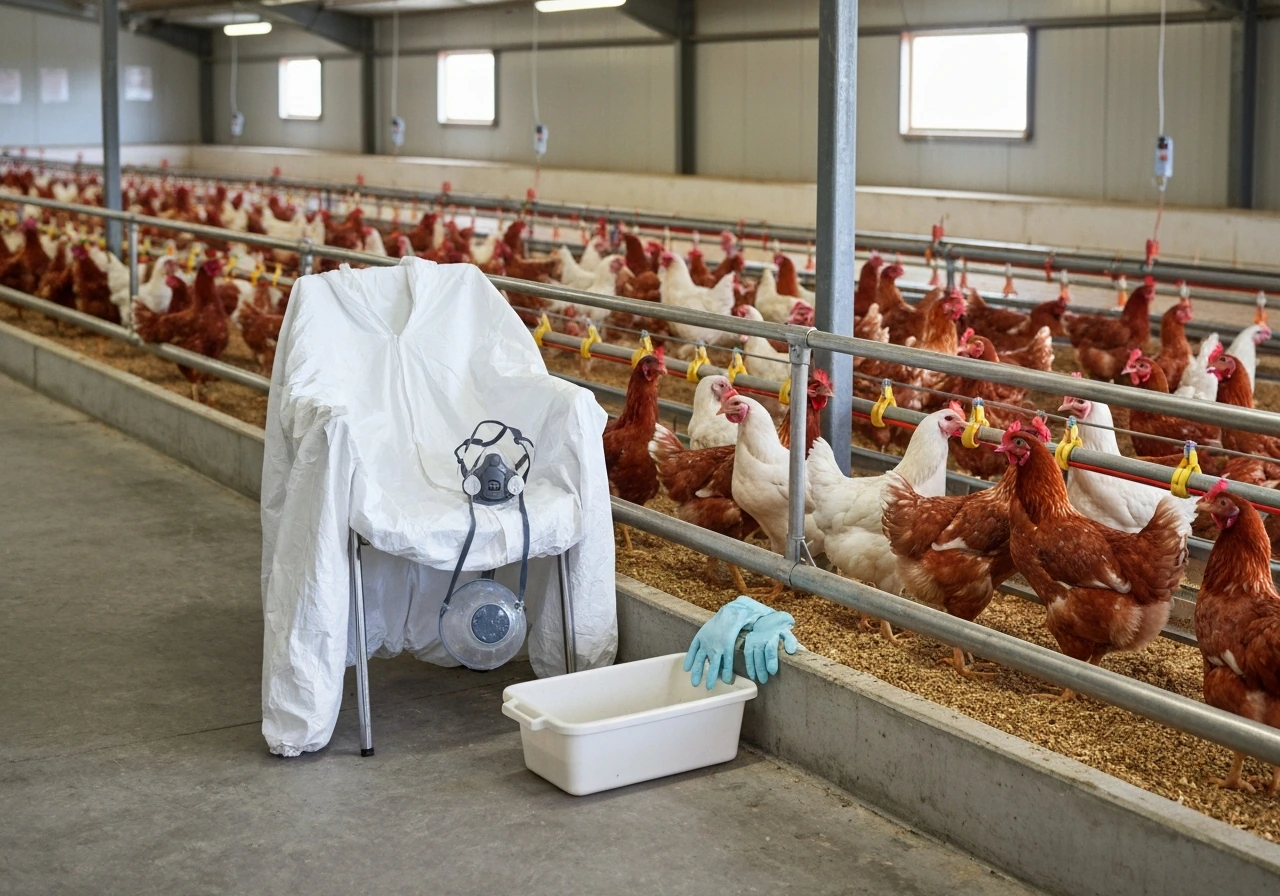
As of May 2026, the WHO has recorded 997 lab-confirmed human H5N1 bird flu cases globally since 2003, with 478 deaths. In 2025, there were 30 confirmed human H5N1 cases and 12 deaths. In early 2026 (through the March WHO update), there were 4 more cases and 1 death. If you include the historically significant H7N9 strain, the cumulative human toll climbs further: roughly 1,568 confirmed H7N9 infections since 2013, almost all in China, with that strain now largely dormant. The honest take is this: human bird flu infections are rare, serious when they do happen, and carefully tracked by multiple global health agencies.
How Many People Have Bird Flu? Latest Human Cases

Maya Chen
13 May 2026

Current human bird flu case numbers at a glance

The WHO releases cumulative case tables for H5N1 specifically, updated periodically. Here is where the numbers stand based on the most recent available data as of this writing:
| Period | Confirmed H5N1 Human Cases | Deaths |
|---|---|---|
| 2003–2024 (cumulative) | 963 | 465 |
| 2025 | 30 | 12 |
| 2026 (partial, through March) | 4 | 1 |
| Total (2003–March 2026) | 997 | 478 |
For context, the Americas have become a notable hotspot in this recent wave. Between April 2022 and March 2026, PAHO and WHO documented 75 human H5N1 infections across five countries in the Americas, including two deaths. The United States alone reported 70 human H5N1 cases during 2024 and into early 2025, mostly tied to farm workers exposed to infected poultry or dairy cattle. That surge is what pushed the global cumulative count close to the 1,000-case milestone.
What "cases," "outbreaks," and "infected people" actually mean
These three terms get used interchangeably in headlines, but they mean very different things, and mixing them up leads to a lot of unnecessary confusion or, sometimes, unnecessary panic.
A confirmed human case means a person tested positive for avian influenza in a lab, and that result was verified and reported to WHO under the International Health Regulations (IHR, 2005). Crucially, WHO's IHR case definition does not require that person to actually be sick. Evidence of illness is not required for IHR notification. That means some counted "cases" are people who tested positive but had mild or no symptoms, particularly farm workers who were tested as part of surveillance sweeps rather than because they showed up at a hospital.
An outbreak is an animal-side term. When authorities confirm bird flu in a flock, a herd, or a group of wild birds, that event is called an outbreak. One outbreak can involve a single backyard flock of 20 chickens or a commercial operation with millions of birds.
Because poultry outbreaks are tracked at the event level, estimates of how many chickens were killed due to bird flu typically come from culling and reporting records rather than a complete census of every infected bird single backyard flock of 20 chickens. The word tells you that the virus was detected in animals at a defined location, not how many animals were infected or how severe the spread was.
Outbreaks are tracked at the event level, not the individual animal level.
Infected people is a looser term that journalists and public health communicators often use to mean "people who tested positive," but it sometimes bleeds into estimates that include probable or suspected cases. WHO's surveillance specifically counts lab-confirmed cases. When you see a higher number somewhere, it may be pulling in probable cases, cases under investigation, or totals from a surveillance system with a different definition. WHO itself cautions that its IHR case definitions may not apply to other reporting systems, which have their own thresholds.
There is also the concept of limited, non-sustained human-to-human transmission. In a small number of cases involving H5N1, H7N7, and H7N9, researchers found probable person-to-person spread through close, unprotected contact with a symptomatic person. These are still counted individually as confirmed cases, not as a separate outbreak category. The key phrase is "non-sustained": the virus did not keep spreading beyond that close contact.
How many birds actually have bird flu right now

This is the question where the honest answer is: nobody knows exactly, and the infrastructure to know does not exist. To answer how many cows have bird flu, you have to look at reported infections in cattle and livestock surveillance rather than any complete census. What we have instead are reported outbreaks and surveillance detections, which together paint a picture of the scale without giving a precise count.
WOAH (the World Organisation for Animal Health) tracks outbreaks worldwide through its WAHIS system, where countries voluntarily submit reports of confirmed disease events. The global situation reports WOAH publishes are compiled from those submissions. The most recent one available at the time of writing is Situation Report 80, covering submissions from February 2026. These reports break down outbreak counts by species category (poultry versus non-poultry, including wild birds) and by region, but they represent reported and confirmed events, not a complete census of every infected bird on Earth.
Wild birds make the counting problem even harder. The USDA's wild-bird surveillance program in the United States works as an early-warning system: testers collect specimens from hunted birds, found carcasses, and live-capture samples, then test them. If a positive comes back, it counts as a detection. But the vast majority of wild birds are never tested. FAO's global tracking systems work similarly, pulling together data from national authorities and international reporting platforms like EMPRES-i, rather than generating a universal total. The result is that "detections in wild birds" is a surveillance artifact as much as it is a true count of infected animals.
What we do know is that wild bird populations, particularly migratory waterfowl and shorebirds, have been heavily affected by the current H5N1 clade (2.3.4.4b) that has swept the globe since around 2021. Mass mortality events in seabirds and raptors have been documented on every continent except Australia. Bald eagles, for instance, have died in notable numbers from H5N1 exposures in North America. But "how many wild birds are infected right now" has no reliable global answer, because global surveillance simply does not have that resolution.
A brief history of bird flu outbreaks: the bigger picture
Bird flu outbreaks in poultry and wild birds are not new, but the scale has accelerated dramatically. The H5N1 strain that drives most of the human case concern was first detected in Hong Kong in 1997. The large wave that WHO began systematically tracking in 2003 drove most of the human case counts in Southeast Asia through the mid-2000s and into the 2010s. The biggest spike in animal outbreaks during that era came between 2004 and 2006, when HPAI H5N1 spread across Asia, into Europe, and into Africa through wild bird migration.
Between 2013 and 2021, a different collection of strains caused additional waves: H7N9 became a major human health concern in China from 2013 onward, accumulating roughly 1,568 confirmed human cases before China's vaccination campaign in poultry dramatically suppressed it after 2017. HPAI H5 and H7 subtypes kept circulating in animals globally throughout this period.
Since 2021, the clade 2.3.4.4b H5N1 lineage has created what many epidemiologists consider the most geographically widespread HPAI outbreak in recorded history. It reached North America, South America, Antarctica-adjacent territories, and spread into dairy cattle in the United States starting in 2024, a previously unknown spillover pathway. WOAH situation reports now track animal outbreaks in the tens of thousands of events per year across poultry and wild birds combined. That animal-side scale is historically unprecedented. The human case count, by contrast, while rising, remains small relative to the animal burden.
How many people get bird flu each year

Looking at the WHO cumulative H5N1 data across 23 years (2003 to early 2026), the annual average works out to roughly 43 confirmed human cases per year globally. But the distribution is extremely uneven. Some years had only a handful of cases; 2006 saw 115 cases, the single highest annual total. The recent U.S. surge in 2024 (70 cases in one year from one country) represents a sharp departure from earlier patterns, driven by the dairy cattle exposure route and active farm-worker surveillance rather than a change in the virus's ability to infect people.
The H7N9 strain adds another layer. It caused roughly 1,568 cases over about four years (2013 to 2017) before poultry vaccination in China effectively cut off the source. That comes to roughly 300 to 400 human cases per year at its peak, almost entirely concentrated in one country with intense live-poultry market exposure.
For comparison, seasonal influenza infects hundreds of millions of people every year. Bird flu's human case count is orders of magnitude smaller, and the CDC's current framing is that the public health risk remains low. The reason it gets serious attention is the case fatality rate: H5N1 historically kills close to 50% of confirmed cases, and H7N9 killed roughly 39% of confirmed cases.
Because of that, discussions of how many people died from bird flu often focus on case fatality rates rather than just raw case counts. Those are extraordinarily high fatality rates, even if total cases are small. Whether those rates hold for the recent U. S.
wave is an open question, since farm-worker surveillance almost certainly captured milder cases that earlier surveillance missed.
How to find the latest verified numbers yourself
The data moves, and no article published today will have tomorrow's numbers. Here is exactly where to go and what to look for when you want the current count:
- WHO's avian influenza A(H5N1) cumulative case table: Go to the WHO website and search for 'cumulative number of confirmed human cases avian influenza H5N1.' WHO publishes a PDF table (updated periodically, most recently March 2026) that breaks cases and deaths down by year and country. This is the authoritative global human case count.
- WHO's 'Influenza at the human-animal interface' summary: WHO publishes monthly or near-monthly summaries that cover all avian influenza subtypes with human case implications. These are listed under WHO Disease Outbreak News and the 'Human-animal interface' section. They are the fastest-updating WHO source for new cases.
- CDC's avian influenza surveillance page: CDC maintains a page called 'Reported Human Infections with Avian Influenza A Viruses' that lists U.S. and global case information. For U.S.-specific counts, this is the most detailed source, and it links out to WHO's global summaries.
- PAHO epidemiological updates: For the Americas specifically, PAHO publishes region-specific updates on H5N1. Search 'PAHO avian influenza A(H5N1) epidemiological update' for the latest Americas-focused picture.
- WOAH HPAI situation reports: For the animal side of the picture, WOAH publishes numbered situation reports (currently in the 80s). Search 'WOAH HPAI situation report' on the WOAH website. These give outbreak counts in poultry and wild birds by region and reporting period.
- USDA APHIS HPAI detections page: For U.S. animal detections, USDA APHIS maintains a regularly updated page listing HPAI detections in commercial poultry, backyard flocks, wild birds, and dairy cattle. It is updated frequently, often weekly.
When you read any case count, ask two quick questions: Does this include only lab-confirmed cases, or also suspected and probable ones? And does it cover all subtypes (H5N1, H7N9, H9N2, etc.) or just one? The WHO H5N1 table covers only H5N1. CDC's global summaries tend to be subtype-specific as well. If a headline throws out a number without specifying the subtype or confirmation status, treat it skeptically.
What the numbers actually mean for your personal risk
Under 1,000 confirmed human H5N1 cases over more than two decades, out of a global population of 8 billion, is an almost vanishingly small absolute risk for most people. The cases that do occur are heavily concentrated in people with direct, close contact with infected birds or animals, particularly farm workers, poultry cullers, and in earlier years, people who regularly visited live-animal markets in Southeast Asia. The virus does not spread efficiently from person to person, and sustained human-to-human transmission has never been documented.
The U.S. farm worker cases in 2024 and 2025 mostly presented as mild illness, often conjunctivitis (eye infection) or mild respiratory symptoms, with no deaths in many clusters. That is meaningfully different from the profile of earlier Southeast Asian cases, which had higher severity. Surveillance design matters here: when you actively test exposed workers, you find mild cases you would have missed otherwise, and that changes the apparent fatality rate.
If you work on a poultry or dairy farm, or have regular contact with wild birds in a professional capacity (wildlife rehabilitation, for example), the relevant next step is checking current guidance from CDC and your state health department on personal protective equipment and when to seek testing. If you are a member of the general public with no animal exposure, the numbers above reflect your baseline risk accurately: it is low.
If you want to know how many farms have bird flu, the key is looking at country and agency reports that track infected premises and farm-level detections. That does not mean the situation should be ignored at a public health level, because the animal-side outbreak scale is genuinely enormous and the virus is evolving. But low risk now does not require personal protective action beyond normal hygiene and staying away from sick or dead wild birds.
If a bird flu pandemic ever involved sustained human-to-human spread, the death toll could be very different from today’s rare, mostly animal-linked cases.
FAQ
Do the “how many people have bird flu” numbers include only H5N1, or do they also include other avian flu subtypes?
Most global totals people cite are subtype-specific. The WHO cumulative table discussed in the article covers H5N1 only, while other subtypes like H7N9 are tracked separately. So a headline that says “bird flu cases” without specifying subtype can mix different reporting streams and end up overstating or understating the true number for the strain you care about.
Why might the confirmed case count look high even though bird flu spreads poorly between people?
Because confirmed cases are based on lab results, not on whether sustained transmission occurred. The article notes that some counted “cases” can be people tested during surveillance sweeps (often with mild or no symptoms). That inflates case totals without implying that the virus is efficiently spreading person to person.
What’s the difference between a confirmed case and an “infection” claim you might see in media or social posts?
In practice, “infection” is sometimes used loosely to include probable, suspected, or under-investigation events, but the WHO IHR case definition is tied to lab confirmation and specific notification rules. If a post does not say it is lab-confirmed (and which agency definition it follows), treat it as uncertain.
If someone had symptoms, would they automatically be counted as a case?
Not automatically. Reporting depends on whether samples are collected and tested, and whether the case meets the notification definition used by the reporting system. That is why surveillance design matters, for example active testing of exposed farm workers can find milder cases that would not be captured by hospital-based detection.
Are deaths counted differently than cases, and can the case fatality rate change over time?
Deaths are counted only when fatal outcomes are verified, so the ratio can shift as detection changes. The article highlights that newer clusters may include milder infections due to targeted testing, which can lower the apparent fatality rate compared with earlier periods.
How often do the global numbers get updated, and why can two articles report different totals?
Updates happen periodically as agencies publish revised tables. Two credible sources can still differ if one uses the latest WHO IHR update and another uses an older snapshot, or if one reports through a slightly different cut-off date.
Do I need to worry about catching bird flu from my community, or is risk almost entirely linked to animal exposure?
Based on the article’s description of the evidence, human cases are heavily concentrated among people with direct contact with infected birds or animals, especially in farm-worker and similar occupational settings. For someone with no animal or wild-bird exposure, the relevant next step is general precautions (avoid handling sick or dead birds, use basic hygiene), not special protective measures.
What should someone do if they had exposure to sick or dead wild birds, but they feel fine?
Even without symptoms, the most important step is to follow local public health and CDC guidance on exposure risk, cleaning practices, and whether testing is recommended. Because the article emphasizes that surveillance can detect mild infections, you may still be advised to contact a health authority, especially after higher-risk contact such as handling carcasses or being in close contact with known infected animals.
If I see “bird flu cases” rising in one country, does that mean the virus is spreading more effectively to humans?
Not necessarily. The article notes that changes in surveillance intensity and exposure routes, such as dairy-cattle spillover and active farm-worker testing, can increase confirmed counts without a change in the virus’s ability to sustain human-to-human spread. Look for whether the reporting is lab-confirmed, how exposures occurred, and whether transmission evidence is present.
Does the “how many people have bird flu” question ever include animal-linked outbreaks with no human illness?
Yes indirectly, but not as human cases. Animal outbreaks are tracked at the event level by livestock health systems, and those events help explain where exposure risk is created. Human totals still come from lab-confirmed human infections reported under specific case definitions, so animal outbreak counts should not be treated as human infection counts.
Next Article
How Many Chickens Were Killed Due to Bird Flu: Counts Explained
Learn how to find accurate local bird flu chicken cull and death counts, timing, and why totals change.