
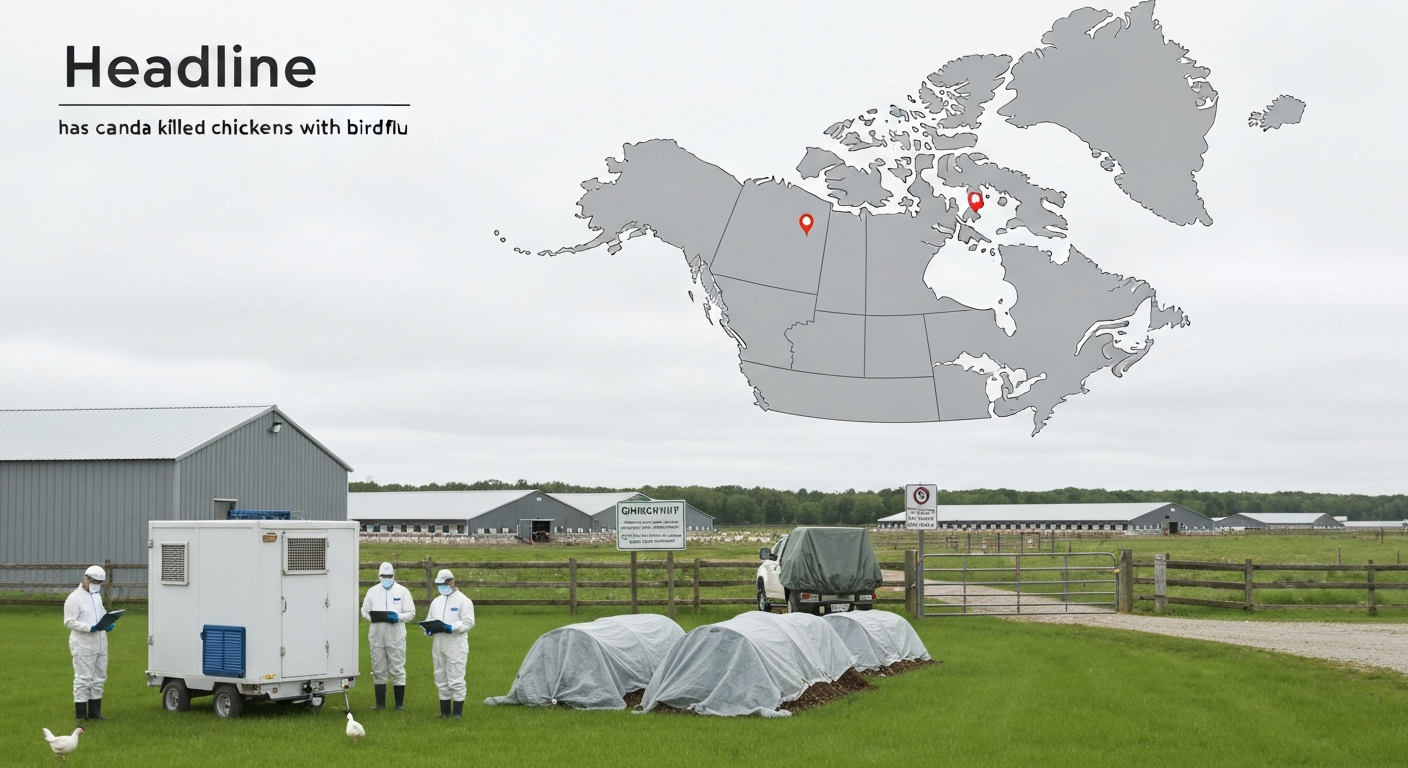
Yes, Canada has culled (killed) chickens and other poultry because of bird flu, and it has done so on a large scale across multiple provinces. The 2004 H7N3 outbreak in British Columbia's Fraser Valley alone resulted in roughly 17 million birds being destroyed. Since 2022, highly pathogenic avian influenza (HPAI H5N1) has triggered further culling operations across British Columbia, Alberta, Saskatchewan, Ontario, Quebec, Nova Scotia, and beyond, affecting commercial laying flocks, broiler chickens, turkeys, and backyard birds. Culling is not a choice made lightly: it is a legally mandated, scientifically grounded disease-control measure used to prevent the virus from spreading further through Canada's poultry industry and into wild bird populations.
Has Canada Killed Chickens with Bird Flu? 2026 Update & Province Breakdown

Canada's bird flu culling at a glance
Canada has responded to HPAI outbreaks with culling orders under the federal Health of Animals Act on multiple occasions since the late 1990s, but two periods stand out for their scale. The 2004 H7N3 outbreak in British Columbia was the largest single event on record, with approximately 17 million birds destroyed across commercial and backyard flocks in the Fraser Valley region. The second major wave, tied to the global H5Nx panzootic that emerged forcefully in North America from late 2021 onward, has produced dozens of infected premises (IPs) across the country every year from 2022 through 2026, each triggering immediate depopulation of the affected flock.
The Canadian Food Inspection Agency (CFIA) tracks every infected premises in its public HPAI dashboards and its 'Investigations and orders' table, both updated regularly. The total number of birds destroyed since 2022 runs into the millions nationally, though exact rolling figures shift as new premises are confirmed and depopulated.
Simple timeline of major Canadian culling events
- 2004: H7N3 outbreak, Fraser Valley, British Columbia. Approximately 17 million birds culled across commercial and backyard flocks. Largest single HPAI culling event in Canadian history.
- 2007–2014: Sporadic low-pathogenicity and localized HPAI detections; small-scale culling on individual premises in BC, Alberta, and Ontario.
- 2015: H5N2 detected in Ontario. Multiple premises affected; birds on each infected premises humanely destroyed and composted on-site under CFIA supervision.
- Late 2021 – 2022: Global H5N1 clade 2.3.4.4b panzootic reaches Canada. Detections in wild birds first, then commercial poultry. Multi-province culling operations begin.
- 2023: Continued H5N1 detections across BC, AB, SK, MB, ON, QC, Atlantic provinces. Dozens of infected premises confirmed; flocks depopulated on each.
- 2024: Ongoing detections, including in dairy cattle in some US states (though not a primary Canadian poultry issue). CFIA compensation regulations amended (SOR/2025-136 published June 6, 2025) in response to scale of losses.
- 2025–2026: Further infected premises confirmed across multiple provinces. CFIA 'Latest bird flu situation' hub and Power BI dashboards continue to update in near-real time.
Province-by-province outbreak summary
The CFIA's 'Investigations and orders' page lists every infected premises by province, including the detection date, premises type, and the WOAH (World Organisation for Animal Health) disease classification. The table below summarizes the scope of confirmed activity by province from 2022 through mid-2026, drawing on that publicly available data. Bird counts per premises vary widely, from a few hundred backyard birds to hundreds of thousands in a single commercial barn, so cumulative provincial bird totals are best tracked through the CFIA's live dashboard.
| Province | Detection period (2022–2026) | Number of infected premises (approx.) | Primary bird types affected | Notable details |
|---|---|---|---|---|
| British Columbia | 2022 – 2026 | 30+ | Broiler chickens, layer hens, turkeys, backyard mixed flocks | Site of Canada's largest-ever cull (2004, 17M birds); ongoing commercial detections in Fraser Valley and interior regions |
| Alberta | 2022 – 2026 | 40+ | Layer hens, broiler chickens, turkeys, ducks | Among the most affected provinces; major commercial layer and broiler operations hit |
| Saskatchewan | 2022 – 2026 | 10+ | Broiler chickens, turkeys, backyard flocks | Detections in both commercial and small flock settings |
| Manitoba | 2022 – 2026 | 10+ | Turkeys, broiler chickens, mixed backyard flocks | Wild bird flyways increase exposure risk in spring/fall migration |
| Ontario | 2015; 2022 – 2026 | 20+ | Layer hens, broiler chickens, turkeys | 2015 H5N2 outbreak notable; ongoing H5N1 detections in densest poultry-producing region |
| Quebec | 2022 – 2026 | 15+ | Layer hens, broiler chickens, ducks, geese | Dense poultry sector; multiple commercial premises affected |
| Nova Scotia | 2022 – 2026 | 5+ | Layer hens, mixed commercial flocks | Atlantic outbreaks linked to migratory wild bird contact |
| New Brunswick / PEI / Newfoundland | 2022 – 2026 | Several | Backyard flocks, small commercial operations | Lower commercial density; detections largely in smaller flock types |
| Other / wild bird interface zones | Ongoing | Multiple control zones | Wild waterfowl, raptors, shorebirds | Wild bird detections trigger surveillance and movement restrictions near commercial zones |
These figures reflect the scale of Canada's response but should be treated as approximate: the CFIA updates its infected premises list continuously, and some premises may be removed from active control zones as investigations close. For the most current count, the CFIA's HPAI dashboards (built on Power BI) are the authoritative source.
Which birds were affected: species, production type, and settings
HPAI does not discriminate neatly by species or farming system. In Canada, confirmed culling has involved commercial broiler chickens, commercial laying hens, turkeys, ducks, geese, and game birds on commercial premises, as well as birds in backyard and hobby flocks. Wild birds (waterfowl, raptors, shorebirds) have also been found dead or sick with HPAI across all provinces, and these cases trigger enhanced surveillance around nearby domestic flocks even though wild birds are not culled in the same regulatory framework as domestic poultry.
Commercial operations account for the vast majority of birds killed, simply because of flock size: a single large commercial barn can house 100,000 to 500,000 birds, so one infected premises can result in a massive one-time cull. Backyard and small-scale flocks are also regularly affected and are subject to the same legal destruction orders under the Health of Animals Act, though their smaller numbers mean a lower absolute bird count per event.
- Commercial broiler chickens: large indoor operations; high bird density increases within-flock transmission speed once virus enters
- Commercial laying hens: cage-free and conventional barn systems; multiple affected premises in Ontario, Quebec, and Alberta
- Turkeys: historically among the most affected species in North American H5N1 outbreaks; detected in BC, AB, SK, ON, and QC
- Ducks and geese: commercial meat operations and hobby flocks; these species can carry HPAI with fewer visible symptoms, complicating early detection
- Game birds (pheasants, quail): small commercial and hunting operations; occasionally affected
- Backyard and mixed flocks: hobby keepers and small producers; higher wild-bird contact risk in free-range settings
Why culling is used: the science and the rules behind it
Culling infected flocks, often called 'stamping out' in official disease-control language, is the primary tool used globally against highly pathogenic avian influenza because it removes the virus's host population quickly and decisively. The scientific rationale is straightforward: HPAI viruses like H5N1 spread rapidly within a flock through direct contact and contaminated surfaces, and an infected but not-yet-showing flock can shed enormous quantities of virus. Every day a large infected flock remains alive is a day the virus can spread to neighboring premises, to vehicle traffic, to workers, and to wild birds that then carry it further.
A 2023 systematic review of mechanistic models for avian influenza control found that stamping out (including pre-emptive ring culling) is generally more effective at reducing epidemic size and duration than vaccination alone, particularly when detection is early. A 2023–2024 systematic review of mechanistic models for avian influenza control concluded that vaccination tends to reduce the number of flocks culled, while pre‑emptive (ring) culling is generally more effective at reducing epidemic size and duration, and that early detection improves the effectiveness of all interventions A 2023–2024 systematic review of mechanistic models for avian influenza control concluded that vaccination tends to reduce the number of flocks culled, while pre-emptive (ring) culling is generally more effective at reducing epidemic size and duration, and that early detection improves the effectiveness of all interventions.. The same review noted that vaccination reduces the number of flocks ultimately culled but requires sustained surveillance and strain-matching to work properly. Canada's current approach prioritizes speed of elimination over the longer runway that a vaccination strategy would require.
The legal authority for culling in Canada sits in the Health of Animals Act, specifically section 48, which allows the CFIA to issue a Notice to Dispose ordering the destruction of animals and things that pose a disease risk. This is not discretionary once HPAI is confirmed on a premises: the Act requires action to prevent spread. The WOAH, to which Canada reports outbreaks, classifies HPAI as a notifiable disease requiring immediate control measures, which in practice means depopulation of confirmed infected premises.
Who makes the call: CFIA, provinces, and the decision-making process
The decision chain in a Canadian HPAI outbreak is federal-led but operationally coordinated with provincial authorities. When a flock shows clinical signs consistent with HPAI, the producer or veterinarian notifies provincial authorities, who notify the CFIA. The CFIA's Area Emergency Operations Centre activates, and a CFIA veterinary inspector collects samples and imposes an immediate standstill (no bird or equipment movement) on the premises pending lab confirmation.
Once the Canadian Food Inspection Agency's National Centre for Foreign Animal Disease (NCFAD) in Winnipeg confirms the diagnosis, the CFIA issues a Notice to Dispose under section 48 of the Health of Animals Act. At that point, the destruction of all birds on the infected premises is legally required. The operational framework used is the Notifiable Avian Influenza Hazard Specific Plan (NAI-HSP), which defines zone structures (infected, restricted, and control zones), movement controls, and depopulation protocols. For large outbreaks, the National Emergency Operations Centre is activated and additional CFIA staff, contracted depopulation crews, and provincial agricultural officials are brought in.
Provincial governments play a supporting role: they may assist with logistics, coordinate with local emergency services, manage road access, and administer some farmer support programs alongside the federal compensation scheme. But the legal authority to order destruction and the compensation framework are both federal instruments under the Health of Animals Act.
How culling is actually carried out
Depopulation methods
The CFIA's guidelines for stunning techniques for avian food animals specify that depopulation must be humane. In practice, the methods used during emergency culling operations in Canada include controlled-atmosphere killing (using carbon dioxide or nitrogen-enriched air in portable units brought to the barn), cervical dislocation for small numbers of birds, and in some situations electrical stunning followed by neck cutting. The choice of method depends on flock size, species, barn layout, and the speed required to minimize virus spread. For very large commercial barns, whole-barn gassing with CO2 or inert gas is typically the most practical option.
Carcass disposal
Once birds are dead, the carcasses must be disposed of in a way that destroys the virus and prevents environmental contamination. Canadian outbreak reports, including the detailed investigation report on the 2015 Ontario H5N2 outbreak, document on-site composting and bio-heat treatment as the primary disposal methods. On-site composting involves layering carcasses with carbon-rich material (wood chips, straw) in large windrows inside the barn or on a sealed surface nearby; the heat generated by decomposition (typically 55–70°C) inactivates the virus within days to weeks. Bio-heat treatment is a variant that manages temperature and moisture more actively. In some situations, rendering or incineration at licensed facilities is used, though moving carcasses off-site carries biosecurity risks that make on-site treatment preferable when feasible.
Cleaning, disinfection, and the fallow period
After depopulation and disposal, the barn goes through a thorough cleaning and disinfection protocol: removal of all organic matter, washing with high-pressure water, application of approved disinfectants, and a fallow period (empty barn, no birds) typically lasting several weeks to months before the CFIA will release the premises from its order. This fallow period is critical because HPAI virus can persist on contaminated surfaces and in the environment, particularly in cool, moist conditions.
Compensation for farmers
Farmers whose flocks are ordered destroyed by the CFIA receive compensation under the federal Compensation for Destroyed Animals and Things Regulations (CDATR), enacted under the Health of Animals Act. The regulations set maximum compensation amounts per animal type based on fair market value, and they were amended in June 2025 (SOR/2025-136) to update eligibility criteria and payment caps in response to the scale of losses since 2022. Compensation does not cover all economic losses (ongoing fixed costs, lost income during the fallow period, and restocking costs may not be fully covered), which is why some provinces and producer organizations have supplementary support programs. The intent of the federal compensation is to reduce the financial disincentive for producers to report suspected disease early, which is essential for rapid detection and control.
What this means for consumers: food safety and public health
The CFIA, Health Canada, and the Public Health Agency of Canada (PHAC) are consistent on this point: avian influenza is not a food safety concern for consumers who handle and cook poultry and eggs properly. The HPAI virus is inactivated by thorough cooking (internal temperature of 74°C / 165°F for poultry), and pasteurization inactivates the virus in liquid egg and dairy products. Birds from confirmed infected premises are destroyed and never enter the food supply. The supply-chain controls, combined with normal cooking temperatures, mean the risk to someone buying chicken at the grocery store is effectively zero.
The broader human health risk from H5N1 to the general public is assessed as low by PHAC and confirmed in joint FAO/WHO/WOAH updates (including the May 2026 assessment)-virus-events-in-animals-and-people--18-may-2026.pdf). Human infections with H5N1 have occurred globally but almost exclusively through direct, prolonged, unprotected contact with infected live birds or heavily contaminated environments, not through eating properly cooked poultry. Poultry workers involved in depopulation operations are provided personal protective equipment and monitored for symptoms as a precaution.
Alternatives to culling: vaccination, biosecurity, and emerging options
Culling is not the only tool available, and there is ongoing global debate about whether widespread vaccination of poultry should replace or complement stamping-out policies. Countries including France, the Netherlands, and China have used or are piloting poultry vaccination programs alongside culling. See what countries vaccinate chickens against bird flu for an up-to-date list of nations using poultry vaccination. WOAH's policy guidance acknowledges vaccination as a legitimate complementary tool when specific epidemiological, surveillance, and trade conditions are met. Canada has not moved to routine poultry vaccination, partly for the same trade-related reasons that shape the US approach: vaccinated flocks can be harder to distinguish from naturally infected ones without enhanced surveillance (the so-called DIVA problem), and major trading partners may impose import restrictions on poultry from vaccinating countries.
Beyond vaccination, enhanced biosecurity remains the single most effective preventive measure available to producers right now. CFIA biosecurity standards require commercial poultry operations to control access, prevent wild bird contact, manage traffic flow, and monitor flocks daily. Farms with strong biosecurity have repeatedly survived outbreaks in neighboring areas without becoming infected themselves. On the longer horizon, gene-editing research is exploring whether chickens can be made genetically resistant to avian influenza, a development that could eventually reduce the need for both culling and vaccination. Research suggests gene editing could make chickens resistant to bird flu, potentially reducing the need for culling and vaccination.
| Control approach | How it works | Used in Canada? | Key trade-off |
|---|---|---|---|
| Stamping out (culling) | All birds on infected premises destroyed immediately | Yes, primary tool | Effective at stopping spread; high economic cost and animal welfare impact |
| Ring/pre-emptive culling | Birds on premises near confirmed IPs destroyed before confirmation | Used selectively | Reduces epidemic size; destroys healthy flocks, increasing compensation costs |
| Vaccination | Birds immunized against circulating strain before or during outbreak | Not currently routine in Canada | Reduces culling numbers; creates DIVA surveillance challenges and trade complications |
| Enhanced biosecurity | Physical barriers, access controls, wild bird exclusion, hygiene protocols | Yes, mandatory for commercial flocks | Prevents entry of virus; requires consistent producer compliance |
| Gene-edited resistant breeds | Chickens bred or edited to lack the ANP32A protein HPAI needs to replicate | Research phase only | Could eliminate need for culling; regulatory and commercial-scale hurdles remain |
How Canada compares to other countries
Canada's stamping-out approach is consistent with the policy used in the United States, Australia, and the United Kingdom, all of which rely on rapid depopulation of confirmed infected premises as their first line of defense. For more on why the US doesn't routinely vaccinate chickens against bird flu, see an explanation of the trade, surveillance, and policy reasons behind that decision. The US has culled well over 100 million birds since 2022 in its own H5N1 response, dwarfing Canada's numbers but reflecting the same regulatory philosophy. Mexico's approach and outbreak history differs in ways worth noting separately. For more detail on Mexico's differing situation, see why doesn't Mexico have bird flu. For details on Mexico's culling response, see has mexico killed chickens for bird flu. Countries like France and the Netherlands, which face pressure from their dense poultry sectors and repeated outbreak cycles, have moved further toward vaccination as a complementary strategy, though they still cull confirmed positive premises. The WOAH framework allows both approaches, with the key condition being that vaccinating countries maintain surveillance systems that can distinguish field infection from vaccine-induced immunity.
Where to find current outbreak data
The CFIA's 'Latest bird flu situation' hub is the most reliable single source for Canadians wanting current outbreak information. For broader context on whether Canada has bird flu and how outbreaks have progressed, see does canada have bird flu. It includes an interactive map of infected premises and control zones, a province-by-province 'Investigations and orders' table updated as new premises are confirmed, links to the HPAI Power BI dashboards with epidemiological curves and flock-count data, and WOAH classification information for each event. PHAC publishes parallel human-health risk assessments, and the joint FAO/WHO/WOAH global updates (the most recent issued May 2026) provide international context. For producers, the CFIA's NAI Hazard Specific Plan and the provincial agriculture ministry websites carry the operational biosecurity and response guidance relevant to their operations.
FAQ
Short answer: has Canada culled (killed) chickens because of avian influenza?
Yes. Canadian authorities have ordered the humane destruction (culling) of domestic poultry on infected premises as part of outbreak control measures for highly pathogenic avian influenza (HPAI). The Canadian Food Inspection Agency (CFIA) documents that birds on infected premises are humanely destroyed and premises are subject to disposal, cleaning and fallow periods (CFIA Latest bird flu situation; CFIA outbreak reports). Sources: CFIA Latest bird flu situation — https://inspection.canada.ca/en/animal-health/terrestrial-animals/diseases/reportable/avian-influenza/latest-bird-flu-situation; CFIA outbreak report example — https://inspection.canada.ca/en/animal-health/terrestrial-animals/diseases/reportable/avian-influenza/disease-incidents/h5n2-avian-influenza-ontario-2015.
How many birds have been culled and where — is there a provincial breakdown and timeline?
CFIA maintains live, authoritative lists and dashboards with infected premises (IPs), dates detected, province, premises type and control zones. Because counts change during active events, check CFIA’s Investigations and orders table and HPAI dashboards for current, province-by-province numbers and timelines. Historically, Canada has had large events (for example, the 2004 H7N3 Fraser Valley outbreak led to about 17 million birds destroyed). For the latest counts and a dated timeline, see: CFIA Investigations and orders — https://inspection.canada.ca/en/animal-health/terrestrial-animals/diseases/reportable/avian-influenza/latest-bird-flu-situation/investigations-and-orders and CFIA HPAI dashboards — https://inspection.canada.ca/en/animal-health/terrestrial-animals/diseases/reportable/avian-influenza/latest-bird-flu-situation/hpai-dashboards.
Which provinces and bird types have been affected?
HPAI detections in Canada have occurred in multiple provinces across commercial and backyard flocks and in wild birds. Recent multi-year events (2022–2026) have included infected premises in provinces such as British Columbia, Alberta, Saskatchewan, Manitoba, Ontario, Quebec and Atlantic provinces (see CFIA Investigations and orders for exact province lists and premises types). Affected bird types include commercial chickens (meat and layer flocks), turkeys, backyard chickens, game birds and less commonly other domestic avian species. Source: CFIA Investigations and orders — https://inspection.canada.ca/en/animal-health/terrestrial-animals/diseases/reportable/avian-influenza/latest-bird-flu-situation/investigations-and-orders.
Why is culling (depopulation) used — what is the scientific and regulatory rationale?
Rationale: Highly pathogenic avian influenza can spread rapidly between flocks and through movement of people, equipment and contaminated materials. Rapid removal of infected flocks (stamping-out) reduces viral shedding, shortens the outbreak, and lowers the risk of onward spread to other flocks, wild birds and markets. Legally, under the Health of Animals Act the Minister and CFIA have authority to require disposal of animals that pose a disease risk; operationally CFIA’s Notifiable Avian Influenza Hazard Specific Plan and emergency frameworks guide stamping-out and control zones. Internationally, stamping-out remains a standard tool, though vaccination is a recognized complementary option in some contexts. Sources: CFIA NAI Hazard Specific Plan — https://inspection.canada.ca/en/animal-health/terrestrial-animals/diseases/reportable/avian-influenza/hazard-specific-plan/avian-influenza-overview; Health of Animals Act — https://laws-lois.justice.gc.ca/eng/acts/H-3.3/; WOAH vaccination guidance — https://www.woah.org/en/avian-influenza-vaccination-why-it-should-not-be-a-barrier-to-safe-trade/.
Who decides to cull and how are decisions made?
Decision-makers: CFIA is the federal authority that leads animal-disease response and can issue legal notices (for example, under s.48 of the Health of Animals Act) ordering disposal on infected premises. CFIA operational decisions are guided by hazard-specific plans (NAI‑HSP), Area and National Emergency Operations Centres and established incident-management procedures; provincial animal-health agencies and public-health agencies coordinate on zoning, movement controls and human-health guidance. Decisions weigh epidemiology (virus type, spread, contact tracing), farm biosecurity, flock size and commercial considerations; legal instruments and emergency plans define roles. Sources: CFIA NAI Hazard Specific Plan — https://inspection.canada.ca/en/animal-health/terrestrial-animals/diseases/reportable/avian-influenza/hazard-specific-plan/avian-influenza-overview; example legal notice context — public court record (s.48) — https://dksdata.com/Court/Ostrich/Ostrich-Responding-Motion-Record-Expedited.pdf.
What methods are used to cull and dispose of birds, and how is animal welfare handled?
Methods and welfare: CFIA outbreak reports state birds on infected premises are ‘humanely destroyed.’ Methods follow CFIA guidance on humane handling and approved depopulation techniques (electrical waterbath stunning, controlled-atmosphere methods, captive bolt for certain species, etc.). Disposal commonly uses on‑site composting/bio‑heat treatment to inactivate virus, followed by cleaning, disinfection and a required fallow period before restocking. CFIA provides operational and welfare guidance to ensure humane approaches and biosafety during depopulation and disposal. Sources: CFIA outbreak reports (e.g., Ontario 2015) — https://inspection.canada.ca/en/animal-health/terrestrial-animals/diseases/reportable/avian-influenza/disease-incidents/h5n2-avian-influenza-ontario-2015; Guidelines for stunning techniques — https://inspection.canada.ca/en/food-guidance-commodity/meat-products-and-food-animals/guidelines-stunning-techniques.