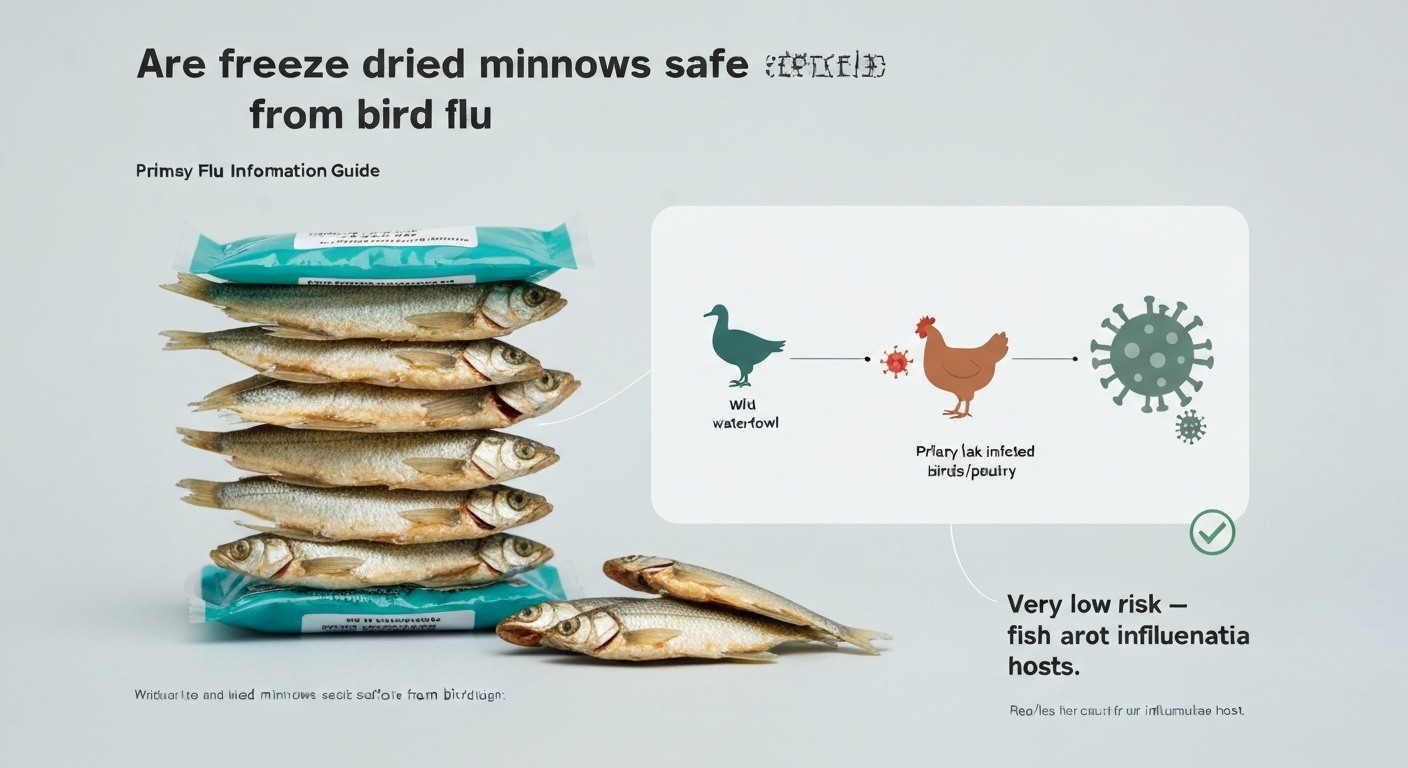
Freeze-dried minnows sold as pet treats or fishing bait pose a very low, and most likely negligible, bird flu risk to people and pets. The core reason: fish are not recognized hosts for avian influenza A viruses, and there is no substantive scientific evidence that influenza A replicates in minnows or other fish species. That said, freeze-drying itself does not guarantee viral inactivation if contaminated raw material were somehow processed, so understanding why the risk is low (rather than zero in a theoretical sense) helps you make practical, confident decisions about using these products.
Are Freeze Dried Minnows Safe from Bird Flu: Pets & Poultry

Maya Chen
28 Jul 2026
What bird flu actually is, and which strains should concern you
Avian influenza is caused by influenza A viruses, a family of RNA viruses that primarily circulate in wild aquatic birds and domestic poultry. The strains most relevant right now are the H5 subtypes, especially H5N1, which has been driving a prolonged global outbreak in wild birds and poultry since 2021. These viruses occasionally spill over into mammals, including cattle, domestic cats, and a small number of people with direct exposure to infected animals or their environments.
Not all avian influenza strains carry the same risk profile. Highly pathogenic avian influenza (HPAI), like H5N1, kills poultry at very high rates and is the strain tracked most closely by public health agencies. Low pathogenic avian influenza (LPAI) strains circulate more quietly and rarely cause serious illness in birds or mammals. For the purposes of this article, when you see 'bird flu,' think HPAI H5N1 and related H5 strains, since those are what current concern and surveillance efforts center on.
As of mid-2026, the CDC continues to assess the human public health risk from H5 bird flu events in the U.S. as low. That assessment is specific to people with no direct exposure to infected birds or raw animal products. The situation remains active and surveillance is ongoing, so checking the CDC and USDA APHIS websites for current outbreak status is always worthwhile.
How bird flu spreads: the routes that actually matter
The primary transmission pathway for avian influenza is direct contact: infected birds, their respiratory secretions, feces, feathers, or contaminated surfaces and equipment. Wild waterfowl and shorebirds are the main reservoir. They shed virus in feces and respiratory secretions, contaminating water, soil, and surfaces. Domestic poultry exposed to wild birds or contaminated environments can become infected quickly, and once HPAI enters a flock, it spreads rapidly.
For people and pets, the most documented exposure routes are handling infected birds (live or dead), contact with raw animal products from infected animals, or consuming raw or undercooked infected tissues. A peer-reviewed EFSA assessment ("Assessment of low pathogenic avian influenza virus transmission via raw poultry meat and raw table eggs, EFSA/peer‑reviewed assessment (PMC)") concludes that the most credible risk from contaminated animal products is via direct contact with raw or undercooked infected tissues or feeding raw contaminated products to susceptible animals, and that properly cooked food is not expected to transmit infection Assessment of low pathogenic avian influenza virus transmission via raw poultry meat and raw table eggs — EFSA/peer‑reviewed assessment (PMC). This is why public health guidance consistently emphasizes avoiding raw, undercooked, or unpasteurized animal products during active outbreaks and practicing thorough hand hygiene after any contact with birds or their environments.
Indirect transmission via contaminated fomites (equipment, footwear, clothing, feed) is also well-documented in agricultural settings. For household pet owners, the relevant indirect route is handling raw pet food products and then touching your face or your pet's food bowl without washing hands first. This is a practical concern with raw or freeze-dried poultry or egg products, though as you will see, it applies much less clearly to fish-based products.
How long influenza viruses survive in foods and the environment
Influenza A viruses are enveloped viruses, meaning they have a lipid outer membrane that is relatively fragile compared to non-enveloped viruses. That said, they can survive for surprisingly long periods under the right conditions. Temperature, humidity, matrix (what the virus is embedded in), and initial viral load all significantly affect how long infectious virus persists.
- At refrigerator temperatures (around 4°C), influenza A can persist in poultry muscle tissue for up to 160 days in some experimental studies, and in feather tissue for up to 240 days.
- Freezing at −20°C does not reliably inactivate influenza A. Infectious virus can be recovered from frozen meat after weeks to months, depending on the tissue type and matrix.
- Storage at −70°C, the standard lab method for preserving influenza isolates, actively maintains infectivity. Low temperatures generally preserve rather than destroy the virus.
- In feces and contaminated water, influenza viruses can survive for extended periods, particularly at low temperatures, making contaminated aquatic environments a concern for wild bird surveillance.
- In drier conditions and at higher temperatures, survival drops more quickly, but protective organic material (proteins, mucus, fats) in the surrounding matrix can dramatically extend persistence even after drying.
The practical takeaway: cold and frozen storage preserves the virus; heat and desiccation under the right conditions can inactivate it, but neither freezing nor simple drying is a reliable kill step on its own. This matters a great deal when evaluating how processed animal products should be treated from a safety standpoint.
What freeze-drying actually does to viruses (and what it does not do)
Freeze-drying, or lyophilization, works by first freezing the product and then removing water through sublimation under low pressure. The process is widely used in both food production and pharmaceutical/vaccine manufacturing. Here is where a really important distinction comes in: in vaccine manufacturing, lyophilization is specifically designed to preserve live virus infectivity. With the right stabilizing agents (sugars like sucrose and trehalose act as cryoprotectants), influenza A viruses remain fully infectious after freeze-drying and long-term storage. Food‑engineering and virology reviews note that food‑grade freeze‑drying typically lacks stabilizers used in vaccine lyophilization, so freeze‑drying food does not guarantee viral inactivation and can preserve pathogens if present in raw material.
Food-grade freeze-drying does not use those stabilizing agents. Pet food and treat manufacturers freeze-dry ingredients to extend shelf life and retain nutritional quality, not to preserve viral infectivity. Without purpose-built stabilizers, drying tends to reduce enveloped virus survival more than freezing alone does. However, the organic matrix of raw animal tissue (proteins, fats, moisture pockets) can still partially protect virus particles during the process. The honest answer from a virological standpoint is that food-grade freeze-drying reduces, but does not guarantee elimination of, any influenza virus that might have been present in raw material. It is not an inactivation step equivalent to thorough cooking.
For comparison, proper cooking to an internal temperature of 70°C (158°F) is what WHO and national food safety agencies consistently recommend to inactivate avian influenza in meat and eggs. That thermal inactivation is well-established and reliable. Freeze-drying, freezing, and simple dehydration at low temperatures do not provide that same assurance. This is exactly why freeze-dried and raw poultry-based pet foods have drawn scrutiny during the current H5N1 outbreak, and why FDA testing detected H5N1 in certain lots of raw and freeze-processed pet food products.
| Processing Method | Reliably Inactivates Influenza A? | Notes |
|---|---|---|
| Thorough cooking (70°C / 158°F internal) | Yes | WHO/CDC-endorsed kill step; recommended for all poultry, eggs, and meat |
| Freeze-drying (food-grade) | No | Reduces but does not guarantee elimination; no added cryoprotectants in food products |
| Freezing (−20°C) | No | Preserves infectivity; standard cold-chain storage does not inactivate virus |
| Deep-freezing (−70°C) | No (actually preserves virus) | Used in labs specifically to keep isolates viable |
| Simple dehydration / air drying | Partially, inconsistently | Depends on temperature, humidity, and protective matrix around the virus |
| Pasteurization / heat treatment | Yes (at adequate temps) | Reliable for liquids and some semi-processed products |
Freeze-dried minnows: what they are, where they come from, and how they are made
Freeze-dried minnows are sold primarily as pet treats for reptiles, amphibians, fish, turtles, and some birds, and also as fishing bait. They are typically small freshwater or brackish-water baitfish, most commonly fathead minnows (Pimephales promelas) or similar cyprinid species. Most commercial products come from aquaculture operations (farm-raised in controlled pond environments) rather than wild capture, though wild-caught baitfish products do exist.
The typical processing chain for freeze-dried minnows involves harvesting, rinsing, arranging on trays, freezing, and then lyophilizing in commercial freeze-dryers before packaging. Some operations include a washing or brine step. There is no cooking or heat-treatment step in standard freeze-dried minnow production. The finished product is dry, shelf-stable, and lightweight, and can be fed as-is or briefly rehydrated in water before use.
Wild-caught minnows could theoretically have environmental exposure to avian influenza through contaminated waterways. Farm-raised minnows in managed aquaculture ponds have lower but not zero environmental exposure, depending on the location and whether wild waterfowl have access to the facility. Neither source involves the minnow being biologically infected with influenza A, for reasons explained in the next section. But the distinction between wild-caught and farmed is still mildly relevant from a surface-contamination standpoint, particularly during active local outbreaks.
The key biology point: fish are not influenza hosts
This is the most important scientific fact in this entire discussion. Avian influenza A viruses require specific receptor types to infect cells, and fish do not have the sialic acid receptors that influenza A viruses use to enter host cells. The natural reservoir for avian influenza is wild aquatic birds. Mammals are occasional spillover hosts. Fish are not recognized hosts for influenza A, and there is no credible scientific evidence that influenza A viruses replicate in fish tissues under natural conditions.
Some surveillance studies have detected influenza A RNA in aquatic environmental samples, including water and sediment where infected birds congregate. Viral RNA detection is not the same as finding live, replication-competent virus, and it does not indicate that fish are infected. At most, it suggests that fish living in heavily contaminated environments could theoretically have virus particles on their external surfaces or in their gut contents from water ingestion, without the fish themselves being infected. That is a very different situation from eating meat from an infected bird.
This biological reality is what separates the risk profile of freeze-dried minnows from freeze-dried chicken, freeze-dried quail eggs, or raw poultry-based pet food products. With poultry products, you are starting from a raw material that can itself be infected with HPAI H5N1, at high viral loads in muscle, blood, and organ tissue. With minnows, the fish itself cannot be infected, so the only conceivable contamination scenario is surface contact with avian fecal material or contaminated water, which would carry much lower viral loads and would be expected to degrade during processing and storage.
Risk to people from handling or eating freeze-dried minnows
For healthy adults and children, the risk of acquiring avian influenza from handling or consuming commercially produced freeze-dried minnows is extremely low and, based on current scientific understanding, implausible as a realistic exposure route. The reasons build on each other: fish are not influenza hosts, so there is no infected tissue to begin with; any theoretical surface contamination from bird feces during aquaculture or wild harvest would be at low concentration; and the freeze-drying process, while not a guaranteed kill step, does reduce overall microbial load and further degrades any environmental contamination that might have been present.
That said, standard food hygiene practices are always sensible. Washing hands after handling any raw or processed animal product, keeping pet food preparation surfaces separate from human food surfaces, and not eating pet treats yourself are practical baseline habits regardless of bird flu specifically. People who are immunocompromised, pregnant, or very young should follow general food safety guidance more carefully as a matter of routine.
If you are using freeze-dried minnows as fishing bait and handling them outdoors in areas where infected wild birds have been found, there is a theoretical environmental contamination scenario, but it would be the same basic precaution as any outdoor wildlife contact: wash your hands before touching your face, and do not rub your eyes after handling bait. This is ordinary outdoor hygiene, not a bird flu-specific alarm.
Risk to pets from freeze-dried minnows
Cats, dogs, and other companion animals face an equally low risk from consuming freeze-dried minnows, again primarily because the fish themselves are not influenza hosts. The H5N1 infections in domestic cats that have been documented in public health reports have consistently traced back to exposure to infected birds directly (often catching wild birds) or consuming raw and undercooked poultry products, raw milk, or raw poultry-based pet food. Freeze-dried minnow treats are not in the same risk category as those products.
Cats are worth highlighting specifically because they are known to be susceptible to HPAI H5N1 and have been infected at higher rates than dogs during the current outbreak. But the documented infection routes in cats involve products where the source animal (poultry or dairy cattle) was itself HPAI-infected, not aquatic products from non-host species. FDA testing and outbreak investigations have flagged specific raw and freeze-processed poultry-based pet food lots, not fish treats.
For pet birds, including backyard poultry and aviary birds, freeze-dried minnows are not a typical feed item. If you do keep birds and also use minnow products around the property, the general biosecurity principle applies: prevent wild bird access to feed, water, and enclosures, and practice good hand hygiene when moving between areas. The minnow product itself is not the threat vector; contact with wild waterfowl and their droppings remains the primary biosecurity concern for backyard flocks.
How freeze-dried minnows compare to other freeze-dried animal products
It is worth putting freeze-dried minnows in context alongside the other products people commonly ask about. Freeze-dried chicken and raw or freeze-dried poultry-based pet foods carry a genuinely different risk profile because poultry is a natural HPAI host and raw poultry can contain high viral loads from infected birds. For more detail comparing risk profiles, see guidance on whether freeze-dried chicken is safe from bird flu (is freeze-dried chicken safe from bird flu). Freeze-dried quail eggs present a more nuanced picture: quail are susceptible to HPAI, but commercially produced eggs from farmed quail with health oversight carry low risk. For more detailed guidance on whether freeze-dried quail eggs are safe from bird flu, see are freeze dried quail eggs safe from bird flu. Kibble, which is heat-extruded at high temperatures, benefits from a reliable thermal kill step that freeze-dried products lack. Freeze-dried minnows sit at the lower end of the risk spectrum, below all poultry-derived products and arguably below quail eggs, simply because the source animal is not a recognized influenza host.
| Product | Source Animal an Influenza Host? | Processing Includes Heat Kill Step? | Bird Flu Risk Level | Main Concern |
|---|---|---|---|---|
| Freeze-dried minnows | No (fish are non-hosts) | No | Very low / negligible | Theoretical surface contamination only |
| Freeze-dried chicken | Yes (poultry) | No | Low to moderate if sourced from infected flocks | Infected tissue possible; no thermal inactivation |
| Freeze-dried quail eggs | Yes (quail are susceptible) | No | Low with healthy farmed quail | Viral load in egg if hen infected |
| Raw/freeze-processed poultry pet food | Yes (poultry) | No | Low to moderate; FDA has flagged specific lots | Documented H5N1 detections in commercial products |
| Kibble (heat-extruded) | Varies | Yes (extrusion heat) | Very low | Thermal processing provides reliable kill step |
Practical steps: safe handling, storage, and when to pause use
Everyday handling and storage
- Wash hands with soap and water for at least 20 seconds after handling freeze-dried minnows or any pet treat, before touching your face or preparing human food.
- Store freeze-dried minnows in their original sealed packaging or an airtight container away from human food and food preparation areas.
- Keep rehydration water (if you soak the minnows before feeding) away from kitchen sinks used for human food prep; use a dedicated dish or container.
- If you have backyard poultry, do not store fish treats in the same area as poultry feed, and wash hands after handling any pet food before entering the poultry area.
- Check the FDA CVM (Center for Veterinary Medicine) recall and safety alert page periodically, especially during active outbreak periods, to catch any product-specific advisories.
When to pause or reconsider use
- If a product recall or FDA safety alert specifically names the brand or lot of freeze-dried minnows you are using, stop feeding and follow disposal guidance immediately.
- If you live in an area with an active HPAI outbreak in wild birds and you are sourcing wild-caught minnows yourself (not commercial products), consider pausing until the outbreak clears or switching to a farmed commercial product.
- If your cat shows sudden neurological signs, difficulty walking, or respiratory distress and has recently been exposed to wild birds or unpasteurized/raw animal products, contact your vet promptly and mention bird flu as a possibility for the vet's awareness.
- If you keep backyard poultry and are seeing illness or unexplained deaths in your flock, contact your state veterinarian or USDA APHIS immediately, implement full biosecurity protocols, and review all feed and environmental exposure sources.
How to check for current guidance and recalls
- CDC bird flu situation summary: cdc.gov/bird-flu — for current human risk assessment and outbreak updates.
- USDA APHIS: aphis.usda.gov — for current confirmed HPAI detections in poultry and wild birds by state.
- FDA CVM updates: fda.gov/animal-veterinary — for pet food safety alerts and product-specific recalls.
- WHO avian influenza page: who.int — for global situation reporting and food safety guidance.
- Your state or local department of agriculture website for region-specific outbreak status relevant to backyard flock owners.
The bottom line on freeze-dried minnows and bird flu
Fish are not influenza A hosts, and that single biological fact is the foundation of this entire risk assessment. Freeze-dried minnows, whether fed to reptiles, aquarium fish, cats, dogs, or turtles, or used as fishing bait, do not present a plausible bird flu transmission pathway for people or pets. This does not mean every food safety precaution becomes irrelevant, but it does mean freeze-dried minnows are in a fundamentally different category from raw poultry products, freeze-dried chicken treats, or raw pet food products that have actually triggered FDA advisories during the current H5N1 outbreak.
Where uncertainty legitimately exists, this article has named it: freeze-drying is not a guaranteed viral kill step, wild-caught minnows from heavily contaminated aquatic environments carry a small surface contamination scenario, and no food-handling situation is literally zero risk. But reasonable precautions (hand washing, checking for recalls, and avoiding products with specific safety alerts) are straightforward and apply across all animal-derived products, not just fish treats.
If bird flu is a concern for your household because you keep cats, backyard poultry, or handle multiple types of raw pet food, the more relevant products to scrutinize are poultry-based raw and freeze-dried items. The evidence base, the FDA's own testing record, and the basic biology all point toward poultry and dairy products as the meaningful exposure routes during this outbreak, not fish-based treats. Feed your freeze-dried minnows with normal food hygiene habits, check for recalls as you would with any pet product, and stay informed through the official sources listed above. For product-specific questions, for example, is Vital Essentials safe from bird flu, check manufacturer notices and FDA/USDA advisories for recalls or testing updates.
FAQ
Bottom line: Are freeze‑dried minnows safe from bird flu (avian influenza) for people, pets, and backyard poultry?
Not automatically. Freeze‑dried minnows are unlikely to be a direct source of avian influenza because fish are not recognized hosts for influenza A. However, if raw material (e.g., contaminated wild birds or cross‑contaminated processing equipment) contained infectious avian influenza, freeze‑drying does not reliably inactivate the virus. Therefore risk is low in most situations but not zero — avoid feeding potentially contaminated animal products raw to susceptible animals (pets/poultry) and follow mitigation steps below.
What is avian influenza and how does it normally spread?
Avian influenza (bird flu) is caused by influenza A viruses that primarily infect wild birds and poultry. It spreads mainly through direct contact with infected birds, their saliva, nasal secretions, feces, and contaminated environments or fomites (clothing, equipment, feed). Spillover to mammals (including humans, cats, and some wild mammals) occurs but is less common and typically requires close contact with infected birds or contaminated materials.
How does processing (freeze‑drying, freezing, refrigeration, cooking, dehydration) affect avian influenza virus survival?
Cooking to recommended safe internal temperatures (WHO/CDC guidance) reliably inactivates avian influenza. Low temperatures (refrigeration, freezing) tend to preserve virus and can allow infectious virus to persist for weeks or months in meat/tissues. Freeze‑drying (lyophilization) can preserve viruses under some conditions — lab-grade lyophilization preserves infectivity when stabilizers are present; food‑industry freeze‑drying often lacks those stabilizers but does not guarantee inactivation. Drying/desiccation without protective organic matrix can reduce infectivity, but survival depends on matrix, humidity, temperature, and initial virus load.
Specifically: does freeze‑drying kill avian influenza?
No—freeze‑drying does not reliably kill avian influenza. It may reduce infectivity in some dried matrices, but it can also preserve infectious virus under favorable conditions. Freeze‑drying should not be considered an inactivation step for avian influenza.
Are minnows (fish) known hosts for influenza A or bird flu?
No established evidence shows fish like minnows serve as natural hosts for influenza A viruses. Birds are the main reservoir. Detection of influenza genetic material in environmental samples does not equate to fish infection or infectious virus in fish tissues under normal circumstances.
How does risk differ between wild‑caught versus farmed minnows and by intended use (pet bait, pet food, bird food)?
Wild‑caught minnows could be cross‑contaminated by bird droppings, shared water with infected wild birds, or during collection/processing. Farmed minnows in closed, biosecure systems present lower risk. Intended use matters: feeding raw/undercooked animal products to cats, dogs, or poultry is higher risk for transmission than using freeze‑dried minnows as bird feed or bait. Always consider potential of cross‑contamination during processing and packaging.