
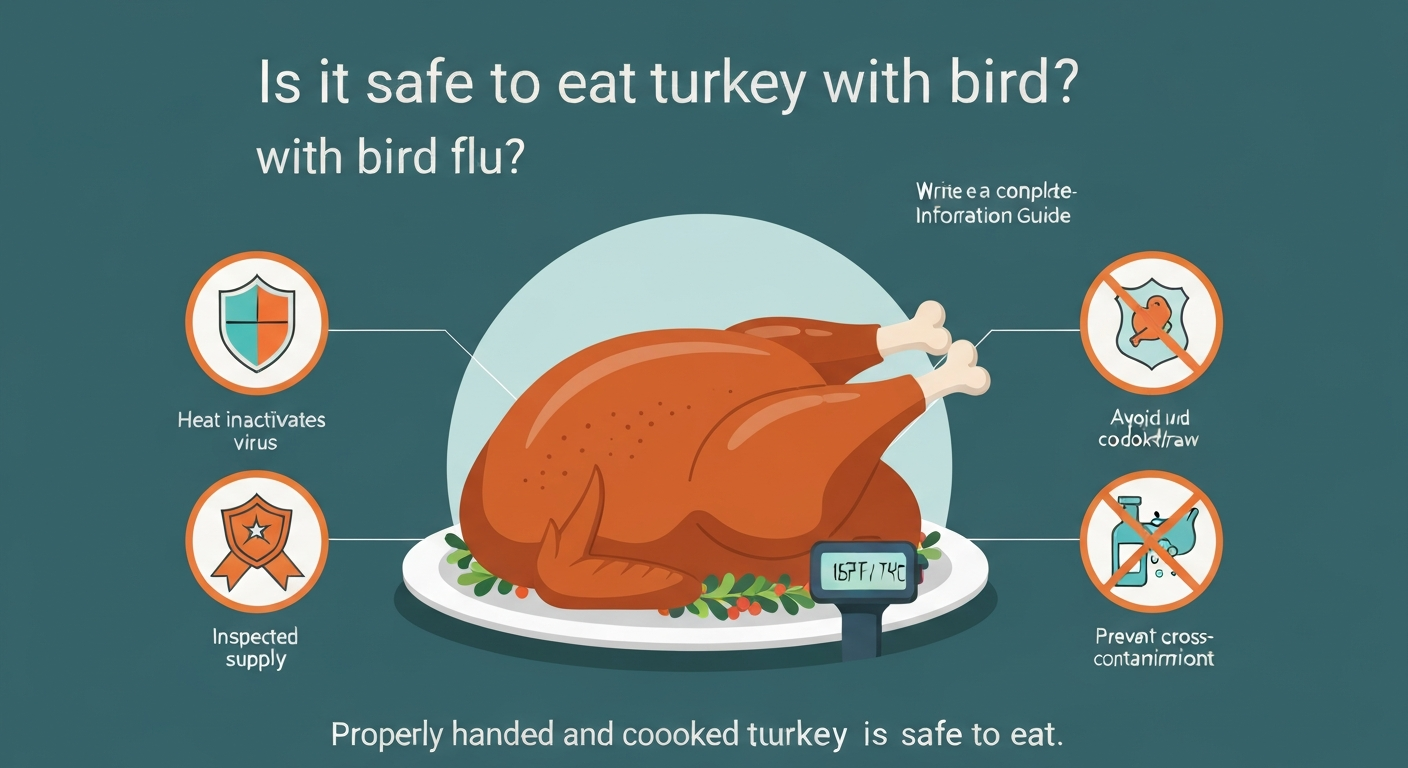
Yes, turkey is safe to eat as long as it is properly handled and cooked to an internal temperature of 165°F (74°C). Every major food-safety authority, the CDC, USDA FSIS, WHO, and FAO, agrees on this point. There is no documented case of a person in the United States contracting avian influenza from eating properly cooked poultry, including turkey. The virus is heat-sensitive and is rapidly inactivated at standard cooking temperatures, so a correctly cooked turkey poses no known risk of H5N1 or any other avian influenza strain.
Is It Safe to Eat Turkey With Bird Flu? Food Safety Guide

Maya Chen
6 Aug 2026
How avian influenza spreads, and why foodborne infection is unlikely
Avian influenza viruses spread primarily through direct or close contact with infected birds, their droppings, respiratory secretions, or contaminated surfaces and water. Farm workers, live-bird market vendors, and people who handle sick or dead poultry without protection carry the vast majority of documented human infection risk. Wild birds, especially waterfowl, act as the main reservoir and carry the virus along migratory routes, seeding both wild and domestic flocks.
Foodborne transmission is a separate and much more limited concern. The small number of human H5N1 cases with a plausible food link, mainly from Southeast Asia in the early 2000s, involved raw or undercooked preparations, most notably dishes made with raw duck blood. Even in those cases, direct isolation of virus from the food itself was rarely achieved, so they remain epidemiological associations rather than proven foodborne transmissions. No comparable cases have been documented in the United States, where food-chain controls are much more rigorous. Laboratory experiments do confirm biological plausibility: under high-dose experimental conditions, mammals can become infected through gastrointestinal exposure to the virus. But plausibility under artificial conditions is not the same as documented real-world risk from eating commercially processed, cooked turkey.
Current surveillance, testing, and outbreak context
Highly pathogenic avian influenza (HPAI) H5Nx has been circulating actively in U.S. and global poultry and wild-bird populations since the current outbreak wave began. WOAH situation reports through early 2026 document ongoing detections across multiple countries, and USDA APHIS has continued recording HPAI findings in commercial and backyard flocks in the United States. The scale is significant from an animal-agriculture standpoint, but it does not automatically translate into elevated food-safety risk for consumers, and here is why.
In January 2025, USDA APHIS announced enhanced pre-slaughter surveillance specifically for turkey flocks in HPAI-affected states. The policy requires premovement testing and clinical monitoring for larger turkey operations, with the explicit goal of reducing the chance that infected birds enter the food chain. On top of that, FSIS inspectors carry out ante-mortem and post-mortem inspection at every federally inspected slaughter facility. Any bird showing signs of disease is condemned and removed from commerce before it ever reaches a store shelf. These layered controls mean that even during active outbreaks, the commercially available turkey supply undergoes meaningful screening.
Why cooking makes turkey safe: the science behind 165°F
Heat is the single most reliable tool for eliminating avian influenza virus in poultry. USDA FSIS sets the safe minimum internal temperature for all poultry at 165°F (74°C), measured with a food thermometer in the thickest part of the meat, away from bone. That number is not arbitrary, it reflects decades of food-microbiology research on pathogen inactivation.
Experimental data on HPAI H5N1 in naturally infected chicken meat show that no infectious virus survived after just one second of exposure at 70°C (158°F) even in heavily contaminated samples. Thermal-kinetics studies measuring D-values (the time needed to achieve a 1-log reduction in viral infectivity at a given temperature) confirm that cooking temperatures produce rapid, multi-log reductions in H5N1 infectivity. By the time turkey reaches 165°F throughout, the virus load, even in a hypothetically contaminated bird, would be reduced to undetectable levels. The key phrase throughout all of this guidance is "throughout": the temperature must be reached in the thickest part of the bird, not just the surface.
It is worth noting what cooking does not fix: it does not address cross-contamination from raw juices before the turkey reaches temperature, and it does nothing for raw products that are intentionally not cooked. This is why proper handling of raw turkey matters as much as the cooking itself.
Handling raw turkey at home safely
One consistent finding across food-safety research is that raw poultry can carry infectious avian influenza virus even when refrigerated or frozen. Studies show H5N1 retains infectivity for many weeks at refrigerator temperatures (around 4°C) and for extended periods when frozen. That means a frozen turkey from a contaminated flock (extremely unlikely given current inspections, but worth understanding) would not become safe simply by sitting in your freezer. Cooking is what neutralizes the threat. With that in mind, the way you handle raw turkey matters.
- Thaw turkey safely: in the refrigerator (allow roughly 24 hours per 4–5 pounds), in cold water (changing water every 30 minutes, cooking immediately after), or in the microwave if you plan to cook it right away. Never thaw on a countertop at room temperature.
- Keep raw turkey isolated: store it on the lowest shelf in the refrigerator to prevent juices from dripping onto other foods. Use a dedicated tray or container.
- Prevent cross-contamination: use separate cutting boards and utensils for raw turkey and ready-to-eat foods. Do not rinse raw turkey in the sink — rinsing spreads juices to surrounding surfaces without eliminating pathogens.
- Clean and sanitize: wash hands with soap and water for at least 20 seconds before and after handling raw turkey. Sanitize all surfaces, cutting boards, and utensils that touched raw meat. Use a solution of 1 tablespoon of unscented bleach per gallon of water on hard, non-porous surfaces.
- Use a thermometer every time: insert an instant-read thermometer into the thickest part of the thigh, avoiding bone, and confirm 165°F before serving. Color alone is not a reliable indicator of doneness.
- Refrigerate leftovers within two hours of cooking and use within three to four days.
Special precautions for higher-risk groups
For most healthy adults, following the standard food-safety steps above is entirely sufficient. But a few groups carry elevated vulnerability to foodborne illness in general, and that same logic applies here: pregnant people, adults over 65, and individuals who are immunocompromised (due to chemotherapy, organ transplantation, HIV, or certain medications). For these groups, the margin for error is smaller, and the consequences of any gastrointestinal or systemic infection tend to be more serious.
- Avoid all undercooked or raw poultry products without exception. This includes rare-poultry dishes sometimes found at restaurants.
- Be especially careful about cross-contamination during food preparation, as even a small exposure to raw juices could be problematic.
- Avoid raw pet foods that contain poultry (more on this below), since handling these products creates an exposure route even without eating them.
- During active local outbreaks, consider extra caution with any poultry products from unregulated or uninspected sources, including live-bird markets.
- If you experience respiratory illness, fever, or gastrointestinal symptoms shortly after handling raw poultry, seek medical evaluation promptly and mention the exposure.
Pregnant people deserve a specific note: avian influenza has not been shown to cause the kind of placental complications associated with some other infections, but the general immunological changes of pregnancy reduce the body's ability to fight off novel pathogens. The practical advice is simply to cook all poultry thoroughly and follow standard hygiene, not to avoid turkey entirely.
Processed and restaurant poultry: how safe is commercially prepared turkey and chicken?
If you're eating turkey at a restaurant, buying pre-cooked turkey slices at a deli, or ordering from a fast-food chain, the risk is even lower than home-prepared poultry. Commercially prepared and ready-to-eat (RTE) poultry products in the U.S. must meet FSIS verification requirements, including validated lethality steps that guarantee the equivalent of thorough cooking. Any product that goes through a federally inspected facility has already passed ante-mortem and post-mortem inspection, and RTE products undergo additional post-lethality controls.
Fast-food chicken and turkey products specifically go through high-temperature commercial cooking processes with built-in temperature controls that are validated to exceed the 165°F threshold. Concerns about chains like KFC, Popeyes, or similar restaurants serving unsafe poultry during an HPAI outbreak are not supported by evidence. The combination of regulated supply chains, mandatory inspection, and commercial cooking provides multiple layers of protection that individual home cooking may not always replicate as consistently. Commercially prepared poultry is, if anything, slightly more reliably safe than home-cooked poultry from a process-control standpoint.
Other foods and meats: what about beef, eggs, and dairy?
Bird flu is primarily an avian disease, but questions about other foods are reasonable given recent headline-making detections in cattle and raw milk. Here is a clear breakdown of what the evidence actually shows.
| Food/Product | Bird Flu Risk Level | Key Notes |
|---|---|---|
| Cooked turkey or chicken | Very low (negligible) | Virus inactivated at 165°F; no documented cases from properly cooked poultry |
| Raw or undercooked poultry | Low but real | Small number of Asian H5N1 cases linked to raw preparations; standard hygiene and cooking eliminates this risk |
| Pasteurized eggs | Negligible | Cooking eggs to a firm yolk (160°F) inactivates influenza viruses; pasteurized products are safe |
| Raw/undercooked eggs | Theoretically possible | H5N1 has been detected in egg whites and yolks in infected flocks; avoid runny eggs during active outbreaks if high-risk |
| Pasteurized dairy (milk, cheese) | Negligible | Pasteurization inactivates H5N1; no documented human cases from pasteurized milk |
| Raw (unpasteurized) milk | Low to moderate risk | H5N1 detected at high titers in raw milk from infected cows in 2024 U.S. outbreaks; thermal-kinetics data confirm pasteurization inactivates the virus |
| Beef (cooked) | Very low | H5N1 detected in some cattle, but no documented human infections from eating properly cooked beef; standard cooking guidelines apply |
| Raw pet food containing poultry | Documented risk (for pets and handlers) | Multiple recalls and documented cat/dog infections; human handler exposure confirmed in at least one case |
The beef question comes up often right now because HPAI H5N1 was detected in U.S. dairy cattle beginning in 2024, raising the question of whether the virus could contaminate beef. Current evidence does not show documented human infections from eating properly cooked beef, and the primary concern in cattle has been concentrated in mammary gland tissue and milk rather than muscle meat. Still, standard cooking to safe internal temperatures (145°F for whole cuts, 160°F for ground beef) remains the right practice and provides a meaningful safety margin. For a deeper look at this specific question, the topic of bird flu and beef safety covers the cattle outbreak and its food-safety implications in more detail. See the deeper discussion 'Is it safe to eat beef during bird flu outbreaks?' for details.
Raw pet food recalls and what pet owners should know
This is one area where the risk picture looks meaningfully different from commercially processed human food. In late 2024 and into 2025, multiple cats and dogs in the United States were infected with HPAI H5N1 after eating raw pet food products containing poultry. At least one veterinary professional who treated an infected cat showed serologic evidence of H5N1 infection, representing a documented spillover event connected to raw pet food. CDC MMWR reported serologic evidence of HPAI A(H5N1) infection in a veterinary professional exposed to an infected domestic cat, Serologic Evidence of Highly Pathogenic Avian Influenza A(H5N1) Virus Infection in a Veterinary Professional Exposed to an Infected Domestic Cat, Los Angeles County, California, December 2024–January 2025 (PubMed / MMWR) CDC MMWR reported serologic evidence of HPAI A(H5N1) infection in a veterinary professional exposed to an infected domestic cat — Serologic Evidence of Highly Pathogenic Avian Influenza A(H5N1) Virus Infection in a Veterinary Professional Exposed to an Infected Domestic Cat — Los Angeles County, California, December 2024–January 2025 (PubMed / MMWR). The FDA issued voluntary recall notices for specific raw pet food products after H5N1 was detected, including products like Wild Coast Raw Boneless Free Range Chicken Formula. State agencies also issued warnings as companion animal infections accumulated.
The core difference between raw pet food and the turkey on your dinner table is heat. Commercial human poultry products are cooked; raw pet foods are deliberately not. If raw poultry in the pet food supply contains HPAI virus, feeding it to a pet creates a direct exposure route, and handling the raw food creates an exposure route for the pet owner as well. If you have cats or dogs and feed them raw pet food, check current FDA and state agency recall notices before continuing. Consider switching to cooked or commercially heat-processed pet food until recalls are fully resolved, and wash hands thoroughly after handling any raw pet food or the dishes and surfaces it contacts. A dedicated resource on raw cat food recalls and bird flu covers the specific products affected and the steps pet owners should take. See the resource titled "raw cat food is being recalled over bird flu concerns" for a current list of recalled products and recommended steps for pet owners.
If you find a sick or dead bird, or your backyard flock is ill
Backyard flock owners and anyone who encounters sick or dead wild birds need to know a few specific steps, because direct contact with infected birds carries genuinely higher risk than eating properly cooked poultry.
- Do not handle dead wild birds with bare hands. Use gloves, a plastic bag turned inside-out, or a shovel. Avoid touching your face. Dispose of the bird in a sealed bag in the trash, or contact your local animal control or wildlife agency for guidance.
- If birds in your backyard flock show sudden illness — decreased activity, loss of appetite, swollen heads, neurological signs, sharp increase in mortality — isolate the affected birds immediately and contact your state veterinarian or local USDA APHIS office. Do not move birds off the property.
- USDA APHIS can arrange for testing of suspect cases in domestic flocks at no cost. Early reporting is critical for containing outbreaks and protecting neighboring farms.
- While investigating a potential flock illness, do not collect or eat eggs from the affected birds.
- Use personal protective equipment (PPE) when cleaning out a potentially infected coop: gloves, eye protection, and an N95 respirator at minimum. Disinfect footwear and clothing before entering other areas.
- Biosecurity basics — limiting visitor access, using dedicated footwear and clothing for the coop, keeping wild birds out of feed areas — reduce the chance of HPAI introduction into a backyard flock in the first place.
What to do during a product recall or if you suspect contaminated poultry
HPAI-related recalls in the U.S. food supply have, to date, involved raw pet foods rather than human poultry products, but it is still worth knowing the standard process.
- Check the FDA recall database and USDA FSIS recall page regularly if you are tracking food-safety news. Recalls are searchable by product name and date.
- If a human food product you purchased is recalled, stop using it immediately. Do not taste it to assess whether it seems fine.
- Return recalled products to the store for a refund, or discard in a sealed bag. Do not put raw recalled poultry down a garbage disposal where it could splash.
- If you have recently eaten a recalled product and develop symptoms (fever, cough, difficulty breathing, vomiting, diarrhea), contact your healthcare provider and mention the potential exposure.
- For recalled raw pet foods, seal the product in a bag, wash all bowls, surfaces, and your hands thoroughly, and contact your veterinarian if your pet shows signs of illness.
When to seek medical attention or report exposure
The symptoms of avian influenza in humans can resemble seasonal flu but often progress faster and may include respiratory distress, conjunctivitis (eye infection), and gastrointestinal symptoms in addition to fever and body aches. The timeline from exposure to symptom onset is typically 2 to 5 days, though it can extend up to 14 days.
Seek medical attention promptly, and mention your exposure, if any of the following apply within 14 days of handling raw poultry, touching sick or dead birds, visiting a live-bird market, or handling raw pet food:
- Fever of 100.4°F (38°C) or higher, especially combined with respiratory symptoms
- Shortness of breath or difficulty breathing
- Conjunctivitis (red, watery, or painful eyes) without another obvious cause
- Severe or rapidly worsening flu-like illness
- Any of the above symptoms in an immunocompromised person, a pregnant individual, or someone over 65 who had a potential exposure
Call ahead to your healthcare provider before arriving so they can take appropriate precautions. In the U.S., providers can report suspect human cases to their local or state health department, which coordinates with CDC. Antiviral treatment with oseltamivir (Tamiflu) is more effective when started early in the illness, so getting evaluated quickly matters. You should not wait to see if symptoms resolve on their own if you have had a meaningful exposure to infected birds or raw infected products.
Consumer quick checklist: what to do right now
If you want a fast reference card to share or post in your kitchen, here are the core actions that cover the main risk points:
| Category | Action to Take |
|---|---|
| Shopping | Buy turkey and poultry from federally inspected sources. Check for USDA or FSIS inspection marks. Avoid uninspected live-bird markets. |
| Storage | Keep raw turkey on the lowest refrigerator shelf in a sealed container. Keep separate from ready-to-eat foods. Use within 1–2 days of purchase, or freeze. |
| Thawing | Thaw in the refrigerator, in cold water (changing every 30 minutes), or in the microwave. Never on the counter. |
| Cooking | Cook all turkey to 165°F (74°C) internal temperature, verified with a food thermometer in the thickest part of the meat. Do not rely on color. |
| Cleaning | Wash hands for 20 seconds before and after handling raw turkey. Sanitize all surfaces, boards, and utensils. Do not rinse raw turkey in the sink. |
| Leftovers | Refrigerate cooked turkey within 2 hours. Consume within 3–4 days or freeze. |
| Pet food | Check FDA recall lists for raw pet food products. Switch to heat-processed pet food if active recalls affect your brand. Wash hands after handling raw pet food. |
| Backyard flocks | Monitor birds daily. Report sudden illness or unexplained deaths to your state vet or USDA APHIS. Isolate sick birds immediately. |
| Symptoms | See a doctor promptly if you develop fever and respiratory symptoms within 14 days of exposure to sick birds or raw poultry. Mention your exposure. |
The bottom line is straightforward: properly cooked turkey, bought from an inspected source and handled with basic food hygiene, is safe to eat even during active HPAI outbreaks. The science on thermal inactivation is clear, the regulatory safeguards are functioning, and no one in the United States has contracted avian influenza from eating properly cooked poultry. The genuine risks in this outbreak, for both humans and animals, lie in direct contact with infected birds, exposure to raw or undercooked products, and, specifically for pets, raw poultry-based pet foods. For more detail on whether bird flu can be transmitted through food, see is bird flu in food. Keep your cooking temperatures honest, your surfaces clean, and your awareness current with recall notices, and you can approach your turkey dinner with well-founded confidence.
FAQ
Is it safe to eat turkey when there is bird flu (avian influenza) in poultry populations?
Yes — eating properly handled and thoroughly cooked turkey from inspected commercial sources is considered safe. Public‑health and food‑safety authorities (CDC, WHO, FSIS, FAO/OIE) conclude there is no credible evidence that people have been infected with avian influenza viruses by eating properly cooked poultry. The critical protections are that meat is inspected, not from visibly sick/condemned birds, handled to avoid cross‑contamination, and cooked to a safe internal temperature (see below). (Sources: CDC, WHO, FSIS, FAO/OIE).
How does avian influenza (bird flu) normally spread, and what are the limits of foodborne transmission?
Avian influenza primarily spreads through direct contact with infected birds, their secretions (feces, respiratory discharges), contaminated farm equipment, or via wild bird reservoirs. Human infections are most often linked to close contact with infected birds or contaminated environments. Foodborne transmission (infection from eating poultry) is not a documented route under normal conditions when poultry is handled and cooked properly. Rare historical human cases were epidemiologically associated with preparation/consumption of raw or undercooked poultry products (e.g., raw duck blood dishes), but these are exceptional and usually involved raw products or very high‑dose exposures. Laboratory and animal studies show biological plausibility for infection by ingestion under high‑dose or raw exposures, and virus can survive for long periods when refrigerated or frozen, so heat inactivation is important. (Sources: CDC, WHO, peer‑reviewed studies).
Can avian influenza virus be present in raw turkey meat or frozen poultry?
Yes — laboratory studies show some avian influenza viruses (including H5N1/H5Nx) can remain infectious in chilled (4°C) or frozen poultry meat for weeks to months. Refrigeration and freezing do not reliably inactivate the virus. However, when poultry products are cooked to recommended temperatures, the virus is inactivated. Regulatory inspection also prevents visibly sick birds from entering the food supply. (Sources: peer‑reviewed persistence studies, Food Standards Agency, FSIS).
What cooking temperature and method make turkey safe?
Cook turkey to an internal temperature of at least 165°F (74°C) measured with a food thermometer in the thickest part (breast, thigh, stuffing if used). FSIS and CDC recommend using a reliable thermometer rather than judging by color or juices. Standard cooking and pasteurization conditions used in food processing produce multi‑log reductions in avian influenza viruses. (Sources: FSIS, CDC, peer‑reviewed thermal‑inactivation studies).
Does barbecuing, roasting, or frying give the same protection?
Yes — any cooking method that brings the internal temperature of the meat to 165°F (74°C) throughout will inactivate avian influenza virus. Ensure even cooking (avoid cold spots), measure temperature in the thickest area, and follow safe rest times where recommended (carryover cooking will raise internal temperature slightly).
What should I do when handling raw turkey to reduce risk of contamination?
Follow standard food‑safety steps: wash hands with soap and water before and after handling; use separate cutting boards/utensils for raw poultry and ready‑to‑eat foods; thoroughly wash cutting boards, knives, and surfaces with hot soapy water or a dishwasher; avoid rinsing raw poultry (rinsing can spread splashes); promptly refrigerate or freeze leftovers; and cook to 165°F (74°C). During outbreaks, people who work with infected flocks should use appropriate personal protective equipment (PPE) as recommended by public‑health authorities. (Sources: CDC, FSIS).