
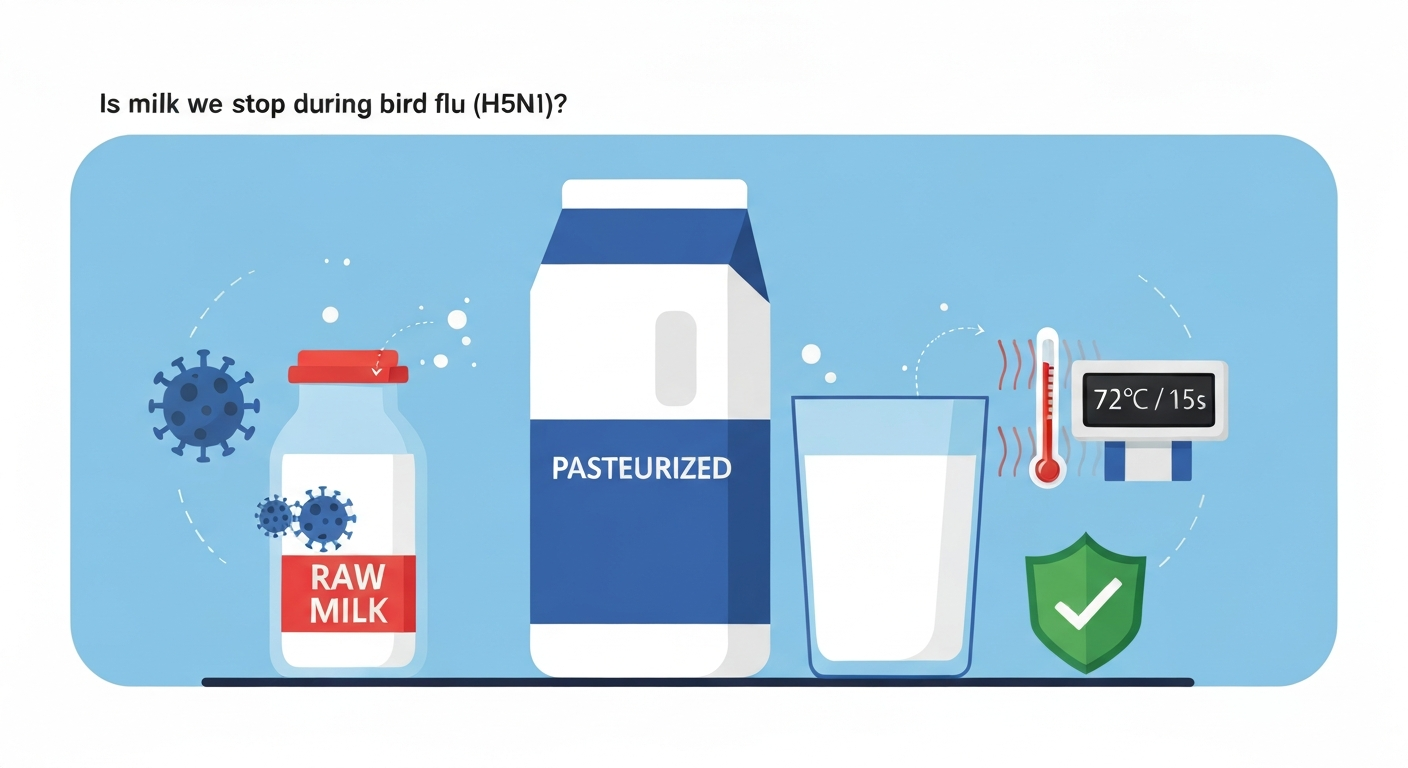
No, you do not need to stop drinking milk because of bird flu, as long as you are buying pasteurized milk. Every major public health agency, including the CDC, WHO, and FDA, agrees that commercially pasteurized milk is safe to drink during the ongoing H5N1 outbreak. The one clear exception is raw (unpasteurized) milk, which has been shown to contain live, infectious H5N1 virus from infected dairy cattle and carries a genuine, documented risk. If you are buying milk at a grocery store, it is pasteurized, and the evidence strongly supports that it is safe.
Should We Stop Drinking Milk Because of Bird Flu? Evidence

Maya Chen
30 Jul 2026
Key takeaways for busy readers
- Pasteurized milk — the standard product sold in virtually every grocery store — is considered safe from H5N1 bird flu. No confirmed human infection has been linked to drinking it.
- Raw (unpasteurized) milk from H5N1-infected cows has tested positive for live, infectious virus at concentrations averaging around 3,500 infectious doses per milliliter. Avoid it during active outbreaks.
- Retail milk surveillance found H5N1 RNA in roughly 20% of tested pasteurized samples at peak outbreak periods, but no viable virus was recovered from those pasteurized products — RNA does not equal infectious virus.
- Ultra-pasteurized (UHT) milk goes through higher heat treatment than standard HTST pasteurization and is at least as safe, likely safer, though both are considered protective.
- Occupational exposure on dairy farms — not consuming pasteurized milk — is the principal documented route of human H5N1 infection.
- Vulnerable groups (pregnant people, immunocompromised individuals, young children) should be especially careful to avoid raw milk and raw-milk dairy products.
- Check the FDA and CDC websites for current outbreak status and any updated guidance on specific products or regions.
How bird flu could get into milk in the first place
To understand the risk level, it helps to trace the biological pathway from wild birds all the way to your glass. The H5N1 strain circulating since 2022 (clade 2.3.4.4b) has an unusually broad host range. Wild aquatic birds, particularly waterfowl, are the natural reservoir. They shed the virus and can infect domestic poultry, chickens, turkeys, ducks, when they share water sources, feed areas, or simply fly over open-air operations. That part of the story is well established.
What changed dramatically in early 2024 was the virus's jump into dairy cattle, a species not historically considered a major H5N1 host. The leading hypothesis is that infected wild birds or contaminated equipment introduced the virus to dairy herds, and it then spread between cattle herds, likely through shared equipment and farm worker movement. Once a dairy cow is infected, the mammary gland appears to be a primary site of viral replication. H5N1 concentrates in milk at remarkably high levels. FDA’s investigation (June 28, 2024) found that among 158 raw milk samples positive for influenza A RNA, 39 yielded infectious H5N1 virus with an average concentration of ≈3.5 log10 EID50/mL (≈3,000 infectious doses/mL) FDA’s investigation (June 28, 2024) found that among 158 raw milk samples positive for influenza A RNA, 39 yielded infectious H5N1 virus with an average concentration of ≈3.5 log10 EID50/mL (≈3,000 infectious doses/mL).. Multiple laboratory studies confirmed infectious virus in raw milk from infected cows, with titres reported broadly from about 1.3 to 6.3 log10 EID50/mL and a median of around 3.5 log10 EID50/mL, meaning a single milliliter of raw milk from an infected cow can contain thousands of infectious viral particles.
So the pathway is real: wild bird to poultry, poultry (or direct wild bird contact) to cattle, infected cattle to raw milk. The question then becomes what happens to that virus before it reaches a consumer, and that is where pasteurization becomes the critical intervention.
Documented cases: what animal-to-human transmission has actually looked like
As of the most recent published outbreak data, the documented human H5N1 cases in the United States linked to the dairy cattle outbreak have virtually all involved occupational exposure, farm workers who had close, direct contact with infected animals, raw milk, or contaminated milking equipment. The exposure routes reported include touching infected animals, handling raw milk without adequate personal protective equipment, and breathing in aerosolized particles near infected cattle during milking. No confirmed human case has been attributed to drinking commercially pasteurized retail milk.
Animal models have reinforced this picture. Experimental studies showed that feeding animals pasteurized milk containing only inactivated viral RNA did not produce infection, while feeding raw milk with live infectious virus did produce infection and disease in susceptible animals. Companion animals, particularly cats, fed raw contaminated milk in farm environments also became infected. This body of evidence consistently points to infectious, live virus as the necessary ingredient for transmission, and pasteurization is what eliminates it.
The USDA's Animal and Plant Health Inspection Service (APHIS) responded to the dairy cattle outbreak with Federal Orders issued in April and December 2024, requiring testing and reporting of HPAI (H5N1) in lactating dairy cattle, mandatory pre-movement testing, and a National Milk Testing Strategy involving bulk-tank and raw-milk surveillance. This infrastructure matters for consumers because it means the supply chain is being actively monitored, and infected herds are being identified before milk enters processing.
How strong is the science here? What we know and what we do not
The evidence base is genuinely solid in some areas and more uncertain in others. I think it is worth being honest about both.
On the solid side: we know with high confidence that raw milk from H5N1-infected cows contains live, infectious virus. We know with high confidence that standard pasteurization dramatically reduces influenza A viruses in milk. Multiple independent peer-reviewed studies and regulatory risk assessments from the UK Food Standards Agency, EFSA, FDA, CDC, and WHO all converge on the same conclusion: pasteurized milk poses negligible consumer infection risk. See the FSA rapid risk assessment: Rapid Risk Assessment: Risk to UK Consumers From HPAI H5N1 in US Dairy, Food Standards Agency (FSA) Rapid Risk Assessment: Risk to UK Consumers From HPAI H5N1 in US Dairy — Food Standards Agency (FSA).
The more nuanced part involves exactly how reliable HTST pasteurization (72°C for 15 seconds) is under real-world processing conditions. Most controlled lab studies show complete or near-complete inactivation of H5N1 at HTST conditions. However, at least one carefully designed experiment showed that under specific conditions, borderline HTST treatment reduced but did not fully eliminate detectable infectivity, while higher temperatures (80°C for 15 seconds) achieved more consistent inactivation. This is worth noting not to alarm anyone, but because it underlines why proper equipment calibration and process validation matter. The U.S. Grade 'A' Pasteurized Milk Ordinance (PMO) and federal standards in 21 CFR set the time-temperature parameters that processors must meet and validate, meaning the regulatory system is designed to account for exactly this kind of variability.
An important methodological point: a lot of the early surveillance data reported influenza A RNA detected in retail pasteurized milk samples, including one study that found RNA in roughly 20% of samples during the peak outbreak period. This sounds alarming on the surface, but detecting RNA by RT-PCR is not the same as detecting infectious virus. RNA can persist in milk after a virus has been killed by heat. The critical finding in those same studies was that no viable, culturable virus was recovered from the pasteurized retail samples, only from raw milk. Researchers used egg inoculation and cell-culture assays (TCID50/PFU measurements) to confirm this distinction, and the results were consistent.
Where genuine uncertainty remains: knowledge gaps exist for certain raw-milk cheeses and artisan dairy products where heat treatment is minimal and processing conditions are highly variable. Risk assessments have specifically flagged these as areas needing further study and processing validation.
How pasteurization works against influenza viruses
Pasteurization is not sterilization, it does not eliminate all microorganisms in milk. What it does is apply enough heat for enough time to destroy pathogens that pose health risks to humans. For influenza A viruses, heat is a very effective killing mechanism. The outer lipid envelope of influenza virions, which the virus needs to infect a cell, is highly susceptible to heat. At 72°C (about 162°F), the protein-lipid structure of the virus is disrupted quickly. The 15-second hold time at that temperature is the regulatory minimum under HTST, and commercially it is consistently achieved or exceeded.
A comprehensive thermal inactivation study using multiple H5N1 strains in clinical milk samples confirmed that both standard pasteurization and higher-temperature regimens efficiently inactivated the virus. Lower-temperature thermization (around 50°C for 10 minutes) was insufficient in some experiments, which is relevant for consumers who might encounter minimally processed or thermized raw-milk products that are not labeled as fully pasteurized. The takeaway is that temperature matters and 'heated' is not the same as 'pasteurized.'
One nuance worth understanding: milk itself provides some thermal protection to viruses. Proteins, fats, and other milk components can slightly shield viral particles from heat compared to a buffer solution. This is why studies performed in actual milk rather than saline are more informative for food safety purposes. The good news is that most of the definitive studies discussed here used real milk, not synthetic matrices, and still found reliable inactivation at standard pasteurization conditions.
Is pasteurized milk safe from bird flu? What consumers should actually know
Yes. Pasteurized milk is safe from bird flu based on current evidence. The CDC, WHO, FDA, and independent food safety agencies in Europe all say the same thing. For related retail food questions, see guidance on whether Costco eggs are safe from bird flu are Costco eggs safe from bird flu. No consumer has been confirmed infected through pasteurized milk, and the laboratory data backs up why: pasteurization kills the virus before it reaches your glass.
When you buy milk at a supermarket, a big-box store, or a convenience store, it is pasteurized. It will say so on the label. The U.S. regulatory framework requires pasteurization for all milk sold across state lines and for all Grade A retail milk, there is no legal gray zone at the standard retail level. If you are buying from a large dairy brand, a store brand, or even a smaller regional dairy in a retail setting, it is pasteurized.
For people in higher-risk groups, pregnant individuals, immunocompromised people, older adults, and young children, the guidance is the same but the stakes of deviating from it are higher. These groups should absolutely avoid raw milk or any product made from unpasteurized milk, not just because of H5N1 but because raw milk carries additional bacterial risks (Listeria, Salmonella, E. coli) that are also more dangerous for vulnerable populations. The H5N1 situation has simply added one more well-documented reason to that existing list.
Is ultra-pasteurized (UHT) milk safer? What shoppers need to know
Ultra-high temperature (UHT) processing heats milk to at least 135°C (275°F) for 2 to 5 seconds, well above standard HTST parameters. At those temperatures, influenza A virus inactivation is essentially certain, the thermal kill is far above any level at which residual infectivity concerns arise in the scientific literature. For more detail on ultra-pasteurized milk and bird flu safety, see Is ultra pasteurized milk safe from bird flu. So yes, UHT milk is at least as safe as HTST-pasteurized milk, and from a pure virology standpoint the margin of safety is larger.
That said, from a practical consumer standpoint, the difference is not clinically meaningful for most people. Standard HTST-pasteurized milk is considered safe, and choosing UHT over HTST is not a necessary precaution during the current outbreak. Some people gravitate toward UHT products (shelf-stable milk boxes, most organic milk brands, and creamers often use UHT) and can take added reassurance from the higher processing temperatures, but it should not create concern about standard pasteurized milk.
Where UHT could be particularly relevant is for immunocompromised individuals, hospitalized patients, or parents of very young infants who want the absolute maximum margin of safety in a dairy product. In those specific contexts, UHT's higher thermal treatment is a reasonable additional precaution, not a panic response.
| Milk Type | Heat Treatment | H5N1 Virus Inactivation | Consumer Risk (current evidence) | Notes |
|---|---|---|---|---|
| Standard HTST pasteurized | 72°C / 15 seconds (minimum) | High: multi-log reduction; no viable virus found in retail surveillance | Negligible | Regulatory standard for all U.S. retail Grade A milk |
| Ultra-pasteurized (UHT) | ≥135°C / 2–5 seconds | Very high: exceeds inactivation threshold by wide margin | Negligible | Shelf-stable; used in many organic and specialty products |
| Raw (unpasteurized) | None | No inactivation: live infectious virus confirmed in outbreak samples | Documented risk | Strongly advised against by CDC, WHO, FDA during H5N1 outbreaks |
| Thermized milk (not fully pasteurized) | ~50–65°C / variable | Inconsistent: insufficient in some experimental conditions | Uncertain | Not a standard U.S. retail category; some artisan/import products |
What about cheese, yogurt, and other dairy products?
Most commercially produced cheese and yogurt in the U.S. is made from pasteurized milk, which means the same viral inactivation logic applies. For more detail, see the related guidance 'Is cheese safe from bird flu'. Yogurt undergoes both pasteurization and acidification (lowering pH through fermentation), and experimental evidence suggests that the combination of heat and acidification further reduces or eliminates viable influenza A virus. See is yogurt safe from bird flu for more detail on yogurt safety during the H5N1 outbreak. Hard aged cheeses made from pasteurized milk are similarly considered safe.
The more complicated picture involves raw-milk cheeses. A 2025 Nature Medicine study on H5N1 stability in raw milk and cheese found that the virus can persist through some raw-milk cheese-making processes, particularly when temperatures stay low and pH drops are modest during aging. However, acidification that lowers curd pH to around 5.0, curd-cooking above 52 to 54°C, or extended ripening each reduced or eliminated detectable infectious virus in tested conditions. The risk varies significantly by cheese style and production method, and risk assessments from the UK FSA and EFSA specifically flagged raw-milk cheeses as an area of genuine uncertainty requiring further study.
For most consumers, the practical guidance is simple: check the label. If a cheese or yogurt is made from pasteurized milk, which is stated on the packaging in the U.S., it is considered safe. If you are buying an artisan, farmstead, or imported raw-milk cheese, particularly for a vulnerable household member, that is where extra caution is warranted during an active H5N1 outbreak.
Practical steps for consumers right now
- Buy pasteurized milk. Check the label if you are ever uncertain — it will explicitly state 'pasteurized.' All standard U.S. retail milk is pasteurized by law.
- Avoid raw (unpasteurized) milk and raw-milk dairy products during active H5N1 outbreaks. This is the single most important action you can take.
- Check dairy product labels for pasteurization status, especially for cheese, butter, and cream products — some specialty or imported items may be raw.
- Store and handle milk properly: refrigerate at or below 40°F (4°C), do not drink from the carton, and consume before the use-by date. Basic hygiene reduces risk from any pathogen, not just H5N1.
- If you work on a dairy farm or have regular contact with cattle, follow CDC and USDA occupational health guidance, including wearing appropriate PPE when handling potentially infected animals or raw milk.
- For vulnerable household members (pregnant, immunocompromised, elderly, infants), be especially diligent about avoiding any raw or unpasteurized dairy — and consider UHT products as an additional comfort measure.
- Stay current: check the CDC's H5N1 situation updates and FDA's dairy safety communications regularly, as guidance can evolve with outbreak conditions.
- If you develop flu-like symptoms after contact with farm animals or raw milk, contact your healthcare provider and mention the potential exposure history.
When to seek medical or regulatory advice
For the vast majority of consumers drinking pasteurized milk, there is no medical action needed. However, if you or someone in your household consumed raw milk or a raw-milk product during an H5N1 outbreak and develops symptoms, fever, respiratory illness, conjunctivitis (eye redness), or muscle aches, contact a healthcare provider and specifically mention the raw milk consumption and the timing. H5N1 infection in humans can range from mild to severe, and early awareness by your doctor helps ensure appropriate testing and treatment options (including antivirals like oseltamivir) are considered promptly.
If you have concerns about a specific dairy product's safety, for example, you bought something labeled as raw or from a farm stand and are uncertain, you can contact your state Department of Agriculture or the FDA's consumer inquiry line. For current outbreak status by state and species, the USDA APHIS website maintains updated maps and herd-level case counts. The FDA's H5N1 dairy investigation page provides the most current regulatory findings on milk testing.
The bottom line on milk and bird flu
The bird flu situation in U.S. dairy cattle is a genuine and ongoing public health concern, but it is one that the existing pasteurization system is, based on current evidence, handling effectively for retail consumers. H5N1 does get into milk from infected cows, and it does so at concentrations that would be dangerous if consumed raw. What pasteurization does is kill that virus before it reaches you. The science backing that up is consistent, multi-institutional, and reaffirmed by every major health authority in the world.
The area where caution is genuinely warranted, and where the evidence clearly supports a behavior change, is raw milk. If you or anyone in your household drinks raw milk, this is a good time to stop, or at minimum to understand the documented risk you are accepting. That recommendation is not alarmism; it is directly supported by the virology, the animal model data, and the epidemiology of documented human infections from this outbreak.
For everything else in the dairy aisle, pasteurized milk, UHT milk, pasteurized yogurt, and pasteurized cheese, the current evidence supports continuing to buy and consume them normally. Keep watching for updates, because H5N1 is still an evolving situation, but the fundamental food safety picture for pasteurized dairy products has been consistent throughout the outbreak.
FAQ
Short answer: should we stop drinking milk because of bird flu?
No — you do not need to stop drinking commercially pasteurized milk. Evidence and official guidance indicate pasteurization (HTST/UHT) reliably inactivates H5N1 in most validated processing conditions, and public‑health agencies (CDC, FDA, WHO) say pasteurized dairy and properly processed products are safe. However, raw (unpasteurized) milk and some minimally processed raw‑milk products pose higher risk and should be avoided during H5N1 outbreaks.
How could avian influenza (H5N1) get into milk and is that common?
Infected dairy cattle can shed influenza A virus into milk if they become infected (likely via contact with infected wild birds or contaminated environments). Surveillance in 2024–2025 detected viral RNA and, in some raw‑milk samples, infectious H5N1. Detection in milk is linked to infected animals; it is not independent production contamination. Occupation exposure (milking, handling raw milk) has been the main documented human risk route rather than consumption of pasteurized milk.
Does detection of influenza RNA in milk mean the virus is infectious?
No. RT‑PCR detects viral RNA but cannot distinguish intact infectious virus from non‑infectious fragments. Culture or egg inoculation assays are required to demonstrate infectivity. Many surveillance positives were RNA‑only; some raw‑milk samples did yield infectious virus in culture, while pasteurized retail samples with RNA typically did not yield viable virus.
Is pasteurization effective against H5N1?
Yes — standard commercial pasteurization (HTST: 72°C for 15 s) and UHT/ultra‑pasteurization produce multi‑log reductions in influenza infectivity under validated conditions and are considered highly effective. Laboratory work shows high inactivation but effectiveness can vary with strain, milk composition and processing validation; therefore industry time‑temperature standards and regulatory oversight are important.
Is ultra‑pasteurized (UHT) milk safer than regular pasteurized milk?
UHT provides equal or greater heat inactivation than HTST and is therefore at least as safe. Both HTST pasteurized and UHT milk, when processed and handled properly, are considered safe by public‑health authorities.
What about raw (unpasteurized) milk — is it risky?
Raw milk is higher risk. Multiple studies recovered infectious H5N1 from raw milk from infected cows (measured titers up to ~10^6 EID50/mL in some samples). Public‑health agencies strongly advise avoiding raw milk and raw‑milk products during H5N1 outbreaks because heat treatment that inactivates virus has not occurred.