
Yes, yogurt made from commercially pasteurized milk is safe from bird flu. The heat treatment used in standard dairy pasteurization inactivates H5N1 avian influenza virus before it ever reaches a yogurt vat, and the acidification that happens during fermentation adds a second layer of virus reduction on top of that. No confirmed human H5N1 infection has ever been traced to eating pasteurized dairy products, and every major food safety authority, the FDA, CDC, WHO, and FAO, agrees the commercial pasteurized dairy supply poses negligible risk. The one situation worth taking seriously is raw (unpasteurized) milk yogurt, which skips that critical thermal step.
Is Yogurt Safe from Bird Flu? Evidence, Risks, and Advice

Maya Chen
23 Jul 2026
How bird flu spreads, the basics
Avian influenza (bird flu) is caused by influenza A viruses that primarily circulate in wild birds and poultry. The strain that has dominated recent headlines, H5N1, has been spreading through U.S. dairy cattle herds since 2024, which is what brought food safety questions about milk and yogurt into the public conversation. The virus spreads between animals mainly through direct contact with infected birds or their secretions, contaminated equipment, and, in the cattle outbreak, likely through milking machinery. Human infections have occurred, but they have almost always involved people with direct, close contact with infected animals, not people who simply ate or drank something from an infected herd.
The documented human H5N1 cases during the 2024 and 2025 dairy outbreaks were overwhelmingly linked to occupational exposure: farm workers handling infected cattle, not members of the general public eating grocery store dairy. That distinction matters enormously for thinking about food risk.
Can bird flu actually spread through food?
Food-borne transmission of H5N1 to humans has not been confirmed in any outbreak investigation to date. That said, the science is nuanced enough to be worth understanding. Infectious H5N1 virus has been detected in raw bulk tank milk from infected dairy cows, this was documented clearly by the FDA during the 2024 outbreak. So the virus can be present in raw milk. Whether that raw milk, if consumed, could infect a person is a separate question. Animal experiments have shown that raw infected milk can transmit H5N1 to susceptible mammals: controlled studies in mice and field reports of cats on farms dying after drinking raw infected milk both point in the same direction. Quantitative risk models suggest the theoretical human risk from consuming raw infectious milk is real, even though no confirmed human case has been pinned to milk ingestion. The important word there is 'raw.' Processing changes everything.
What pasteurization and UHT actually do to the virus
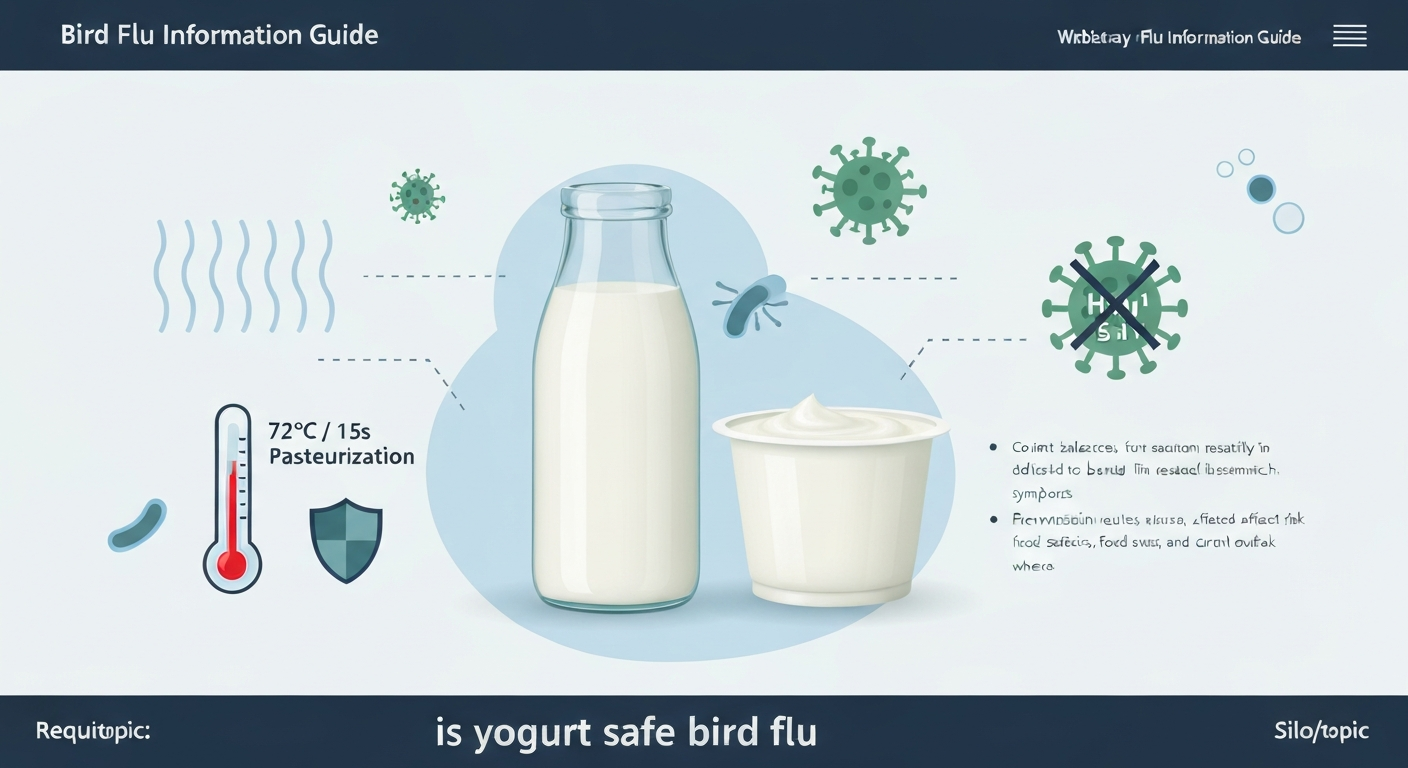
Pasteurization is a thermal treatment, meaning heat is applied for a defined time at a defined temperature to kill pathogens. There are two main commercial profiles used in dairy. Low Temperature Long Time (LTLT) heats milk to 63°C for 30 minutes. High Temperature Short Time (HTST), which is the industry standard for most fluid milk and the milk base used in commercial yogurt, heats milk to 72°C for at least 15 seconds. Ultra-High Temperature (UHT) processing pushes that further to around 135°C for just a few seconds, producing shelf-stable milk. Influenza viruses are fragile at these temperatures. Multiple controlled laboratory studies spiking raw milk with H5N1 and running it through commercial-style HTST conditions showed complete inactivation of infectious virus, not just a reduction, but elimination of viable virus below detectable limits. UHT offers an even larger thermal margin. This is not a theoretical prediction; it has been validated on commercial-scale equipment.
One early study using rapid benchtop heating equipment raised a question about whether some viral material might survive under non-standard rapid-ramp conditions, but follow-up work using actual industry-style pasteurizer simulations resolved that concern, confirming inactivation is consistent with what commercial systems achieve. The viral RNA fragments detected by PCR testing in some retail pasteurized milk samples (roughly 20% of samples in one U.S. retail survey) are the remnants of already-destroyed virus, genetic debris, not infectious particles. Independent culture assays on those same samples found no viable virus. PCR detects a genetic fingerprint; it cannot tell you whether the virus is alive. Culture assays can, and they came up empty.
What happens to bird flu virus during yogurt fermentation
Making yogurt involves two things that are unfriendly to influenza viruses: sustained warm temperature and rapid acidification. Yogurt is fermented at roughly 42°C using bacterial starter cultures, primarily Lactobacillus bulgaricus and Streptococcus thermophilus, which convert lactose to lactic acid and drop the pH of the milk from around 6.7 down to approximately 4.2 to 4.6. Controlled laboratory studies that spiked raw milk with H5 influenza virus and then fermented it under standard yogurt conditions found large reductions in infectious virus, with several studies reporting infectious virus falling below detection limits by the end of fermentation. This is a meaningful additional safety buffer.
That said, EFSA and other risk assessors have noted that fermentation and acidification alone, without prior thermal treatment, may not be sufficient under worst-case scenarios. If you start with heavily contaminated raw milk and rely solely on fermentation to protect you, you are betting on a process that is helpful but not guaranteed. This is exactly why the combination of pasteurization followed by fermentation is the gold standard: the pasteurization step eliminates viable virus, and fermentation simply reinforces that safety margin.
What the research says about virus survival across dairy products
Research and regulatory agencies have looked at H5N1 survival across several dairy matrices: fluid milk, yogurt, and cheese. The picture is clearest for pasteurized fluid milk and pasteurized-milk yogurt, the evidence is strong that commercial pasteurization effectively eliminates infectious virus. Cheese is more complicated because cheesemaking involves a wider range of temperatures, pH levels, moisture contents, aging times, and processing steps depending on the variety. Some controlled studies show that the combined effect of heating, acidification, salting, and extended ripening in cheese production can inactivate influenza viruses. However, other raw-milk cheese experiments under worst-case laboratory inoculation conditions found that virus can persist for extended periods in higher-pH, higher-moisture cheeses, particularly those made from unpasteurized milk with short aging times. For more detail on whether cheese is safe from bird flu, see is cheese safe from bird flu.
| Dairy Product | Key Processing Step(s) | Infectious H5N1 Risk (commercial) | Primary Caveat |
|---|---|---|---|
| Pasteurized fluid milk | HTST (72°C/15 s) or LTLT (63°C/30 min) | Negligible — no viable virus recovered in retail testing | PCR-positive RNA fragments present but non-infectious |
| UHT/ultra-pasteurized milk | ~135°C for a few seconds | Negligible — larger thermal margin than HTST | None under standard production |
| Commercial yogurt (pasteurized-milk base) | Pasteurization + fermentation to pH ~4.2–4.6 | Negligible — pasteurization eliminates virus; fermentation adds buffer | Only applies to pasteurized-milk products |
| Raw-milk yogurt | Fermentation only (no prior pasteurization) | Low but non-negligible — fermentation reduces but may not eliminate virus | Not recommended by WHO, CDC, FDA |
| Pasteurized hard/aged cheese | Pasteurization + acidification + extended aging | Negligible for pasteurized-milk varieties | Depends on cheesemaking parameters |
| Raw-milk soft/unaged cheese | Acidification and/or short aging only | Non-negligible — virus can persist in some experimental models | Not recommended during active outbreaks |
Commercial yogurt vs. homemade or raw-milk yogurt
The vast majority of yogurt sold in grocery stores, including store brands, Greek yogurt, and flavored varieties, is made from milk that has been commercially pasteurized before the cultures are added. This is true whether you buy it at a large retailer, a health food store, or a discount club warehouse. That product is safe. The label will often say 'made with pasteurized milk,' and even if it does not say it explicitly, commercial yogurt in the U.S. and most other countries is legally required to be made with pasteurized milk.
Homemade yogurt made from store-bought pasteurized milk is also safe, you are starting with a pathogen-reduced base, and fermentation further reduces any residual risk. Where risk increases is with homemade yogurt made from raw milk, which is sold legally in some U.S. states and through direct farm sales in several countries. Raw milk yogurt skips the pasteurization step entirely. As discussed above, fermentation provides meaningful virus reduction, but the scientific and regulatory consensus is that it cannot be relied on as the sole protective step, particularly during active H5N1 dairy outbreaks. WHO, CDC, and FDA all advise against consuming raw milk and raw-milk products, and that guidance is especially relevant for people who are pregnant, elderly, immunocompromised, or young children.
Practical guidance by yogurt type
- Commercial pasteurized-milk yogurt (any brand, any style): safe, no need to change purchasing or consumption habits.
- Homemade yogurt from store-bought pasteurized milk: safe, standard food hygiene practices apply.
- Homemade or artisan yogurt explicitly made from raw milk: not recommended during active H5N1 dairy outbreaks, particularly for vulnerable individuals.
- If you are unsure of the milk source in an artisan or farm-direct yogurt, ask the producer directly whether the milk was pasteurized before fermentation.
Is pasteurized milk safe from bird flu?
Yes. This question comes up constantly alongside yogurt safety, and the answer is the same: commercially pasteurized milk is safe from H5N1. See the section Is ultra pasteurized milk safe from bird flu for details on UHT (ultra‑pasteurized) processing and its implications for virus inactivation. For more detail, see is pasteurized milk safe from bird flu. The FDA's own retail survey during the 2024 outbreak found H5N1 viral RNA in roughly 20% of pasteurized milk samples, a finding that caused significant public concern. But when those same samples were tested for infectious virus using culture methods, no viable virus was recovered. The RNA signal was a ghost of a pathogen that had already been destroyed by heat. The FAO concluded after review that the risk of foodborne H5N1 transmission through commercially pasteurized milk is negligible, and no human H5N1 case has been linked to drinking pasteurized milk. Raw milk is the product to avoid: infectious H5N1 was confirmed in raw bulk tank samples from infected herds, and the animal transmission data (including cats dying after drinking contaminated raw farm milk) shows the virus can move through that route in susceptible mammals.
What about eggs and other animal products?
Eggs from commercially regulated flocks go through monitoring and inspection systems that remove eggs from flocks confirmed to have avian influenza, so retail eggs from major suppliers are considered safe. For specific retailer questions, such as "Are Costco eggs safe from bird flu", check guidance focused on retail-sourced eggs and supplier monitoring. Cooking eggs thoroughly to an internal temperature of 74°C (165°F) provides an additional layer of protection, as heat inactivates influenza virus. There is no documented case of H5N1 transmission to humans through eating properly cooked eggs or poultry. The same general principle applies: commercial processing and cooking eliminate the risk that might theoretically exist in a raw, untreated product from an infected flock.
Who should be most careful and when to seek more information
For most people buying commercially pasteurized yogurt, milk, or cheese at a grocery store, there is no action required beyond continuing to buy the same products you always have. The risk from the commercial supply chain is negligible based on the available evidence. There are a few specific situations worth knowing about:
- Farm workers or anyone with close contact with dairy cattle or poultry should follow occupational health guidance, use appropriate PPE, and report any flu-like illness to a healthcare provider with information about their animal exposure.
- Pregnant people, elderly individuals, immunocompromised people, and young children should avoid raw milk and raw-milk dairy products entirely — this was true before bird flu and remains true during any outbreak period.
- If you produce milk on a small farm or make raw-milk dairy products at home, monitor official guidance from the FDA, CDC, and USDA for current herd status and outbreak advisories in your area.
- If you develop fever, cough, or eye irritation after contact with birds or cattle, contact a healthcare provider and mention the exposure. Early antiviral treatment (oseltamivir/Tamiflu) is effective against H5N1 when started promptly.
Should you stop eating dairy because of bird flu?
No. The evidence does not support avoiding commercial pasteurized dairy products. The current scientific and regulatory consensus from the FDA, CDC, WHO, and FAO is consistent: pasteurized milk and products made from it (including yogurt and most commercially available cheeses) do not pose a meaningful risk of H5N1 transmission to consumers. For a focused discussion on the question 'should we stop drinking milk bird flu,' see our dedicated guidance on milk and bird flu safety. Stopping consumption of these products would carry real nutritional costs, particularly for people who rely on dairy as a source of protein, calcium, and other nutrients, without any meaningful reduction in bird flu risk. The public health message during the 2024 and 2025 outbreaks was never 'stop drinking milk. The FDA advisory recommended continued surveillance of herds, diverting or disposing of milk from infected animals, and clear public messaging to avoid consuming raw milk during the H5N1 dairy events blank" rel="noopener noreferrer">U.S. Food & Drug Administration letter on HPAI H5N1 in raw milk (FDA advisory). ' It was 'do not drink raw milk.' That distinction is important and worth holding onto.
Ongoing surveillance of U.S. dairy herds, retail milk testing, and human case monitoring continues as of mid-2026. Guidance may be updated as the outbreak situation evolves. For the latest advisories, the CDC, FDA, and USDA APHIS websites are the most current and reliable sources.
FAQ
Bottom line — is yogurt safe from bird flu?
Yes: yogurt made from commercially pasteurized milk is considered safe with respect to current H5N1 (avian influenza) concerns when produced under normal commercial pasteurization and manufacturing controls. Pasteurization and standard fermentation used in commercial yogurt production inactivate or strongly reduce infectious H5N1; public‑health agencies (WHO, CDC, FDA, FAO/EFSA) consider the commercial pasteurized dairy supply safe. Avoid raw (unpasteurized) milk and products made from raw milk because they can carry infectious virus.
How does avian influenza (bird flu) spread and can it be transmitted through food?
Avian influenza spreads mainly by direct contact with infected birds or their secretions (feces, respiratory droplets) and by contaminated surfaces. Transmission through properly pasteurized food is highly unlikely. Evidence shows raw milk from infected animals can contain infectious virus and has transmitted infection to animals in studies, but there is no confirmed human case linked to eating pasteurized dairy. Viral RNA detection in pasteurized products does not mean infectious virus is present.
What is pasteurization, HTST, and UHT (ultra‑pasteurization), and why do they matter?
Pasteurization refers to validated heat treatments that inactivate pathogens: common methods are LTLT (63°C for 30 min) and HTST (72°C for 15 s). UHT/ultra‑pasteurization uses higher temperatures (~135°C for a few seconds) to create commercially sterile milk. Laboratory and industry‑scale data show these heat treatments reliably inactivate influenza A (H5N1) when applied correctly; UHT provides an even larger safety margin.
Does fermentation to make yogurt inactivate H5N1?
Yes—fermentation (heating then acidification by starter cultures to pH ≈4.2–4.6) significantly reduces infectious H5N1. Controlled lab studies using H5‑spiked milk showed large reductions and often virus below detection after standard yogurt fermentation. However, acidification alone is less certain than prior pasteurization—thermal treatment before fermentation increases safety margins, which is the usual commercial practice.
Is homemade yogurt made from raw milk risky?
Yes. Homemade yogurt made from raw (unpasteurized) milk carries a higher risk because heating and process control may be insufficient to inactivate virus present in raw milk. Some small‑scale/home heating methods may not match validated industrial pasteurization; in outbreak contexts public health agencies advise avoiding raw‑milk products and using pasteurized milk for home yogurt.
What about commercial versus raw/unpasteurized dairy?
Commercial dairy typically uses validated pasteurization (HTST or UHT) with documented time/temperature controls; surveillance and studies indicate pasteurization inactivates H5N1. Raw/unpasteurized dairy can contain infectious virus if sourced from infected animals—regulatory agencies recommend not consuming raw milk or raw‑milk cheeses during outbreaks and generally advise against raw milk for vulnerable people at all times.