Yes, Costco eggs are safe to eat. Properly cooked commercial shell eggs from a major retailer like Costco pose a minimal risk to healthy consumers, even during active H5N1 bird flu outbreaks. The key safeguards are cooking eggs to 165°F, basic refrigeration and handling hygiene, and the multiple food-safety controls built into commercial egg supply chains before the carton ever reaches your cart. There is no CDC, FDA, or USDA guidance recommending that consumers avoid commercially produced, properly cooked eggs because of bird flu.
Are Costco Eggs Safe from Bird Flu? Consumer Safety Guide

Maya Chen
5 Aug 2026
Bird flu basics and how it actually spreads
Avian influenza (bird flu) is caused by influenza A viruses that primarily circulate in wild birds and domestic poultry. Highly pathogenic avian influenza (HPAI), including the H5N1 strain currently circulating in the United States, can devastate poultry flocks but is not easily transmitted to people. Human infections do occur, but almost all documented cases have involved direct, close contact with infected live or dead birds, their droppings, or heavily contaminated environments, not from eating properly cooked poultry or eggs.
The virus spreads between birds through respiratory secretions and feces. People who work on infected farms, process live birds, or handle raw poultry from sick flocks without protective equipment face the most meaningful exposure risk. Casual consumers buying eggs at a grocery store are several layers removed from that exposure. There is no documented case of a person contracting avian influenza from eating a fully cooked egg.
The 2024 and 2025 U.S. outbreaks added an important wrinkle: HPAI H5N1 spread into dairy cattle herds, and infectious virus was detected in raw milk from affected cows. This prompted new USDA testing requirements and reinforced why raw or unpasteurized dairy products carry a different risk profile than commercially pasteurized products. The egg story is somewhat similar: raw eggs from infected flocks can theoretically carry virus, but cooking eliminates that risk entirely. If you want to understand the dairy side of this in more detail, the questions around pasteurized milk, ultra-pasteurized milk, cheese, and yogurt follow the same core principle.
Why properly handled commercial eggs carry minimal risk
Laboratory research confirms that avian influenza viruses can contaminate eggs. USDA Agricultural Research Service experiments show that eggs from HPAI-infected hens can carry virus on the shell surface and, in some cases, inside the egg contents, with higher contamination levels seen with highly pathogenic strains. The UK Food Standards Agency's risk assessment came to a pragmatic conclusion: while contamination is possible, the probability of a consumer actually acquiring bird flu from handling or eating table eggs is very low given standard cooking and supply-chain controls. Not zero in theory, but effectively negligible in practice.
The main reason the risk is so low is heat. HPAI viruses are temperature-sensitive. Experimental data show they can survive for extended periods at refrigerator temperatures (around 4°C) but lose infectivity rapidly at cooking temperatures. The CDC recommends cooking poultry and eggs to an internal temperature of 165°F (74°C), and at that temperature, avian influenza A viruses are inactivated. Runny eggs, raw cookie dough, and homemade eggnog prepared with raw eggs are the practices worth rethinking, not eating a scrambled egg or a fried egg cooked through.
Costco also sells pasteurized liquid egg products and ready-to-eat Kirkland hard-boiled eggs alongside its Kirkland Signature shell eggs (cage-free, free-range, organic pasture-raised, and others). Pasteurized liquid egg products have been subjected to validated thermal treatment that eliminates pathogens including influenza A viruses, making them the lowest-risk option if you want to use eggs in preparations that stay raw or lightly cooked.
How retail egg supply chains reduce risk before you buy
Commercial egg production operates within a layered regulatory framework. Shell eggs fall primarily under FDA jurisdiction through the Egg Safety Rule (21 CFR Part 118), which sets on-farm requirements for Salmonella prevention, testing, and refrigeration. USDA's Agricultural Marketing Service oversees grading and inspection. Processed egg products (liquid, dried, frozen) require pasteurization under USDA regulations. Any HPAI detection in a commercial flock triggers mandatory depopulation and prohibits those eggs from entering the food supply, a hard firewall between an infected flock and retail shelves.
At the packer level, commercial egg processing typically involves prompt egg collection, washing and sanitizing (wash water is maintained around 110-115°F in industry practice, which also helps reduce shell surface contamination), candling, grading, and refrigeration, all within about 36 hours. These steps reduce but do not fully eliminate the theoretical possibility of surface contamination, which is why cooking temperature remains your primary protection.
Costco sources Kirkland Signature eggs from commercial egg packers, with some product listings referencing specific packer names. For example, the Kirkland Signature Eggs, Large, 5 dozen-count | Costco (product listing indicating packer) product listing shows a named packer for certain Kirkland multi‑dozen eggs. Costco's corporate sustainability reporting describes supplier animal welfare audits and supplier programs for egg suppliers. Large retailers like Costco have purchasing specifications, traceability requirements, and the contractual leverage to enforce them. A flock-level HPAI outbreak means eggs from that facility cannot be sold as table eggs, period. The supply chain controls are real, not marketing language.
Egg testing, recalls, and how regulators respond
HPAI surveillance in poultry uses RT-qPCR assays targeting the influenza A matrix gene as the standard rapid screening method, with virus isolation used to confirm viable infectious virus when needed. USDA APHIS publishes situation reports on HPAI detections and maintains the National Poultry Improvement Plan (NPIP), which provides a framework for flock testing and interstate movement controls.
Egg recalls are handled through the FDA's recall and alert system, the same system used for Salmonella-related shell egg recalls. If eggs sold by any retailer, including Costco, were subject to a food-safety recall, the FDA would post it publicly. Historical shell-egg recalls (such as the Cal-Maine Foods voluntary recall posted on FDA recall pages) show exactly how this process works: the recall notice identifies the product, lot codes, UPC, and states affected, giving consumers actionable information to check their purchases.
It is worth being direct about what a HPAI-related egg recall would look like versus a Salmonella recall. In a Salmonella scenario, contaminated eggs can enter the retail chain because Salmonella does not make hens visibly sick and does not trigger automatic flock removal. HPAI is different: the virus causes severe, rapid disease in flocks, meaning infected flocks are identified and depopulated quickly. The financial and regulatory consequences of an HPAI detection make it unlikely that eggs from a confirmed positive flock would reach retail shelves, which is one reason HPAI-specific egg recalls have not been a feature of U.S. outbreaks the way Salmonella recalls have.
How to check for egg recalls and report a concern
Checking for egg recalls takes about 30 seconds and should be a habit any time you hear about food-safety news. The FDA posts all egg-related recalls on its recall and market withdrawals page (fda.gov/safety/recalls-market-withdrawals-safety-alerts). Search for your egg brand or packer name. Costco also posts food safety recall notices on its website and sends emails and app notifications to members who purchased the affected item, since Costco tracks member purchases by membership account.
- FDA Recalls page: fda.gov/safety/recalls-market-withdrawals-safety-alerts (search by brand or product type)
- USDA FSIS Recalls: fsis.usda.gov/recalls (for processed egg products under USDA jurisdiction)
- USDA APHIS HPAI Situation Reports: aphis.usda.gov (for current outbreak status by state and species)
- CDC Bird Flu page: cdc.gov/bird-flu (for human health guidance and case counts)
- Costco Member Notifications: check your account email or the Costco app for member-specific recall alerts
- To report a suspect product: contact FDA at 1-800-551-3989 or submit a report via SafetyReporting.hhs.gov
If you think you were exposed to a sick bird or contaminated product and develop symptoms including fever, cough, eye irritation, or difficulty breathing within 10 days, contact your healthcare provider and mention the potential exposure. Your local or state health department is also a resource. Do not simply wait it out if symptoms are severe.
When you should actually be cautious about eggs
For most healthy adults buying commercially produced eggs at a major retailer, bird flu is not a meaningful concern with normal cooking. But there are situations where extra caution is warranted.
- Active recall: If a specific product you have at home is listed in an active FDA or USDA recall, do not eat it. Check the lot code and UPC against the recall notice.
- Visibly compromised carton: Cracked, leaking, or unusually dirty shells can indicate hygiene issues at any stage. Discard cracked eggs rather than washing and using them.
- Backyard or small-flock eggs: Eggs from backyard chickens that are sick, have died unexpectedly, or live near wild waterfowl with a known HPAI exposure carry a higher theoretical risk than commercially produced eggs. If your flock shows signs of illness, contact your state veterinarian before consuming or selling eggs.
- Immunocompromised individuals: People undergoing chemotherapy, organ transplant recipients, pregnant women, adults over 65, and young children face higher risks from foodborne pathogens generally. Avoiding raw or undercooked eggs and choosing pasteurized egg products for preparations that stay raw (smoothies, dressings, mousse) is a sensible precaution for this group year-round.
- Raw or undercooked egg preparations: Soft scrambled eggs, sunny-side-up eggs with a fully runny yolk, homemade mayonnaise with raw eggs, and similar preparations do not reach 165°F. This is the residual risk window for any egg-borne pathogen, bird flu included.
Raw vs. pasteurized egg products: a quick comparison
| Product type | Avian influenza risk | Best for | Notes |
|---|---|---|---|
| Commercial shell eggs (cooked to 165°F) | Negligible | Everyday cooking: scrambles, omelets, baking | Heat eliminates virus; standard retail supply-chain controls apply |
| Commercial shell eggs (raw or undercooked) | Very low but not zero | Avoid for high-risk individuals; use pasteurized alternative instead | Runny yolk, raw batter, homemade mayo |
| Pasteurized liquid egg products (e.g., Kirkland liquid eggs) | Negligible | Preparations used raw or lightly cooked; immunocompromised users | Thermal pasteurization validated to inactivate influenza A viruses |
| Ready-to-eat hard-boiled eggs (e.g., Kirkland) | Negligible | No-cook use; meal prep | Already fully cooked and pasteurization-equivalent in terms of heat exposure |
| Backyard flock eggs (flock exposed to HPAI) | Low to moderate depending on flock status | Avoid until flock is confirmed healthy | Higher uncertainty; cook thoroughly; contact state vet if flock is ill |
Safe egg handling at home: a practical checklist
Good egg handling is not complicated, and most of it is the same food-safety guidance you would follow for any raw protein. The steps below cover refrigeration, shelf life, cooking, and cross-contamination, all of which matter for bird flu as well as for more common egg-borne pathogens like Salmonella.
Storage and refrigeration
- Refrigerate shell eggs at or below 40°F (4°C) immediately after purchase. Do not leave them on the counter.
- Keep eggs in their original carton, in the coldest part of the fridge, not in the door (temperature fluctuates most there).
- Use refrigerated shell eggs within 3 to 5 weeks of the purchase date (the Julian date code on the carton tells you the pack date).
- Hard-boiled eggs in the shell keep for up to 1 week refrigerated. Peeled hard-boiled eggs should be used within 5 days and stored in water or an airtight container.
- Opened liquid pasteurized egg products should be used within 3 days of opening; follow the label on sealed cartons.
Cooking and cross-contamination
- Cook eggs to an internal temperature of 165°F (74°C). This is the CDC-recommended temperature for poultry and eggs and the threshold that inactivates avian influenza A viruses.
- For fried eggs and other preparations where a thermometer is impractical, cook until both the white and yolk are firm.
- Wash hands with soap and water for at least 20 seconds after handling raw eggs or the carton.
- Clean and sanitize any surface, cutting board, or utensil that contacted raw egg before using it for ready-to-eat foods.
- Keep raw eggs and raw poultry away from ready-to-eat foods in both the fridge and on the counter during meal prep.
- Do not taste raw batter, dough, or sauces made with raw eggs. Use pasteurized liquid eggs instead if the dish will stay uncooked or lightly heated.
- If an egg cracks during transport or storage, either cook it immediately or discard it. Do not store cracked raw eggs.
If you have a backyard flock
Backyard flock owners face a different calculus than supermarket shoppers. HPAI can spread to backyard chickens through contact with wild waterfowl or their droppings. If birds in your flock are showing signs of illness (sudden death, reduced egg production, respiratory distress, neurological symptoms, swollen wattles or combs), stop collecting eggs, contact your state veterinarian or state department of agriculture, and follow their guidance before consuming or distributing any eggs. Until the flock's status is confirmed, treat handling any eggs or birds as a potential exposure event: wear gloves, avoid touching your face, and wash thoroughly afterward.
How egg safety compares to dairy safety with bird flu
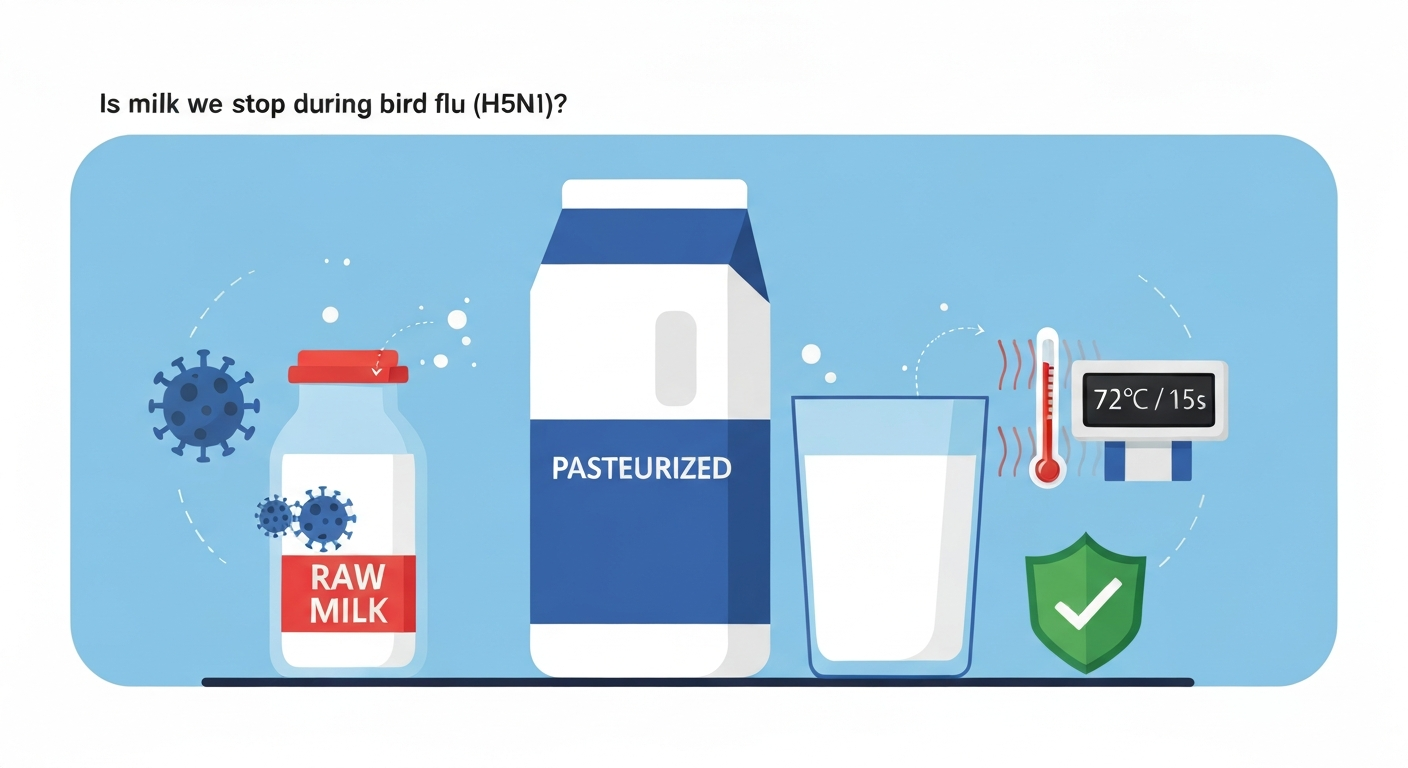
The core principle that heat destroys avian influenza virus applies equally to dairy products. The reason pasteurized milk, ultra-pasteurized milk, cheese made from pasteurized milk, and commercially produced yogurt are considered safe is the same reason cooked eggs are safe: validated thermal processing inactivates influenza A viruses. For more on dairy risk and whether yogurt is safe from bird flu, see is yogurt safe from bird flu. If you’re wondering if ultra pasteurized milk is safe from bird flu, the answer is yes, ultra-pasteurization reliably inactivates avian influenza virus, so commercially ultra-pasteurized milk is considered safe is ultra pasteurized milk safe from bird flu. FDA-sponsored research using high-temperature short-time (HTST) pasteurization conditions completely inactivated H5N1 HPAI virus in spiked milk samples, and peer-reviewed studies confirm both LTLT (63°C for 30 minutes) and HTST (72°C for 15 seconds) methods are effective. The concern with dairy arises specifically with raw, unpasteurized milk, where infectious virus has been detected during the 2024-2025 U. For more on whether bird flu affects milk safety, see our Q&A “Should we stop drinking milk because of bird flu.”. S. cattle outbreaks. For people thinking about food-safety risk more broadly across their kitchen, the consistent message is: thermal processing works, and raw or undercooked products are where the residual risk lives. See "Is pasteurized milk safe from bird flu" for more detail on why pasteurization inactivates HPAI and when raw milk poses a risk.
FAQ
Are Costco eggs safe from bird flu (avian influenza)?
Short answer: Yes — eggs purchased at Costco from commercial suppliers are generally safe for consumers when handled and cooked properly. Commercial supply chains, retailer sourcing controls, and refrigeration reduce risk, and cooking eggs to recommended temperatures inactivates avian influenza viruses. If an egg product or batch were linked to contamination, regulators and retailers would issue recalls and notices.
How can avian influenza (bird flu) transmit via eggs and what is the actual human risk?
Avian influenza viruses have been detected on eggshells and, in some infected flocks, inside egg contents. However, human infections from eating commercially handled, properly cooked eggs are very unlikely. The risk is reduced by supply‑chain controls, refrigeration, and the fact that influenza viruses are inactivated by standard cooking temperatures. Public health agencies characterize the foodborne risk as very low for properly handled retail eggs, though not absolutely zero.
Why do commercial egg production and large retailers like Costco reduce the risk of bird‑flu contamination?
Commercial producers and retailers use multiple controls: supplier audits and sourcing programs, routine on‑farm biosecurity and surveillance under FDA/USDA rules, prompt egg collection, washing/sanitizing, grading, refrigeration, traceability, and established recall channels. Retailers list packer/supplier information and participate in supplier oversight. These layers lower the chance that eggs from an infected flock reach consumers.
How do testing and recalls work if eggs are suspected to be contaminated with avian influenza?
Regulatory labs use RT‑qPCR screening and, when needed, virus isolation to confirm infectious virus. If contamination or infected flocks are identified, USDA/FDA/APHIS issue situation updates and may require testing, movement restrictions, and recalls. Retailers also remove affected products and notify customers via recall notices posted on FDA/USDA websites and retailer channels.
What cooking and food‑safety steps should I follow to minimize any risk from eggs?
Checklist: - Cook eggs until both yolk and white are firm; cook dishes to an internal temperature of 165°F (74°C) when poultry or egg mixtures are included. - Avoid eating raw or undercooked eggs (e.g., homemade mayonnaise, cookie dough) unless using pasteurized eggs. - Refrigerate eggs promptly (store at ≤40°F/4°C). - Prevent cross‑contamination: wash hands, utensils, and surfaces after contact with raw eggs. - Use a food thermometer for mixed or multi‑ingredient dishes to ensure 165°F where recommended.
What about pasteurized egg products — are they safer?
Pasteurized liquid egg products and pasteurized shell eggs (where available) have been heat treated to inactivate pathogens. Studies and regulatory guidance show standard pasteurization protocols cause multi‑log reductions of influenza A viruses in egg matrices, so pasteurized products provide extra assurance and are recommended when recipes call for raw eggs or for people with higher vulnerability.
Next Article
Should We Stop Drinking Milk Because of Bird Flu? Evidence
Bird flu and milk: evidence-based answer on safety of pasteurized vs raw milk, cheese, eggs, and shopper precautions.