
Yes, vaccines for bird flu (avian influenza) exist, but they work very differently depending on whether you're talking about protecting humans or protecting poultry. For humans, there are FDA-licensed H5N1 vaccines (including AUDENZ and AREPANRIX) held in government stockpiles for people at increased occupational risk and for emergency pandemic response, not for routine public use. For poultry, commercially available inactivated and recombinant vector vaccines are used in flocks around the world, and in early 2025 the USDA granted a conditional license for a new H5N2 killed vaccine for chickens. No bird flu vaccine is currently recommended or approved for dogs or most other companion animals.
What Is the Vaccine for Bird Flu? Human and Poultry Options

Maya Chen
7 Aug 2026
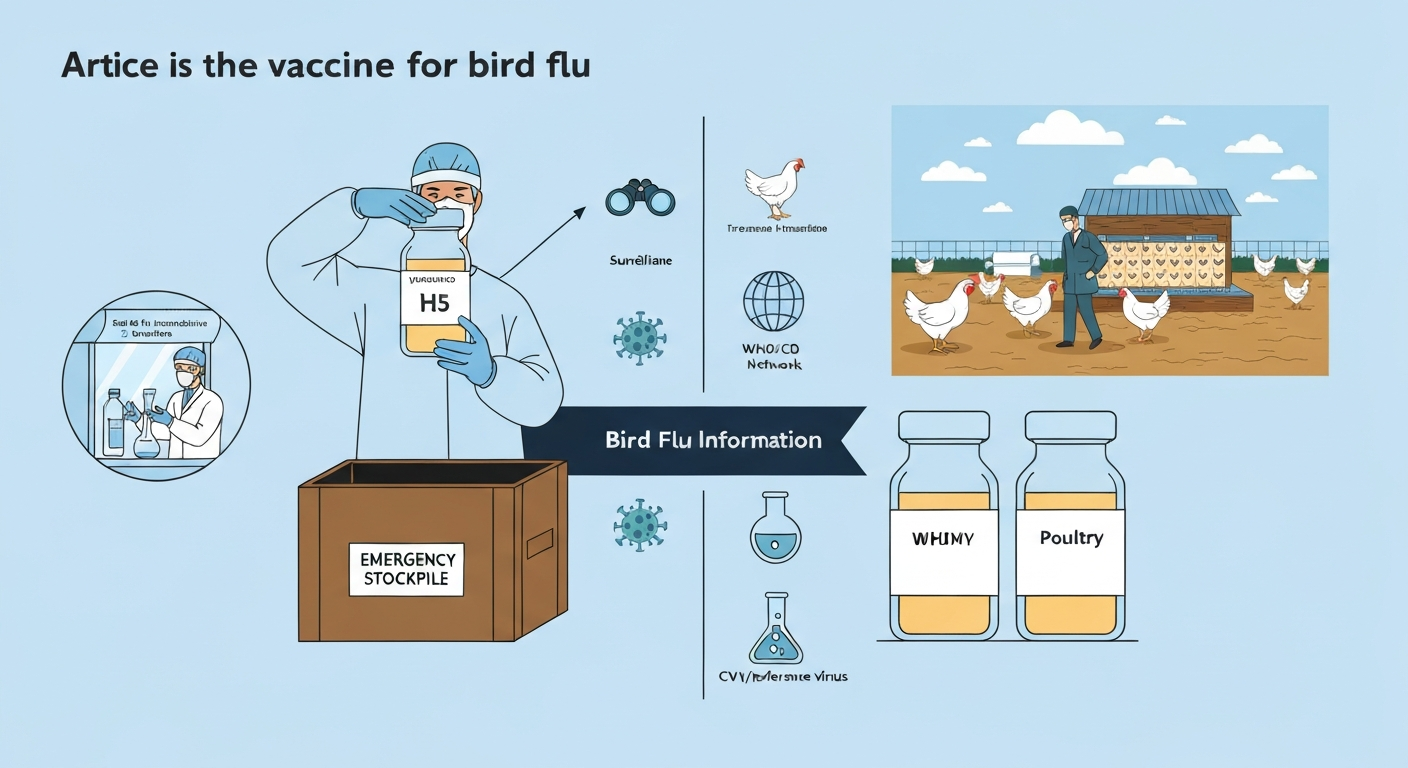
Is there a bird flu vaccine? The quick summary
The short answer is: it depends on the species and the situation. For humans, the honest picture is that licensed H5 vaccines exist and are stockpiled, but they are not available at your local pharmacy and are not recommended for the general public right now. They are a preparedness tool, held in reserve so that if an H5N1 strain starts spreading efficiently between people, authorities can move quickly. For poultry, vaccines are a real and increasingly common outbreak-control tool, with new products gaining regulatory approval as recently as 2025. The gap between "a vaccine exists" and "a vaccine is widely available for everyone" is important, and it's worth understanding exactly why that gap exists.
What is the bird flu vaccine called?
Several human H5 (avian influenza) vaccines have specific brand names and regulatory identities. The two FDA-licensed options that are probably most relevant in the United States are AUDENZ, made by Seqirus, and AREPANRIX, made by ID Biomedical/GSK. AUDENZ is a cell-culture-derived inactivated H5N1 vaccine formulated with the MF59 adjuvant (a squalene-based oil-in-water emulsion) and is licensed for people aged 6 months and older. AREPANRIX uses a different adjuvant system, AS03, which is also an oil-in-water emulsion developed by GSK. Both adjuvants boost the immune response significantly, which matters because the H5 antigen on its own tends to produce a weaker antibody response than seasonal flu antigens do. Beyond these licensed products, newer candidates on mRNA platforms, including Moderna's mRNA-1018 (H5), are in active clinical development with BARDA funding and have reported Phase 1/2 trial data, though they are not yet licensed.
On the poultry side, named commercial products include VECTORMUNE HVT-AI (also written as Vectormune HVT-AIV), a recombinant herpesvirus of turkeys (HVT)-vectored H5 vaccine made by Ceva that received EU centralised authorisation in 2025, and an H5N2 killed (inactivated) poultry vaccine from Zoetis that received a USDA conditional license in February 2025. There are also Newcastle disease virus-vectored and other viral-vector products used in various countries under national regulatory frameworks. So there is no single "the bird flu vaccine" because multiple products exist across species and platforms.
Why isn't there a standard bird flu vaccine for everyone?
This is one of the most common questions, and it's a fair one. For a concise explanation of why there isn't a standard vaccine for everyone, see why is there no vaccine for bird flu. The core reason is that H5N1 and related avian influenza viruses do not currently spread efficiently from person to person. Because human-to-human transmission is rare, vaccinating the entire population would be a huge logistical and financial undertaking with uncertain benefit and some risk from the vaccines themselves. Population immunity to H5 antigens is essentially zero, which sounds alarming but actually means that if and when a pandemic strain emerges, authorities would need to start almost from scratch with a new vaccine matched to that strain. Stockpiled vaccines may not match whatever mutated version triggers a pandemic, so pre-vaccinating everyone now provides limited protection against a future strain anyway. On top of that, manufacturing and fill-and-finish capacity globally cannot instantly produce billions of doses. This is why WHO, CDC, and other public health bodies frame H5 vaccination as a targeted preparedness measure rather than a routine recommendation for the general public.
Human bird flu vaccines: prepandemic candidates and WHO reference viruses
The term "prepandemic candidate vaccine" refers to a vaccine that has been developed against a strain of avian influenza that could potentially become pandemic, but has not yet done so. Governments and manufacturers invest in these vaccines now so that they are not starting from zero if an outbreak explodes. WHO's Global Influenza Surveillance and Response System (GISRS) plays a central role here by maintaining and distributing what are called Candidate Vaccine Viruses, or CVVs. A CVV is a specially prepared reference strain, often a lab-created reassortant or modified version of a circulating avian influenza virus, designed to be safe enough to work with in standard manufacturing facilities while retaining the key surface proteins (mainly hemagglutinin) needed to train the immune system.
WHO Collaborating Centres, including CDC in the United States, develop and distribute these CVVs to vaccine manufacturers worldwide. As the dominant H5 clade circulating in birds has shifted over the years, so have the CVVs. The current focus is heavily on clade 2.3.4.4b H5 viruses, which are the lineage driving recent widespread outbreaks in birds and the spillover cases in humans and dairy cattle seen from 2024 onward. WHO publishes updated CVV status documents listing available strains, the clades they represent, and which collaborating centres can supply them to manufacturers. WHO, Candidate vaccine viruses (CVVs) for influenza lists and regularly updates available CVVs, their clades, and supplying collaborating centres to support vaccine development and manufacturing WHO — Candidate vaccine viruses (CVVs) for influenza. This infrastructure is the backbone of any rapid vaccine response if H5 becomes a pandemic threat.
Adjuvants: why they matter for H5 vaccines
Adjuvants are ingredients added to vaccines to enhance the immune response. With H5 antigens specifically, adjuvants are particularly important because the antigen alone tends to be poorly immunogenic in humans who have never been exposed to H5 viruses before. AS03 (used in AREPANRIX) and MF59 (used in AUDENZ) are both well-studied oil-in-water emulsion adjuvants that significantly boost antibody titers. They also allow manufacturers to use smaller amounts of the precious antigen per dose, which matters enormously when you need to produce millions or billions of doses quickly. Clinical studies show that adjuvanted H5 vaccines generate measurable hemagglutination-inhibition (HI) and microneutralization antibody responses, though the actual protection these titers provide against real-world infection is still being studied.
Poultry and veterinary bird flu vaccines
Avian influenza vaccines for poultry have been in use in various countries for decades, and the technology has evolved considerably. There are three broad categories in commercial or regulatory use today.
Inactivated (killed) vaccines
These are the most traditional type: the whole virus is grown, chemically killed so it cannot replicate or cause disease, and then formulated for injection. The Zoetis H5N2 killed vaccine that received a USDA conditional license in February 2025 falls into this category. Inactivated vaccines are well understood and relatively straightforward to manufacture, but they require individual injection, which is labor-intensive at large flock scales. They also do not allow easy field differentiation between vaccinated and infected birds (the so-called DIVA problem, standing for Differentiating Infected from Vaccinated Animals), which creates complications for trade and surveillance.
Recombinant and viral-vector vaccines
Recombinant vector vaccines work by inserting a gene encoding the avian influenza hemagglutinin into a harmless carrier virus. The most established platform uses herpesvirus of turkeys (HVT) as the vector. Ceva's VECTORMUNE HVT-AI is an HVT-vectored H5 vaccine that can be administered to day-old chicks, including in ovo (in the egg) at hatcheries, which makes mass vaccination at the point of production far more practical. The EU granted centralised authorisation for this product in 2025. Newcastle disease virus (NDV) is another vector platform used in some countries. A key advantage of these recombinant products is that the bird only develops antibodies to the inserted H5 antigen, not to other influenza proteins, which can support DIVA strategies when combined with appropriate diagnostic tests.
Field use considerations
Using poultry vaccines in the field is more complicated than it might seem. Vaccines must be antigenically matched to circulating strains to provide good protection, just as with human vaccines. A vaccine designed for one H5 clade may give incomplete protection against a different clade. There are also national and international trade implications: some countries restrict or ban imports of poultry and poultry products from vaccinated flocks unless robust DIVA testing protocols are in place, because vaccination can mask infection and complicate surveillance. For this reason, poultry vaccination programs typically involve close coordination between producers, veterinary authorities, and trading partners.
Availability and limitations: what stockpiles, strain specificity, and regulation really mean
For humans in the United States, H5 vaccines are held in the Strategic National Stockpile (SNS) and related pre-pandemic preparedness stockpiles. These are not available for individual purchase or routine medical use. They are reserved for people with documented occupational exposure risk (such as poultry farm workers and laboratory personnel during an outbreak) and for broader emergency deployment if human-to-human transmission is confirmed. Regulatory approval frameworks, including FDA Emergency Use Authorization (EUA) pathways, exist specifically to allow faster deployment of pandemic vaccines when needed, coordinating with updated WHO CVVs to authorize new antigen compositions rapidly.
The strain-specificity limitation is real and significant. Studies show meaningfully reduced cross-neutralization between older H5 vaccine antigens (such as clade 1, A/Vietnam-like strains) and the clade 2.3.4.4b viruses dominating current outbreaks. In practical terms, this means a stockpiled vaccine developed years ago may offer reduced protection against the H5 strain most active right now. This is precisely why WHO and CDC continually update CVVs to match circulating clades, and why manufacturers are working on updated formulations. It is also why the mRNA vaccine platform is generating excitement: mRNA vaccines can, in principle, be updated and produced much faster than traditional inactivated vaccines once a strain is sequenced.
How bird flu vaccines are developed and updated
The development and updating of avian influenza vaccines is a continuous, globally coordinated process. It starts with surveillance: national and international laboratories constantly monitor bird populations (wild and domestic), human spillover cases, and occasionally other mammals for new influenza A viruses with pandemic potential. When a concerning strain is identified, samples are sent to WHO Collaborating Centres where scientists generate the CVV, a reference virus that vaccine manufacturers can use safely and effectively.
Antigenic characterization determines how closely the CVV matches circulating strains in terms of immune recognition, which is the key factor for vaccine effectiveness. If a new clade diverges enough antigenically from existing CVVs, a new CVV is generated and distributed. Manufacturers then use these CVVs to produce vaccine antigens, test them in preclinical and clinical studies for safety and immunogenicity, and work with regulators on approval or authorization. For pandemic scenarios, accelerated regulatory pathways and pre-negotiated strain-update procedures (similar to how seasonal flu vaccines are updated annually) are designed to compress the usual timeline from years to months. The mRNA platform, in theory, compresses this even further because antigen sequence updates can be incorporated quickly into manufacturing without retooling the entire production process.
When vaccines are actually used: prepandemic planning, emergency deployment, and poultry control
For humans, the current phase is prepandemic planning. H5 vaccines are not being administered to the general public. Occupational vaccination of farm workers and others with direct exposure to infected animals can be considered under targeted programs, particularly during active outbreak situations, and this is an area where public health officials weigh the risk-benefit balance carefully for specific groups. If human-to-human H5 transmission is confirmed and a pandemic is declared, pre-positioned stockpiles and emergency regulatory mechanisms would enable relatively rapid rollout, at least for priority populations.
For poultry, vaccination is used in two main strategies. Mass vaccination involves vaccinating entire commercial flocks in a region or country as a preventive measure, as is done in several countries in Asia, the Middle East, and parts of Europe and Africa. Ring vaccination is more targeted: when an outbreak is detected, flocks in the surrounding area are vaccinated to create a buffer zone and slow spread. The choice between these strategies, and whether to vaccinate at all, involves trade considerations, available vaccine supply, flock density, and the regulatory environment in each country. Poultry owners in the United States should contact their state veterinarian or USDA Animal and Plant Health Inspection Service (APHIS) for guidance, as vaccination decisions in the U.S. have historically been handled on a case-by-case basis tied to outbreak response rather than routine preventive use.
Safety and efficacy: what the evidence shows
The safety profiles of licensed human H5 vaccines (AUDENZ and AREPANRIX) are generally similar to seasonal influenza vaccines, with the most common adverse events being local injection site reactions (soreness, redness, swelling) and systemic reactions (fatigue, headache, muscle pain). The adjuvants AS03 and MF59 are associated with somewhat higher rates of injection site reactions compared to unadjuvanted vaccines, but serious adverse events in clinical trials have been rare. Both products are licensed for individuals as young as 6 months old.
On immunogenicity, Phase 1 and 2 clinical trials of multiple H5 vaccine platforms, including adjuvanted inactivated vaccines, recombinant protein candidates, and mRNA-based candidates, have demonstrated measurable antibody responses. A Phase I trial of an intranasal adjuvanted recombinant H5 vaccine reported in PMC showed the formulation was safe and induced measurable H5 hemagglutination‑inhibition and neutralizing antibody responses in humans Intranasal adjuvanted recombinant H5 vaccine Phase I trial (PMC article). However, it is important to be honest about the gaps: because no large-scale human H5 pandemic has occurred, we do not have direct field evidence of how well these antibody levels translate into protection against disease or death in a real outbreak. Researchers use surrogate endpoints (HI titers, microneutralization titers) that are considered reasonable proxies based on seasonal flu vaccine experience, but the correlation may differ for H5 given the near-complete lack of pre-existing immunity in the population. Ongoing surveillance, post-authorization studies, and advancing clinical trial programs are designed to fill these gaps over time.
Medical treatment for bird flu in humans: antivirals and when to seek care
Vaccination is only one part of the medical response to bird flu in humans. Antiviral medications, particularly oseltamivir (Tamiflu) and other neuraminidase inhibitors, are the primary treatment for human cases of avian influenza and are most effective when started early, ideally within 48 hours of symptom onset. CDC recommends that anyone who has had recent exposure to infected birds or animals and develops influenza-like illness (fever, cough, difficulty breathing, muscle aches) should seek medical attention promptly and inform their healthcare provider about the exposure. Supportive care, including oxygen therapy and management of secondary complications, is also critical in severe cases, since H5N1 and related strains can cause rapidly progressive respiratory disease. Antiviral treatment decisions for exposed individuals are a related topic covered in more detail alongside broader medical management options for bird flu.
Bird flu vaccines for dogs, cattle, and other animals
As of mid-2026, there is no licensed or widely available bird flu vaccine specifically for dogs or companion animals. For more detail on the evidence and guidance specifically about dogs, see is there a bird flu vaccine for dogs. Cats and dogs can become infected through contact with infected birds or contaminated raw poultry products, but they are not considered high-risk amplifying hosts for H5 transmission, and no vaccine product has been approved for these species. The best protection for pets is minimizing their contact with wild birds, dead birds, and raw poultry, especially during active outbreaks in an area.
For cattle, the situation is different. H5N1 has been detected in dairy cattle herds in the United States since 2024, which represented a notable and concerning new finding. As of mid-2026, there is no USDA-licensed H5 vaccine specifically approved for cattle either. Research into cattle vaccination options is ongoing, but regulatory approval for a cattle-specific product had not been granted as of this writing. Dairy farmers dealing with H5N1 in their herds should work closely with their herd veterinarian and contact USDA APHIS for current guidance, as recommendations and regulatory status may evolve. For the latest details specifically about vaccines for cattle, see Is there a bird flu vaccine for cattle Is there a bird flu vaccine for cattle?. These questions about vaccines for specific animal species are worth watching closely as the outbreak situation continues to develop.
Practical prevention: what individuals and poultry owners should do right now
For most people, the risk of contracting bird flu remains very low, and there is no need to seek out an H5 vaccine or take special precautions beyond general hygiene. If you work with poultry, wild birds, or potentially infected animals, however, the calculus is different.
- Use appropriate personal protective equipment (PPE) when handling potentially infected birds: gloves, eye protection, N95 or equivalent respirator, and protective clothing.
- Wash hands thoroughly with soap and water after any contact with birds, poultry, or their environments.
- Avoid touching your face, eyes, or mouth when working around birds.
- Report sick or dead birds to your state veterinarian, USDA APHIS, or local animal health authority promptly.
- If you develop fever or respiratory symptoms after exposure to potentially infected animals, seek medical attention immediately and mention the exposure.
- Keep up to date with seasonal influenza vaccination: while it does not protect against H5, it reduces the chance of seasonal flu co-infection and simplifies clinical diagnosis.
- Poultry owners should follow current USDA and state biosecurity guidelines, including controlling access to flocks, using clean equipment, and preventing contact between domestic and wild birds.
On food safety: properly cooked poultry and eggs are safe to eat. Avian influenza viruses are killed by standard cooking temperatures (internal temperature of 165°F / 74°C for poultry). There is no evidence that bird flu is transmitted through fully cooked food. Avoid consuming raw or undercooked poultry, eggs, or unpasteurized products from animals in affected areas.
If you are a poultry producer and want to know whether your flock qualifies for any current vaccination program, the first call to make is to your state veterinarian or USDA APHIS (in the U.S.) or your national veterinary authority. Given the ongoing changes in regulatory approvals (including the new conditional licenses issued in 2025), the guidance available directly from authorities will be more current than any single article can provide.
Human vs. animal bird flu vaccines: a side-by-side comparison
| Feature | Human (H5) Vaccines | Poultry Vaccines | Cattle / Dogs |
|---|---|---|---|
| Examples | AUDENZ (Seqirus), AREPANRIX (GSK/IDB), mRNA-1018 (Moderna, in trials) | VECTORMUNE HVT-AI (Ceva), Zoetis H5N2 killed vaccine | No licensed product as of mid-2026 |
| Vaccine types | Adjuvanted inactivated (cell-culture or egg-based); mRNA candidates in development | Inactivated (killed) whole-virus; recombinant viral-vector (HVT, NDV); subunit/VLP platforms | N/A |
| Regulatory status | FDA-licensed (AUDENZ, AREPANRIX); others in clinical trials; EUA pathways available for pandemic use | EU centralised authorisation (Vectormune HVT-AI, 2025); USDA conditional license (Zoetis H5N2, Feb 2025) | Not licensed |
| Who can access it | Stockpile for occupational risk groups and emergency pandemic use; not for general public routine use | Commercial poultry producers through licensed veterinary channels; program-dependent | No approved product to access |
| Adjuvants used | AS03 (AREPANRIX), MF59 (AUDENZ) | Not applicable (vector-based); oil emulsion adjuvants in some killed products | N/A |
| Strain specificity | High: reduced cross-protection across H5 clades; CVVs updated to match clade 2.3.4.4b | High: antigen matching to circulating clade required for best protection | N/A |
| Key limitations | Not for general public; stockpile may not match pandemic strain; limited fill-and-finish capacity | DIVA challenges; trade restrictions; labor-intensive for inactivated products at scale | No approved option; ongoing research |
| Primary purpose | Pandemic preparedness and targeted occupational protection | Flock protection, outbreak control (ring and mass vaccination) | Not applicable |
Key things every reader should take away
- Bird flu vaccines for humans do exist and are FDA-licensed (AUDENZ and AREPANRIX), but they are held in government stockpiles for preparedness and occupational use, not for routine public vaccination.
- WHO maintains Candidate Vaccine Viruses (CVVs) that seed manufacturing globally, and these are regularly updated to match circulating H5 clades including clade 2.3.4.4b.
- Newer vaccine platforms, especially mRNA candidates like Moderna's mRNA-1018, are in clinical trials and could offer faster production timelines if a pandemic is declared.
- Poultry vaccines are commercially available and increasingly regulated, with new product approvals in 2025 from both USDA and the EU. Inactivated and recombinant HVT-vectored products are the main options.
- No licensed bird flu vaccine exists for dogs or cattle as of mid-2026.
- Strain specificity is the central technical limitation: vaccines developed against one H5 clade provide limited protection against other clades, which is why surveillance and CVV updates are critical.
- Antivirals (especially oseltamivir) are the front-line medical treatment for human H5 infection, not vaccines, and early treatment matters.
- Practical prevention for most people comes down to biosecurity, PPE for high-risk workers, proper cooking of poultry, and prompt reporting of sick birds or personal symptoms after exposure.
Where to get current information and who to contact
The avian influenza situation changes quickly, and vaccine approvals, outbreak statuses, and guidance documents are updated regularly. These are the primary authoritative sources to consult, and what to ask when you contact them.
| Organization | What they cover | What to ask them |
|---|---|---|
| WHO (Global Influenza Programme) | CVV updates, global pandemic preparedness guidance, international vaccine coordination | What is the current CVV status for H5 clade 2.3.4.4b? Are there updated CVVs available for manufacturers? |
| CDC (U.S. Centers for Disease Control and Prevention) | U.S. outbreak updates, human case surveillance, clinical guidance for providers, occupational vaccine recommendations | Is occupational H5 vaccination recommended for my work setting? What antivirals are recommended for possible H5 exposure? |
| FDA (U.S. Food and Drug Administration) | Licensed vaccine products, EUA status, regulatory pathways for new H5 vaccines | What H5 vaccines are currently licensed or authorized in the U.S.? Has any new EUA been issued? |
| USDA APHIS (Animal and Plant Health Inspection Service) | U.S. poultry outbreak status, poultry vaccination programs, biosecurity guidance | Is my flock eligible for H5 vaccination under any current program? What biosecurity protocols are required? |
| State veterinarian / state department of agriculture | State-specific poultry flock guidance, local outbreak information, reporting sick birds | What is the current H5 situation in my state? Should I vaccinate my flock and is it currently permitted? |
| EMA (European Medicines Agency) | EU-licensed veterinary vaccine products, EPAR documents for poultry vaccines | What veterinary H5 vaccines are centrally authorised for use in the EU? |
If you are a poultry worker or farmer experiencing symptoms after a known or possible exposure to infected birds, do not wait for official guidance: seek medical care immediately and tell your provider about the exposure. Time matters with antiviral treatment.
Suggested images for this article
- Vaccine vial and syringe on a clean background, captioned: "FDA-licensed H5 vaccines like AUDENZ and AREPANRIX are held in government stockpiles for preparedness, not routine use."
- Poultry farm worker in PPE vaccinating a chicken, captioned: "Poultry vaccination programs using inactivated and recombinant vector vaccines are an increasingly common tool for outbreak control."
- Infographic showing the vaccine development pipeline from wild bird surveillance to CVV distribution to manufacturer production to stockpile, captioned: "How WHO Candidate Vaccine Viruses seed global H5 vaccine manufacturing."
- Comparison flowchart or decision tree: 'Are you a member of the general public, a poultry worker, or a flock owner?' with branches leading to relevant guidance for each group, captioned: "Who needs to think about bird flu vaccines right now and what actions apply to them."
FAQ
Short answer: Is there a vaccine for bird flu (avian influenza) for humans and birds?
Yes — but different vaccines exist for humans and for birds and they serve different purposes. Human H5 (avian) influenza vaccines have been developed and some products (e.g., AUDENZ, AREPANRIX formulations) are licensed or maintained as pre‑pandemic stockpiles for targeted use, not routine mass immunization. Poultry vaccines (inactivated/killed, recombinant vectored, and other platforms) are widely used in some countries for poultry control and prevention; several commercial and conditionally authorized poultry H5 vaccines (for example Vectormune HVT‑AI and a Zoetis killed H5N2 vaccine) exist or have regulatory approvals.
What human vaccines are available or in development for H5 (bird) flu?
Regulatory and preparedness landscape: • Licensed/prepandemic human H5 vaccines: AUDENZ (Seqirus; MF59‑adjuvanted inactivated H5) and other adjuvanted H5 monovalent vaccines (AREPANRIX/AS03 formulations) have FDA documentation for targeted use. • Stockpiles & preparedness: Governments hold H5 vaccine stockpiles for occupational or emergency use rather than routine immunization. • Candidates in development: multiple platforms (mRNA, recombinant protein, adjuvanted inactivated, intranasal recombinant) are in clinical trials (Moderna, Pfizer, Sanofi and others). • Limitations: H5 vaccines are strain‑specific; manufacturer/regulator updates are needed to match circulating clades for optimal protection.
Why isn’t there a single routine vaccine for bird flu for everyone?
Key reasons: • Low baseline human exposure and immunity to H5 means routine vaccination would have different benefit/risk and logistics than seasonal flu programs. • H5 viruses are diverse and evolve in birds; vaccines are strain‑specific so a preexisting H5 vaccine may poorly match an emergent strain. • Manufacturing capacity and stockpile strategy favor targeted preparedness and rapid update (CVV) approaches rather than annual mass programs until a sustained human‑to‑human pandemic is confirmed.
What are WHO Candidate Vaccine Viruses (CVVs) and how do they help?
WHO CVVs are laboratory strains selected and prepared by WHO collaborating centres to represent circulating zoonotic influenza viruses (including H5 clades). CVVs are distributed to manufacturers to accelerate vaccine seed generation and regulatory submissions. They are updated as virus clades change to improve antigenic match and speed production during outbreaks or pandemic responses.
How are avian influenza vaccines developed and updated?
Process overview: 1) Surveillance identifies circulating avian strains and genetic/clade changes. 2) Public‑health labs and WHO collaborating centres create and test CVVs (attenuated/ reassortant strains or antigen constructs). 3) Manufacturers adapt CVVs to their platform (inactivated, recombinant, mRNA, vectored), perform preclinical and clinical testing as needed, and seek regulatory authorization or use emergency pathways. 4) Regulators may authorize updated vaccines via strain‑change procedures or EUA/emergency routes during outbreaks. Vaccine antigen selection is repeated as clades evolve because cross‑protection is limited between distant H5 variants.
How do human and poultry vaccine types compare? (short table)
Type | Target species | Example products/platforms | Purpose | Notes Human H5 vaccines | Humans | AUDENZ (adjuvanted inactivated), AREPANRIX (adjuvanted) ; mRNA/recombinant candidates | Prepandemic/emergency immunization for at‑risk people or outbreak response | Strain‑specific; stockpiled; not for routine mass use Poultry vaccines | Chickens, other poultry | Inactivated (killed) H5 vaccines (Zoetis H5N2, conditional USDA license); recombinant HVT‑vectored (Vectormune HVT‑AI) | Control infection, reduce virus shedding and mortality in flocks | Used under national veterinary programs; may require movement/testing restrictions Other animals (dogs, cattle) | Dogs, cattle | No widely authorized, routine H5 vaccines for these species in most jurisdictions | Occasional experimental or species‑specific research vaccines; policies vary (Notes: table is a concise summary — specific product authorization and availability vary by country and regulatory approval.)
Next Articles

Is There a Bird Flu Vaccine for Dogs? What to Do Now
No approved bird flu vaccine for dogs. Learn what to do after exposure or illness and how to prevent spread safely.

Why There Is No Vaccine for Bird Flu Today
Learn why no one-size bird flu vaccine exists: shifting strains, approvals, animals vs humans, plus what to do now.
Is There a Bird Flu Vaccine Yet? Human and Poultry Availability
Is there a bird flu vaccine now? Get the latest on human and poultry vaccine availability, approval, and timelines.