The World Health Organization (WHO) is the central global authority on avian influenza, coordinating surveillance, issuing public-health guidance, and maintaining the systems that would detect a pandemic threat early enough to act on it. As of July 2026, WHO continues to monitor ongoing H5N1 outbreaks across poultry, wild birds, and mammals in dozens of countries, while its most recent human-animal interface summary (7 July 2026) recorded just a handful of new human detections, and still no evidence of sustained human-to-human transmission. The general public's risk remains low, but the situation is actively watched, and WHO's guidance is clear on what individuals, farmers, and governments should be doing right now.
WHO and Bird Flu: What WHO Advises on Risks, Vaccines

Maya Chen
15 Jul 2026
Key points about WHO and bird flu
- WHO's Global Influenza Programme (GIP) leads international surveillance, risk assessment, and guidance on avian influenza.
- Bird flu viruses are negative-sense, single-stranded RNA viruses — a biology that makes them capable of rapid mutation and genetic reassortment.
- The dominant strain globally right now is HPAI H5N1 clade 2.3.4.4b, affecting poultry, wild birds, and an expanding range of mammals.
- Human infections remain rare and almost always tied to direct, unprotected exposure to infected animals or contaminated environments.
- WHO's 7 July 2026 report recorded 1 human H5, 2 human H9N2, and 1 H3N2v detection in the preceding four weeks.
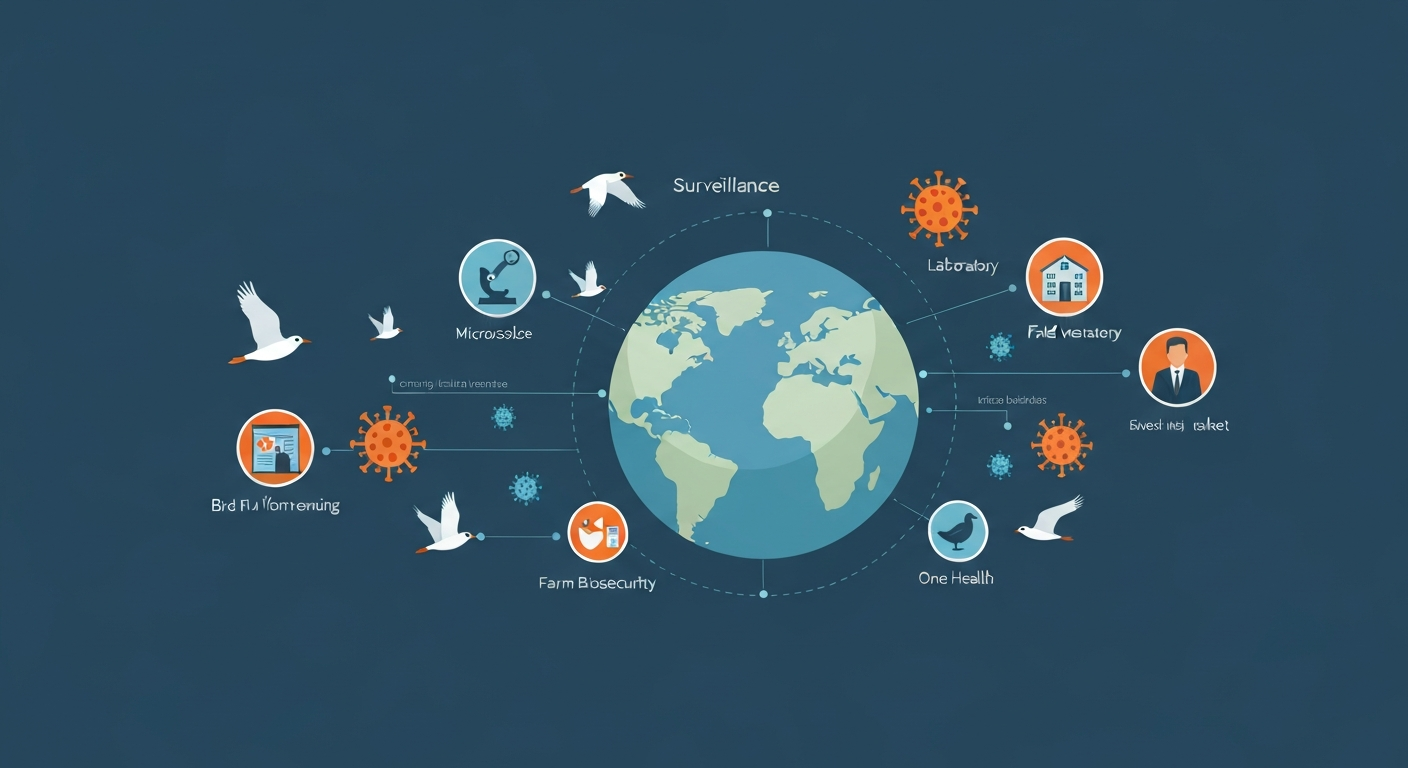
- WHO works with FAO and WOAH under a One Health framework to assess zoonotic risk across animal and human health simultaneously.
- Practical prevention focuses on avoiding sick or dead birds, using PPE during animal exposures, and following food safety practices.
What bird flu actually is, the virus, the strains, and who it affects
Avian influenza viruses belong to the influenza A group, which are enveloped, negative-sense, single-stranded RNA viruses with eight genomic segments. That segmented RNA genome matters because segments can mix when two different strains infect the same cell simultaneously, a process called reassortment, which can produce novel subtypes with unpredictable properties. Viruses are classified by two surface proteins: haemagglutinin (HA, numbered H1–H18) and neuraminidase (NA, numbered N1–N11). The most globally significant strains right now are H5N1, H5N2, H7N9, and H9N2, with HPAI (highly pathogenic avian influenza) H5N1 clade 2.3.4.4b driving the vast majority of current animal outbreaks.
Wild aquatic birds, ducks, geese, shorebirds, are the natural reservoir for most influenza A subtypes and typically show few or no signs of illness. Domestic poultry (chickens, turkeys, ducks) are far more vulnerable, especially to HPAI strains that can wipe out a flock in days. Over the past few years, H5N1 clade 2.3.4.4b has spread further than any previous avian influenza strain, infecting not just birds but also an expanding range of mammals including foxes, mink, sea lions, cattle, and domestic cats. WOAH's situation reports document hundreds of new outbreaks monthly across multiple continents, reflecting a level of geographic spread that makes this an ongoing global animal health emergency even when the human case count stays very low.
How bird flu spreads, from wild birds to people
The primary transmission pathway is from infected birds to the environment, and from the environment to other animals or people. Infected birds shed virus in their saliva, nasal secretions, and feces. Those secretions contaminate surfaces, water, feed, equipment, and soil, which is why live bird markets and backyard flocks with mixed species are considered high-risk settings. Direct contact with sick or dead birds, or with their droppings, is the dominant exposure route for both other animals and for humans who get infected.
Mammal-to-mammal transmission has been documented in mink farm outbreaks and in U.S. dairy cattle herds, where spread appears to have occurred via contaminated milking equipment and potentially direct animal contact. Raw milk from infected cows has also been identified as a transmission route. These mammalian spread events are worrying from a surveillance standpoint because more mammalian infections mean more opportunities for the virus to acquire mutations that improve human adaptation, specifically changes in the HA protein that shift binding preference from avian-type (α2,3-linked sialic acid) receptors to the human-type (α2,6-linked) receptors found in the upper human airway.
Human infections, when they do occur, are almost always tied to close, unprotected contact with infected animals or heavily contaminated environments. WHO and CDC both state clearly that there is no current evidence of sustained human-to-human transmission of HPAI H5N1. Casual contact with birds in a park, or eating properly cooked poultry and eggs, does not present a meaningful infection risk. That distinction between 'direct animal exposure' and 'everyday public exposure' is the foundation of all current risk communication.
What happens when a person gets infected, symptoms and who is most at risk
Human H5N1 infections have historically carried a high case fatality rate, over 50% in reported cases tracked by WHO going back to 2003. It is important to note, though, that surveillance historically captured mainly severe cases, so the true fatality rate may be lower if mild infections went undetected. In the current U.S. H5N1 outbreak, which has involved mostly agricultural workers, the infections have more commonly presented as mild illness (conjunctivitis, mild respiratory symptoms), suggesting strain and dose may influence severity.
Clinical illness in severe human H5N1 cases typically starts 2 to 5 days after exposure (incubation up to about 7 days) and resembles severe influenza: high fever, cough, sore throat, and rapid progression to pneumonia, acute respiratory distress syndrome (ARDS), and multi-organ failure in serious cases. H9N2 infections in humans tend to cause milder, self-limited respiratory illness. H7N9, which caused large human case clusters in China between 2013 and 2017, sat somewhere in between, serious respiratory illness with significant mortality but not as high as H5N1.
Risk factors for severe illness largely mirror those for seasonal influenza: older age, immunosuppression, and underlying cardiovascular or respiratory conditions. However, occupation is the most practically important risk factor right now, farmworkers, poultry handlers, veterinarians, and slaughterhouse workers who have unprotected contact with potentially infected animals are the group most at risk of exposure. General public risk, in WHO's and CDC's current assessments, remains low.
| Strain | Main reservoir | Human cases (historic/recent) | Typical human severity | Sustained human spread? |
|---|---|---|---|---|
| H5N1 (clade 2.3.4.4b) | Wild birds, poultry, cattle, mammals | 900+ since 2003; ongoing U.S./global cases 2024–2026 | Potentially severe to critical; recent U.S. cases often mild | No |
| H7N9 | Poultry (live bird markets) | ~1,500 cases, mainly 2013–2017 China | Moderate to severe | No |
| H9N2 | Poultry (endemic in Asia/Middle East) | Sporadic cases; 2 detected July 2026 | Mild to moderate | No |
| H5N2 | Poultry | 1 fatal human case confirmed 2024 (Mexico) | Severe (single case) | No |
| H3N2v | Swine (variant) | Sporadic; 1 detected July 2026 | Mild, self-limited | No |
WHO's role, surveillance systems, and where things stand in mid-2026
WHO's Global Influenza Programme (GIP) is the hub for all WHO activity on avian influenza. It publishes technical guidance, coordinates candidate vaccine virus (CVV) development, maintains the Global Influenza Surveillance and Response System (GISRS), and issues the 'Influenza at the human-animal interface' summary reports that consolidate new human detections and WHO's public-health risk judgements. Those reports are published roughly every three weeks and are the most reliable near-real-time source of the global picture.
GISRS is the backbone of this system. It connects over 150 National Influenza Centres (NICs) in more than 120 countries, five WHO Collaborating Centres (including the CDC in Atlanta and the Francis Crick Institute in London), and four WHO Essential Regulatory Laboratories. When a country detects a novel influenza A subtype in a human, the International Health Regulations (IHR 2005) require notification to WHO, triggering a formal risk assessment. The lab confirmation workflow runs from clinical sampling through NIC rRT-PCR subtyping to referral for sequencing, antigenic characterization, and CVV selection at WHO Collaborating Centres. This infrastructure is why new detections surface quickly and why WHO can issue rapid risk assessments.
WHO does not operate alone. It works under a One Health framework with FAO (Food and Agriculture Organization) and WOAH (World Organisation for Animal Health, formerly OIE) to produce joint risk assessments that examine animal and human data together. ECDC publishes regional threat and risk assessments (e.g., blank" rel="noopener noreferrer">Risk assessment H5 clade 2.3.4.4b viruses (ECDC)) for Europe that summarize epidemiology in animals and humans, antigenic relationships to candidate vaccine viruses, and public-health recommendations for EU/EEA countries. blank" rel="noopener noreferrer">FAO's April 2026 update documented 763 H5Nx events across 31 countries in animals, alongside 5 new human events since the previous update. WOAH's March 2026 situation report (No. 81) mapped hundreds of new HPAI outbreaks across multiple regions, documenting active H5N1 events in the United States, Europe, Asia, and the Americas. Together, these three organizations provide a cross-sector picture that no single agency could produce alone.
As of WHO's 7 July 2026 report (covering 13 June to 7 July 2026), there were 1 human A(H5) detection, 2 human A(H9N2) detections, and 1 H3N2v detection recorded in that period. WHO's risk assessment remains: low risk to the general public, elevated risk for people with occupational or recreational exposure to infected animals. No evidence of sustained human-to-human transmission. This is the status that guides all current WHO guidance.
What WHO recommends for public health authorities and outbreak response
WHO's guidance for national health authorities draws directly from IHR obligations and from GIP technical documents. The core requirements are: maintain robust surveillance at the human-animal interface; ensure NICs have capacity to detect and subtype novel influenza A viruses; immediately notify WHO of any confirmed human infection with a novel influenza A subtype; conduct thorough contact tracing and exposure investigation for every human case; and share virus specimens with GISRS for sequencing, risk assessment, and CVV development.
For outbreak response, WHO guidance covers risk communication, case management, antiviral use (oseltamivir/Tamiflu is the primary recommended antiviral for treatment and post-exposure prophylaxis in high-risk exposures), and healthcare worker protection. Health authorities are advised to maintain stockpiles of antivirals and PPE calibrated to their national risk assessments, and to have pandemic preparedness plans in place that can scale from the current sporadic human case scenario upward if human-to-human transmission were detected. The speed of that scaling depends on the surveillance infrastructure already being in place.
WHO's biannual vaccine composition consultations also sit within the public health framework. At each consultation, WHO recommends CVVs for zoonotic influenza strains, which manufacturers can use to develop pre-pandemic or pandemic vaccines. Having CVVs already developed and shared means vaccine production can start faster if the risk picture changes significantly. This preparation work runs continuously in the background and is one of the most consequential, and least visible, parts of WHO's role.
Poultry control and farm biosecurity: WHO's guidance for producers and vets
WHO's guidance on poultry biosecurity works alongside that from FAO and WOAH, as the human health risk cannot be separated from what is happening in animal populations. The foundational message is that controlling virus circulation in animals is the primary way to reduce human exposure. A person cannot get bird flu from poultry that was never infected.
For poultry producers and veterinarians, the recommended biosecurity measures align closely with WOAH and FAO standards. Key steps include strict separation of species (particularly waterfowl and chickens), controlled access to poultry houses, sanitation of equipment and vehicles, avoiding contact between domestic flocks and wild birds, and reporting unusual mortality promptly to veterinary authorities. In outbreak zones, rapid culling of affected flocks and thorough decontamination of premises are the standard response tools. Workers involved in culling or handling sick birds must use appropriate PPE, gloves, goggles, N95 or equivalent respirator, and protective clothing.
Live bird markets (LBMs) are a particular focus in WHO and FAO guidance because they concentrate multiple species, create fomite transmission pathways, and are associated with a disproportionate number of human H5N1 and H7N9 exposures historically. Recommended LBM controls include regular rest days with full cleaning, species separation, prohibition on returning unsold birds to farms, and active surveillance. These measures have proven effective in reducing human cases in settings where they are consistently applied.
Food safety for consumers: what WHO actually says about handling and cooking
WHO's food safety guidance on avian influenza is clear and not particularly alarming: properly cooked poultry and eggs are safe to eat. Influenza viruses are inactivated by heat. Cooking poultry to an internal temperature of at least 70°C (158°F), the point at which the juices run clear and no pink remains, eliminates any viable virus. The same applies to eggs: cook until both yolk and white are firm. There is no evidence that anyone has been infected with avian influenza through eating properly cooked poultry products.
The risks in food handling are about raw products and cross-contamination before cooking. WHO recommends keeping raw poultry separated from other foods, washing hands and surfaces thoroughly after handling raw poultry, and avoiding raw or undercooked poultry in areas with active outbreaks. The raw milk concern that emerged during the U.S. dairy cattle H5N1 outbreak is real: infectious H5N1 virus has been detected in raw milk from infected cows, and WHO and CDC both advise against consuming unpasteurized milk as a precaution. Pasteurization inactivates the virus.
At markets, WHO advises consumers to avoid direct contact with live birds or their droppings, to wash hands after visiting markets, and to avoid surfaces that may be contaminated with bird feces. Travelers to regions with active poultry outbreaks should avoid visiting live poultry markets, backyard farms, or other settings with concentrated bird populations where biosecurity may be limited.
Avian influenza vaccines: where things stand
This is an area where it is worth being precise about what exists and for whom. Several H5N1 candidate vaccines and pre-pandemic vaccines have been developed, stockpiled, or approved in various countries, but as of mid-2026 there is no general public vaccination program against H5N1 anywhere in the world. For more on the timeline and history of when the bird flu vaccine was made, see a detailed timeline of development efforts and approvals. Vaccines exist primarily as government stockpiles intended for first responders, healthcare workers, and other high-risk groups if a pandemic were declared. See WHO and bird flu vaccine for more on vaccine stockpiles, candidate vaccine viruses (CVVs), and prioritization for high-risk groups. For more on vaccine performance and effectiveness data, see how effective is bird flu vaccine. See our guide on how to get bird flu vaccine for details on eligibility, where vaccines are offered, and how governments distribute stockpiled doses.
WHO coordinates the development of CVVs through GISRS and shares them with vaccine manufacturers globally. Those CVVs are the biological starting material for both traditional egg-based and newer cell-based or recombinant H5N1 vaccines. Some manufacturers have been contracted by governments to maintain the capacity to rapidly scale production using those CVVs. The development timelines, vaccine types (including whether any are mRNA-based), manufacturer details, and effectiveness data are subjects covered in related articles on this site. For a focused explanation of whether H5N1 vaccines use mRNA technology, see the article 'Is the bird flu vaccine mRNA'. See the related article "how long did bird flu vaccine take to develop" for a concise timeline of CVV creation, testing, regulatory review, and manufacturing lead times. See the related guide 'Who makes bird flu vaccine' for a list of manufacturers and details on available H5N1 vaccine types.
It is also worth stating plainly: current seasonal influenza vaccines do not provide meaningful protection against HPAI H5N1. CDC is direct on this point. Seasonal flu shots protect against the strains selected for each season's human influenza viruses, they are not cross-protective against antigenically distant avian strains. This is why WHO's ongoing CVV work, and the preparedness infrastructure it feeds, is so important.
Practical steps for the public right now
For most people reading this, the immediate action list is short. Avoid direct contact with sick or dead birds, this applies whether you encounter them in the wild, at a farm, or at a market. If you work with poultry, livestock, or in veterinary settings, follow your employer's PPE protocols and report any illness to a healthcare provider, mentioning your animal exposures. Do not consume raw or undercooked poultry, eggs, or unpasteurized dairy products, particularly if you are in or have traveled from a region with active outbreaks. Wash hands thoroughly and frequently, especially after contact with animals or animal environments.
If you develop respiratory illness or conjunctivitis within 10 days of a known or suspected exposure to infected birds or animals, seek medical care and tell your doctor about the exposure. Early antiviral treatment with oseltamivir is most effective when started promptly. Do not wait for test confirmation to start treatment if clinical suspicion is high. These are the practical steps that WHO, CDC, and ECDC all converge on, regardless of which specific strain is circulating.
- Avoid handling sick, dead, or visibly unwell birds without gloves and eye protection.
- Use full PPE (gloves, eye protection, N95 respirator, protective clothing) if you must be near potentially infected animals in an outbreak area.
- Cook all poultry to at least 70°C internal temperature; cook eggs until firm throughout.
- Do not drink unpasteurized milk, especially from areas with known H5N1 dairy cattle infections.
- Wash hands with soap and water after any animal contact, market visits, or raw poultry handling.
- Avoid live bird markets in areas reporting active HPAI outbreaks if possible.
- Report any unusual poultry deaths to local veterinary or agricultural authorities promptly.
- If you have animal exposure and develop flu-like symptoms or eye redness, seek medical care immediately and mention your exposure history.
The overall picture in July 2026 is one of significant ongoing animal health impact, hundreds of outbreaks in birds and mammals across dozens of countries, combined with a very low human case burden and no evidence of the kind of human-to-human spread that would signal a genuine pandemic threat. WHO's surveillance systems are the reason we can say that with reasonable confidence. Staying informed through WHO's periodic 'Influenza at the human-animal interface' summaries is the most reliable way to track whether that picture changes.
FAQ
Which authoritative sources should be used to explain WHO’s role and guidance on avian influenza (bird flu)?
Primary WHO pages: Global Influenza Programme (GIP) — avian influenza, 'Influenza at the human–animal interface' summary & assessment reports, GISRS/FluNet pages, WHO laboratory and CVV guidance, and IHR notifications. Complementary authoritative sources: WOAH/WAHIS (animal outbreaks), FAO (EMPRES/Global AIV updates), CDC (country-level interim guidance), ECDC (regional risk assessments), WHO Collaborating Centres and peer‑reviewed virology papers for mechanistic detail.
What specific outbreak‑status information must be collected and where to find it?
Collect latest human detections and WHO risk judgements from the most recent 'Influenza at the human–animal interface' report; global animal outbreak counts and maps from WOAH/WAHIS and FAO (EMPRES) situational updates; national notifications under IHR available via WHO; and laboratory surveillance trends via GISRS/FluNet. Use the most recent dated reports (cite date) and note geographic spread, clades (e.g., 2.3.4.4b), and any evidence of mammalian infections.
What virology facts should be summarized and which sources answer them?
Key facts: Influenza A are enveloped, negative‑sense, segmented (8) RNA viruses classified by HA/NA subtypes (H5N1, H9N2, etc.); genetic reassortment and HA mutations drive host range shifts. Sources: WHO virology and laboratory guidance, NCBI/standard virology reviews, and structural receptor‑binding literature (e.g., Nature Reviews Microbiology) for HA receptor specificity determinants.
What transmission routes, exposure scenarios, and environmental risks must be explained and where to verify them?
Explain direct contact with infected birds, contaminated environments (live bird markets, backyard flocks), indirect contact via fomites, possible exposure through raw contaminated animal products, and currently limited human‑to‑human transmission. Verify via WHO GIP pages, CDC interim recommendations, and joint FAO/WHO/WOAH assessments that summarize exposure routes from human cases.
What clinical presentation, risk factors and severity data are needed and which sources provide them?
Document typical human symptoms (fever, cough, sore throat, conjunctivitis, severe pneumonia), incubation periods, severe‑disease risk factors (age extremes, immunosuppression, chronic lung disease, close/unprotected animal exposure), case‑fatality patterns for specific subtypes where reported, and antiviral responsiveness. Use WHO human case summaries, CDC clinical guidance, and peer‑reviewed case series cited in WHO/CDC assessments.
What WHO surveillance and laboratory workflow should be described?
Describe sentinel and clinical sampling → NIC rRT‑PCR for influenza A/subtyping → referral to WHO Collaborating Centres for sequencing, antigenic characterization and CVV development → inclusion in GISRS/FluNet reporting and WHO risk assessments. Source: WHO surveillance/laboratory guidance and GISRS pages.