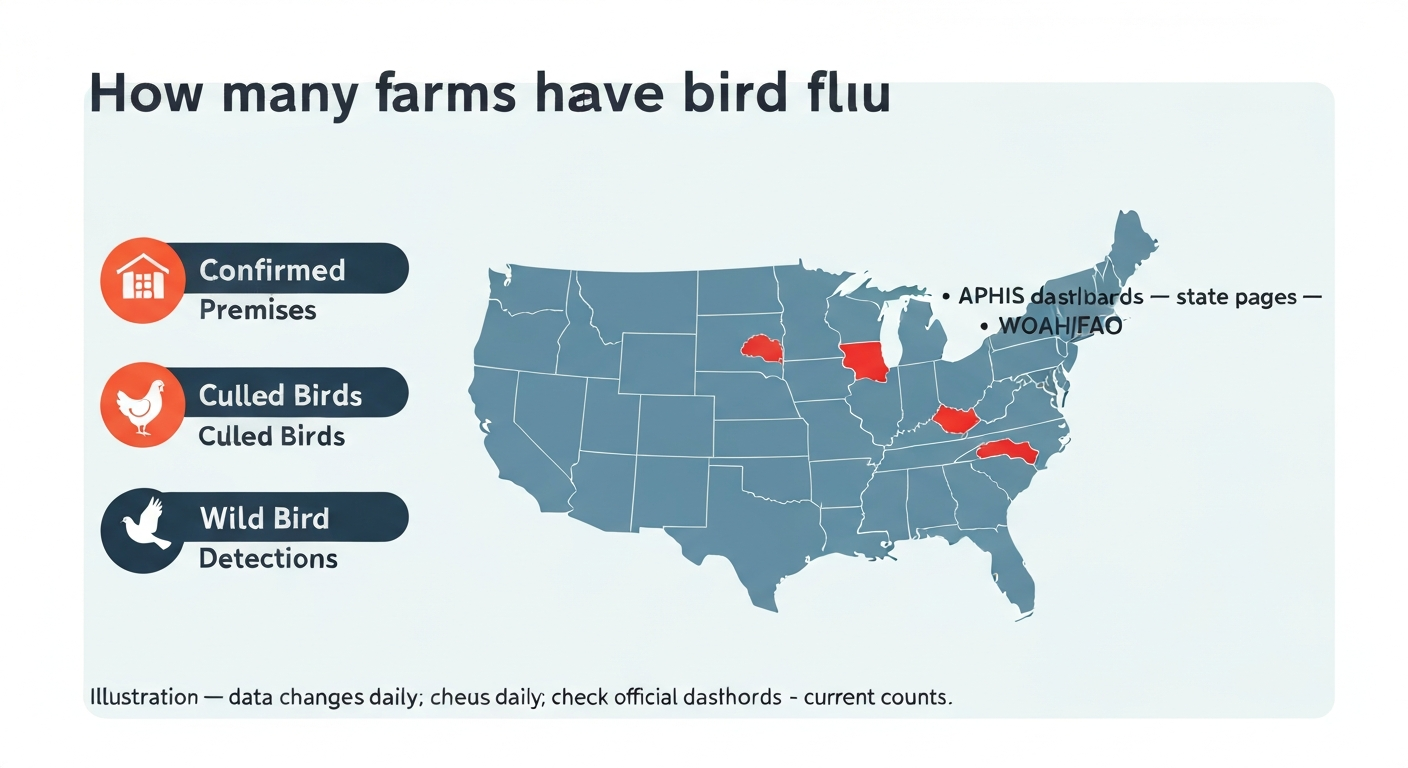
As of mid-2026, hundreds of poultry and livestock premises in the United States have been confirmed as infected with highly pathogenic avian influenza (HPAI) since the current outbreak wave began in late 2021, with the exact running total changing every weekday as USDA APHIS updates its official dashboards. The most reliable way to get today's number is to check the APHIS 'Confirmations of Highly Pathogenic Avian Influenza in Commercial and Backyard Flocks' dashboard directly, because any figure printed here will age quickly. What this article does is explain what those numbers mean, where they come from, how to read them accurately, and what to do with that information whether you're a backyard flock owner, a farmer, a veterinarian, or just someone following the news.
How Many Farms Have Bird Flu: Current Counts, Risks & Steps

What this article covers and what it doesn't
This article is focused on helping you find, read, and interpret official farm-level bird flu counts in the United States, with context for international data as well. It covers confirmed poultry premises, backyard flocks, cattle operations, wild bird events, and human cases, and it explains the reporting systems behind all of those numbers. What it cannot do is give you a single, permanently accurate count of currently infected farms, because that number updates continuously. Think of this as a guide to reading the scoreboard rather than the final score itself. For closely related questions, you may also want to look at how many cows have bird flu, how many chickens were killed due to bird flu, and how many people have bird flu, all of which fill in different parts of the same outbreak picture.
Where to check current farm counts right now
The three dashboards you actually need are all maintained by USDA APHIS and updated every weekday. For poultry farms and backyard flocks, go to the APHIS 'Confirmations of Highly Pathogenic Avian Influenza in Commercial and Backyard Flocks' dashboard. It shows state- and premises-level data, a rolling 30-day view of recent detections, and cumulative totals. For cattle and other livestock, the separate 'HPAI Confirmed Cases in Livestock' interactive map shows confirmed cases over the last 30 days and cumulative counts by state. For questions about specific cattle counts, see the resource on how many cows have bird flu. Note that the livestock map page itself says you may need to refresh your browser to pull the most current table. For wild bird detections, APHIS publishes a downloadable table (available as CSV) titled 'Detections of Highly Pathogenic Avian Influenza in Wild Birds,' which includes detection date, county, state, and species. If you want global data, the FAO's EMPRES-i portal (Emergency Prevention System / Global Animal Disease Information System) aggregates country-level and event-level outbreak records worldwide, and the World Organisation for Animal Health (WOAH) publishes regular HPAI Situation Reports through its WAHIS system.
| Dashboard / Resource | What it covers | Update frequency | Best used by |
|---|---|---|---|
| APHIS HPAI Poultry & Backyard Flock Dashboard | Confirmed premises (commercial + backyard), state maps, 30-day and cumulative views | Weekdays | Farmers, vets, general public, journalists |
| APHIS HPAI Livestock Map | Confirmed cattle and other livestock premises by state, 30-day and cumulative | Weekdays | Dairy/beef producers, vets, public health |
| APHIS Wild Bird Detection Table (CSV) | Wild bird detections by date, county, state, species | Regularly updated | Wildlife biologists, epidemiologists, researchers |
| WOAH WAHIS / HPAI Situation Reports | Country-level outbreak reports submitted by national veterinary authorities | Within 24 hrs of member notification; periodic situation reports | International health agencies, researchers, policy analysts |
| FAO EMPRES-i | Global event-level dataset, map dashboards, downloadable data | Continuous, country-dependent | Researchers, risk analysts, international responders |
Key terms defined: a quick glossary before you read any count
Bird flu reporting comes with a specific vocabulary, and using these terms interchangeably is one of the most common sources of confusion in news coverage. Here's what each term actually means in official usage.
- Infected Farm (Infected Premises / IP): In APHIS terminology, an Infected Premises is a specific location (farm, backyard flock, ranch) where a presumptive positive or confirmed positive case exists based on lab results, compatible clinical signs, and the applicable case definition. One IP equals one farm or location, not one bird.
- Confirmed Infection: A detection that has been validated by USDA's National Veterinary Services Laboratories (NVSL) through rRT-PCR testing, virus isolation, and/or full genetic sequencing. A 'presumptive positive' from a state lab becomes 'confirmed' once NVSL signs off.
- Culled / Depopulated Birds: Birds that have been killed as part of a disease-control response on or around an infected premises. Culling is done to stop spread, not because every bird was necessarily infected. Depopulation numbers are typically far larger than confirmed-infected bird counts.
- Backyard Flock: A small, non-commercial group of poultry (chickens, ducks, turkeys, etc.) kept by private individuals, often for personal use or small-scale sales. Backyard flocks are tracked separately from commercial operations in APHIS data.
- Commercial Poultry: Large-scale, professionally managed operations raising chickens, turkeys, or other poultry for egg or meat production. These are subject to more systematic surveillance and faster reporting than backyard flocks.
- Wild Bird Event: A detection of HPAI in free-living wild birds, reported separately from farm or livestock premises. These detections are logged by USDA Wildlife Services and published in the wild bird detection table.
- Zoonotic Case: An infection that has jumped from an animal to a human. HPAI H5N1 is classified as zoonotic, meaning human cases are possible through direct exposure to infected animals, but the virus does not currently spread efficiently between people.
Why you can't find a public list of every affected farm
One of the most frequent questions I hear is: 'Can I see which specific farms are affected?' The answer is: not by name, and that's intentional. APHIS and most state agencies deliberately redact owner names, business names, and specific addresses from public datasets. They use de-identified location codes instead, such as 'County-03,' and APHIS pages explicitly state that private and business names will not be released. This isn't bureaucratic opacity for its own sake. There are real reasons behind it.
- Biosecurity risk: Publishing the exact location of an active infection could attract visitors (curious neighbors, journalists, advocates) who might inadvertently carry virus on their clothing, vehicles, or equipment to neighboring farms.
- Producer privacy and legal protection: Farm owners have privacy rights. Publicly naming a farm with a confirmed infection can trigger economic harm through market stigma, contract cancellations, or community pressure, even after the flock has been depopulated and the farm has been cleaned and disinfected.
- Accurate quarantine enforcement: When control zones are established around an infected premises, the zone coordinates are managed operationally by state and federal responders rather than broadcast publicly, to prevent panic buying, illegal movement of birds, or interference with response activities.
- FOIA conventions: Even under Freedom of Information Act requests, APHIS has applied consistent de-identification conventions to public HPAI datasets, with premises identified by internal codes rather than names.
The most granular public sources for sub-national farm information are state agriculture department press releases. When a new case is confirmed, states like Delaware and Wisconsin routinely issue immediate press releases naming the county, the type of flock (commercial or backyard), and the approximate flock size, along with biosecurity contact numbers for nearby producers. For example, Delaware announced a presumptive positive in Kent County on January 10, 2026, and Wisconsin DATCP confirmed a case in a commercial flock in Jefferson County on February 27, 2026. Delaware announced a presumptive positive in Kent County on January 10, 2026 Delaware announced a presumptive positive in Kent County on January 10, 2026.. These state-level releases are your best lead on which geographic area has current activity, even if they stop short of naming the individual operation.
Infected farms vs. culled birds vs. suspected events: how to read the numbers without getting confused
The three numbers that tend to get mixed up in headlines are: how many premises (farms) are confirmed infected, how many birds have been depopulated, and how many suspected or presumptive events are under investigation. They measure very different things.
Premises counts tell you the geographic and operational footprint of the outbreak. One large commercial broiler operation with 2 million birds counts as one premises, just like a backyard flock of 12 chickens. So a relatively small number of premises can still represent an enormous number of animals at risk. As of a USDA APHIS interim epidemiologic report from February 29, 2024, NVSL-confirmed detections through that date included 472 WOAH-classified commercial poultry premises, 2,144 backyard poultry premises, and 480 non-poultry premises (including cattle and other species), showing that backyard flocks actually make up the majority of premises counts even though commercial operations account for the vast majority of birds affected.
Culled bird counts reflect the depopulation response, not the confirmed infection count. When a flock is depopulated, the entire population of that premises is typically destroyed to stop the virus from spreading, even if only a fraction of birds tested positive. This is why the number of birds killed due to bird flu runs into the tens or hundreds of millions nationally while the number of confirmed premises is in the hundreds or low thousands. Treating culled-bird counts as a proxy for confirmed infections overstates the direct infection toll.
Suspected or presumptive events are cases where a state NAHLN lab has returned a positive rRT-PCR result but NVSL confirmation is still pending. These may appear in state press releases before showing up in the APHIS federal dashboard. Response actions like quarantine and control zone establishment typically begin at the presumptive stage rather than waiting for NVSL confirmation, so the operational outbreak response is often running ahead of the official confirmed count.
How a bird flu case is actually detected and confirmed
Detection usually starts one of two ways: a farmer or veterinarian notices sick or dead birds and calls their state veterinarian's office, or a wildlife biologist collects samples from dead or dying wild birds as part of routine surveillance. In both cases, samples go to a National Animal Health Laboratory Network (NAHLN) state lab, which runs a real-time reverse transcription PCR (rRT-PCR) assay. This test is fast, typically returning results within 24 to 48 hours, and a positive at this stage is reported as a 'presumptive positive.' Those samples are then forwarded to USDA's National Veterinary Services Laboratories (NVSL) in Ames, Iowa, for full confirmation, which includes additional PCR testing, virus isolation, and full genetic sequencing and characterization. USDA APHIS and NVSL diagnostic guidance and SOPs describe this workflow: state/NAHLN labs run rRT‑PCR and report presumptive positives, then samples are sent to NVSL for confirmation, sequencing, and final characterization, with rRT‑PCR providing rapid presumptive results while virus isolation and full sequencing can take days to weeks blank" rel="noopener noreferrer">HPAI diagnostics guidance / NVSL SOPs (USDA APHIS / NVSL diagnostic guidance and SOPs). That sequencing step can take several additional days to weeks.
The lag between presumptive and confirmed status matters for interpreting public dashboards. The APHIS dashboard reflects confirmed cases, so it may trail the real situation on the ground by a few days during periods of rapid spread. State press releases often announce presumptive positives before APHIS updates its federal count. If you're tracking an active outbreak in your area, watching both the state agriculture department site and the APHIS dashboard gives you a more complete picture.
Wild bird surveillance: a different picture
Wild bird surveillance operates at a different scale and with different limitations. USDA Wildlife Services conducts both active surveillance (systematically sampling birds from target species in target areas) and passive surveillance (responding to reports of sick or dead wild birds from the public or wildlife biologists). The APHIS interim epidemiologic report noted that between December 30, 2021, and February 29, 2024, approximately 82,295 apparently healthy wild birds were sampled and 4,290 H5Nx detections were recorded. That same report estimated at least 33,500 wild birds had been infected since the outbreak began, and the authors explicitly noted that confirmed detection counts underestimate true infection numbers. Wild birds, including raptors like bald eagles, have experienced significant mass mortality events in this outbreak, and those incidents are tracked separately from farm-level data.
Who reports what: navigating the multi-agency system
No single agency runs the whole bird flu reporting system. Understanding who does what helps you know where to look for which kind of information.
| Agency | What they report | Where to find it |
|---|---|---|
| USDA APHIS | Confirmed HPAI in commercial poultry, backyard flocks, livestock; maintains national dashboards and downloadable tables; coordinates federal response | APHIS HPAI dashboards (poultry and livestock); epidemiologic reports |
| CDC (Centers for Disease Control and Prevention) | Human cases of HPAI in the U.S.; occupational exposure investigations; human health guidance for workers and the public | CDC Bird Flu website; situation update pages |
| State Departments of Agriculture | State-level press releases for presumptive and confirmed poultry/livestock cases; local biosecurity guidance; producer contacts | State agriculture department websites and press release pages |
| State Public Health Departments | Human exposures and cases within each state; coordination with CDC on worker health monitoring | State health department websites |
| USDA Wildlife Services | Wild bird HPAI detections; samples submitted to NAHLN/NVSL; feeds the APHIS wild bird detection table | APHIS Wild Bird Detection Table (CSV/printable) |
| WOAH (World Organisation for Animal Health) | International outbreak reports submitted by national veterinary authorities; HPAI Situation Reports; WAHIS database | WOAH WAHIS portal; HPAI Situation Reports (e.g., Situation Report No. 81, March 2026) |
| FAO (Food and Agriculture Organization) | Global event-level disease data via EMPRES-i; country-level aggregate data; risk assessments | FAO EMPRES-i portal |
The coordination pathway in the U.S. runs roughly like this: a farmer or wildlife biologist reports a suspected case to a state veterinarian or wildlife agency. State NAHLN labs run the initial PCR test and report presumptive positives to both the state agriculture department and to APHIS. NVSL confirms the case federally. APHIS then updates its national dashboard and, for internationally reportable events, notifies WOAH through the appropriate channels. WOAH requires its member countries to submit an Immediate Notification within 24 hours of confirming a listed disease event, followed by weekly follow-up reports as needed. Those reports feed into WAHIS and eventually into FAO's EMPRES-i system.
Reporting gaps, lags, and what the numbers actually miss
Every headline number you see is a minimum confirmed count, not a true prevalence estimate. That's not a criticism of the agencies producing the data; it's an inherent feature of how outbreak surveillance works, and it's important to understand when interpreting those numbers.
Surveillance intensity shapes what gets counted
Regions with more active surveillance, meaning more systematic sampling of wild birds, more rigorous on-farm monitoring, and better-funded state veterinary labs, will report more detections than regions doing only passive surveillance. This is not because those regions have more bird flu. It's because they're looking harder. WOAH and FAO guidance formally distinguishes active surveillance (investigator-led, systematic sampling) from passive surveillance (observer-initiated reporting of sick or dead animals), and this distinction directly affects how comparable case counts are across states and countries. A state with minimal active surveillance and no confirmed cases may still have circulating virus that no one has sampled.
Backyard flocks and wild birds are especially undercounted
Commercial poultry operations have biosecurity protocols, regular veterinary oversight, and strong financial incentives to report quickly (to access federal indemnity programs for depopulated birds). Backyard flock owners may not recognize early clinical signs of HPAI, may not know they need to report, or may hesitate for fear of losing their birds without compensation. Wild bird mortality is undercounted for a different reason: carcasses decompose, are scavenged, or simply aren't found in remote habitats. The APHIS report's estimate that at least 33,500 wild birds had been infected (against roughly 4,290 confirmed detections) illustrates this gap clearly.
Confirmation delays mean dashboards lag reality
There is always a gap between when a flock starts dying, when a sample is collected, when NAHLN returns a presumptive positive, and when NVSL issues a final confirmed case that appears on the APHIS dashboard. During periods of rapid geographic spread, this lag can mean the dashboard understates current active cases by several days. State press releases are your best real-time supplement during such periods.
International data has additional inconsistencies
At the global level, WAHIS and EMPRES-i data are only as complete as what national veterinary authorities submit. Countries with limited lab capacity, resource-constrained surveillance systems, or political incentives to underreport will show lower case counts that don't reflect actual circulation. WOAH's 24-hour immediate notification requirement is the formal standard, but analyses of WAHIS reporting trends show meaningful variation in how consistently and promptly different countries meet it. When using FAO or WOAH global figures, treat them as a minimum confirmed floor, with the understanding that real global spread is likely broader.
Case definition changes can shift the numbers
Occasionally, the case definitions or reporting categories used by APHIS or WOAH are updated as understanding of the virus evolves. When this happens, historical counts may be reclassified, and apparent jumps or drops in cumulative totals can reflect definitional changes rather than true changes in outbreak activity. If you notice an unexpected shift in cumulative counts, check for any announcements of updated reporting guidance before assuming it reflects actual new spread or recovery.
A practical guide for different readers
If you're a backyard flock owner or small farmer
Check the APHIS dashboard for your state to understand whether there is current activity in your region. If you see or hear of sick or dead birds in your flock, contact your state veterinarian's office immediately. Early reporting triggers a response that includes free testing and, if your flock is depopulated as part of a confirmed case response, federal indemnity payments. The longer you wait, the more you risk spreading virus to neighboring flocks. Maintain strict biosecurity: limit visitors, change footwear and clothing when moving between poultry areas, and keep wild birds away from your flock's feed and water sources.
If you're a veterinarian or animal health professional
The APHIS NAHLN laboratory network is your diagnostic pathway. Familiarize yourself with the rRT-PCR submission process for your state NAHLN lab and with the APHIS Red Book (HPAI Emergency Response materials), which describes the presumptive-to-confirmed workflow and response trigger points. Understanding that field response (quarantine, control zone establishment) routinely begins on presumptive results rather than waiting for NVSL confirmation is operationally critical. For cattle and other livestock, use the separate APHIS livestock dashboard and monitor WOAH WAHIS for any updates to the case definition or international spread patterns affecting the strain circulating in your region.
If you're a public health professional or epidemiologist
Human cases in the U.S. are reported through CDC. For context on the scale of animal infection driving potential human exposure risk, the APHIS dashboards and WOAH HPAI Situation Reports are your best sources. Keep in mind that the majority of human cases documented so far have involved direct, close contact with infected birds or animals. The virus does not currently transmit efficiently between people, but the occupational risk for poultry workers and farm workers involved in outbreak response is real and has been the subject of active CDC monitoring and guidance. For questions about how many people have been affected and the history of human cases in this outbreak, the broader outbreak context is important. For broader context on potential human mortality scenarios, see analyses addressing how many people would die in a bird flu pandemic. For a concise list of reported human fatalities and case details in this outbreak, see an overview of who died from bird flu. For up-to-date counts of human infections, see how many people have bird flu. For a focused summary of human mortality, see how many people died from bird flu.
If you're a general reader following the news
The most useful thing to know is that the headline numbers you see in news coverage tend to mix premises counts, bird counts, and culled-bird counts without distinguishing them. When a report says 'X farms affected' and another says 'Y million birds killed,' those are measuring different things. Farms are operational units. Birds killed includes every bird depopulated as part of the outbreak response on and around infected farms, most of which may not have tested positive individually. Neither number directly tells you your personal risk as a consumer. Standard food safety practices (cooking poultry and eggs thoroughly, practicing good hand hygiene) are sufficient protection under current conditions.
FAQ
What is meant by “how many farms have bird flu” — what definitions matter?
Official counts usually report infected premises (IP) or confirmed premises: a geographic location (premises) where surveillance and diagnostics indicate a presumptive or confirmed positive according to the authority’s case definition. APHIS defines an Infected Premises (IP) as a premises where laboratory results and compatible clinical signs meet the case definition. Distinguish this from: (a) number of individual birds infected, (b) number of birds culled/depopulated during control, and (c) wild‑bird detections. Official “farm” counts = premises/IP counts and are the primary unit in dashboards and situation reports (not exact flock prevalence).
Where can I find the up‑to‑date authoritative farm‑level counts in the United States?
USDA APHIS is the primary source for U.S. premises‑level HPAI counts: (1) APHIS “Confirmations of Highly Pathogenic Avian Influenza in Commercial and Backyard Flocks” dashboard — state and premises snapshots and a 30‑day view (https://www.aphis.usda.gov/aphis/ourfocus/animalhealth/animal-disease-information/avian/avian-influenza/hpai-2022/2022-hpai-commercial-backyard-flocks). (2) APHIS interactive map “HPAI Confirmed Cases in Livestock” and related downloadable tables (https://direct.aphis.usda.gov/livestock-poultry-disease/avian/avian-influenza/hpai-detections/hpai-confirmed-cases-livestock). State agriculture/veterinary agency press releases provide the most granular local detail and contact info.
Where can I find global and country‑level outbreak data?
Use FAO EMPRES‑i for global event‑level datasets, maps and data downloads (EMPRES‑i: https://empres-i.apps.fao.org/). WOAH (formerly OIE) publishes member notifications and situation reports via WAHIS and HPAI situation reports (disease page and situation reports: https://www.woah.org/en/disease/avian-influenza/). These are the standard global data sources used by researchers and policymakers.
Why do official counts often underestimate true infections?
Reported counts are 'confirmed' or detected events and depend heavily on: surveillance intensity (active vs passive), laboratory confirmation delays, reporting thresholds and editorial redaction. Areas with more active sampling detect more events; many infections in wild birds or low‑mortality flocks go undetected; NAHLN rRT‑PCR presumptive positives may be confirmed later at NVSL, and counts reflect that workflow. FAO/WOAH documentation and APHIS epidemiologic analyses note that confirmed detections are minimums and under‑estimate true infection numbers.
How do ‘infected premises’ (farms) differ from numbers of birds infected or culled?
An infected premises = location where infection is confirmed or presumptive. One premises can contain anywhere from a handful of birds (backyard flock) to hundreds of thousands (commercial operations). The reported premises count does not equal total birds infected. Authorities often report both premises counts and birds affected (e.g., birds infected or depopulated) in summaries, but the two are separate metrics and should not be conflated.
How are cases detected and confirmed (diagnostic pathway)?
In the U.S., state/NAHLN labs run real‑time RT‑PCR (rRT‑PCR) producing presumptive positives that trigger response actions; samples are forwarded to USDA NVSL for confirmation, sequencing and typing. rRT‑PCR is fast for presumptive detection; virus isolation/sequencing can take several days to weeks. APHIS and NVSL SOPs document this workflow; response actions are often initiated on presumptive results to limit spread.
How Many Cows Have Bird Flu Now? Live Counts and Context
Live bird flu in cattle counts, plus deaths and case definitions, with tips to find the latest official numbers