Yes, dozens of bald eagles have died from highly pathogenic avian influenza (HPAI), and confirmed detections are spread across multiple U. For specifics, see who died from bird flu for a list of reported individuals. S. states. The USDA APHIS wild-bird detections dashboard lists bald eagle HPAI cases with specific collection dates, counties, and subtypes, including a detection from Laurel County, Kentucky (collected April 7, 2026; confirmed June 25, 2026) classified as EA H5. A deceased juvenile bald eagle found at George Washington Birthplace National Monument on January 4, 2026, tested presumptive positive for avian influenza through evaluation by the USGS National Wildlife Health Center (NWHC). New Jersey's Department of Environmental Protection cited HPAI as a likely contributor to a measurable decline in active bald eagle nests in a March 2026 press release. These are not isolated incidents, they are part of a much larger, ongoing H5 clade 2.3.4.4b outbreak that has affected wild birds, poultry, dairy cattle, and a small number of people across North America and beyond.
Dozens of Bald Eagles Have Died from Bird Flu: What to Know Now

Quick facts
- Dozens of confirmed HPAI detections in bald eagles are logged in the USDA APHIS wild-bird dashboard, with cases spanning multiple states and years of the current outbreak.
- The dominant strain in North American wild birds, including bald eagles, is H5 clade 2.3.4.4b (H5N1).
- A juvenile bald eagle at George Washington Birthplace National Monument tested presumptive positive for avian influenza on or around January 4, 2026 (NWHC evaluation).
- New Jersey DEP linked HPAI to a decline in active bald eagle nests and increased nest failures in a March 26, 2026 news release.
- Bald eagles are exposed primarily through predation or scavenging of infected waterbirds, plus contact with contaminated water or carcasses.
- Bald eagles are federally protected under the Bald and Golden Eagle Protection Act — handling a sick or dead eagle requires contacting a licensed wildlife rehabilitator or state/federal wildlife agency.
- The public health risk from finding a dead eagle remains low. CDC recommends avoiding bare-hand contact and monitoring for symptoms for 10 days after any unprotected exposure.
- HPAI has now affected tens of millions of poultry birds across hundreds of U.S. farms, as well as dairy cattle herds and a limited number of people.
- Bald eagle genome sequences from HPAI-positive birds have been deposited in GenBank and are used by researchers to track clade assignments and search for mammalian-adaptation markers.
What happened: the confirmed eagle deaths
Reports of bald eagle deaths from bird flu did not come from a single event or one agency announcement. They have accumulated steadily through several overlapping surveillance channels: the USDA APHIS wild-bird detections dashboard (which lists species, county, collection date, detection date, subtype, and submitting agency), USGS NWHC wildlife health bulletins and necropsy case summaries, and state natural resource agency press releases. What's verified is that HPAI detections in bald eagles appear in the official APHIS dashboard with specific location and date data, confirmed through PCR testing and, in many cases, subtyping by the USDA National Veterinary Services Laboratories (NVSL) in Ames, Iowa, which functions as the confirmatory lab for U.S. HPAI detections.
The George Washington Birthplace National Monument case is one of the most publicly documented individual incidents. The National Park Service reported a juvenile bald eagle found deceased there on January 4, 2026, with NWHC performing the initial evaluation and returning a presumptive positive result. That kind of transparency, a federal agency issuing a site-specific public notice, is relatively unusual and illustrates how seriously wildlife managers are treating each detection. Most other cases filter through state wildlife agencies, raptor rehabilitation centers, and university diagnostic labs before reaching the APHIS dashboard, so the public often doesn't hear about individual birds.
What's less certain is the precise total count of eagle deaths attributable specifically to HPAI versus other causes. Necropsy studies show that HPAI can mimic other neurological and systemic diseases in raptors, so definitive attribution always requires lab confirmation. Peer-reviewed research (including a study published in PMC documenting bald eagle mortality and nest failure due to clade 2.3.4.4 H5N1) confirms that the virus is capable of causing acute fatal disease in eagles, with pathology including encephalitis, neuronal necrosis, and multi-organ degeneration. The nest-failure data from New Jersey adds a population-level dimension: eagles may be dying before or during the breeding season at rates high enough to suppress nest success measurably.
Current outbreak status: wild birds, farms, mammals, and people
The H5 clade 2.3.4.4b outbreak that entered North America in late 2021 is among the largest and most geographically widespread HPAI events ever recorded. Wild waterbirds, primarily dabbling ducks, geese, shorebirds, and gulls, have been the primary reservoir and long-distance carriers, seeding infections in raptors, scavengers, and poultry through direct contact, shared water sources, and environmental contamination. USDA APHIS epidemiologic reports document hundreds of affected poultry premises and losses in the tens of millions of birds, making this the most economically damaging poultry disease event in U. For detailed counts of poultry losses, consult sources that track how many chickens were killed due to bird flu. S. history by that measure. The virus also made an unexpected jump into U.S. dairy cattle herds beginning in 2024, and a small number of human infections, predominantly in people with direct occupational exposure to infected animals, have been confirmed. FAO, WOAH, and WHO publish joint risk assessments characterizing the current human risk as low for the general public, though elevated for those with unprotected exposure to infected animals. For historical and recent totals on human fatalities, see the section on how many people died from bird flu.
| Category | Affected group / species | Scale of detections (as of mid-2026) | Primary source |
|---|---|---|---|
| Wild birds | Bald eagle | Dozens of confirmed HPAI detections across multiple U.S. states; multiple nest failures linked to HPAI | USDA APHIS wild-bird dashboard; USGS NWHC; NJDEP (Mar 2026) |
| Wild birds | Waterfowl (ducks, geese), shorebirds, gulls, raptors broadly | Thousands of individual wild-bird detections since 2021; ongoing | USDA APHIS wild-bird detections dashboard |
| Poultry / farms | Chickens, turkeys, other commercial and backyard flocks | Hundreds of affected premises; tens of millions of birds lost (depopulated or died) | USDA APHIS HPAI affected-flocks reports |
| Mammals (livestock) | Dairy cattle | Confirmed in dairy herds across multiple U.S. states beginning 2024; ongoing detections | USDA APHIS; CDC H5 current situation |
| Mammals (wildlife) | Various (foxes, skunks, sea lions, bears, vultures, etc.) | Documented in numerous mammal species across multiple countries; H5N1 clade 2.3.4.4b | FAO/WHO/WOAH joint assessments; USGS NWHC |
| Humans | Occupationally exposed individuals (farmworkers, poultry workers) | Limited confirmed human cases; no sustained human-to-human transmission documented | CDC H5 current situation hub; WHO |
The mammal detections are worth flagging because they show the virus is continuing to probe new hosts. USGS research has even recovered infectious clade 2.3.4.4b HPAI virus from wetland surface water near infected wild birds, a finding that underscores how environmental contamination can bridge species that never directly interact. For bald eagles specifically, that contaminated water is a plausible exposure route given how often they wade, fish, and bathe in shared wetland environments.
How avian influenza works, and why some strains hit harder
Avian influenza viruses are Type A influenza viruses classified by two surface proteins: hemagglutinin (H) and neuraminidase (N). The H and N subtypes determine how the virus binds to host cells and how it's released after replication. Strains causing the current outbreak belong to the H5N1 subtype, clade 2.3.4.4b, a lineage that originated in Asia, spread to Europe, then reached North America via migratory birds in 2021. The critical distinction between "low pathogenic" (LPAI) and "highly pathogenic" (HPAI) avian influenza is determined by the molecular structure of the hemagglutinin cleavage site. LPAI strains typically cause mild respiratory or intestinal disease. HPAI strains, by contrast, contain a polybasic cleavage site that allows the virus to replicate in a much wider range of tissues, including the brain, heart, liver, and spleen, which is why HPAI infections in birds are so often fatal and so rapid.
Clade 2.3.4.4b H5N1 has proven unusually persistent in wild birds compared to earlier HPAI lineages, partly because it replicates efficiently in migratory waterfowl without always killing them quickly, giving infected birds enough time to carry the virus across continents. Phylogenetic analyses published in journals including the Journal of Virology have deposited sequences from A/bald eagle isolates in GenBank, confirming that the viruses found in eagles fall within the same clade circulating in waterfowl and poultry. Genomic surveys from Alaska (2022) further document how the virus was introduced and diversified as it spread across North America, with reassortment events creating new genotypes that continue to circulate.
Why HPAI is especially dangerous for raptors
Waterfowl, particularly dabbling ducks, have co-evolved with influenza A viruses over millennia and can carry and shed LPAI strains with minimal illness. Raptors have no such evolutionary relationship. When a bald eagle ingests H5N1 HPAI by eating an infected duck or goose, it is encountering a virus its immune system has no adapted defense against. Published necropsy studies confirm the result: systemic infection spreading to the brain (encephalitis, neuronal necrosis), liver, spleen, heart, and pancreas. Death can occur within one to three days of exposure in some cases. Surveillance studies at raptor rehabilitation centers have found a measurable proportion of admitted bald eagles and other raptors testing positive for H5 HPAI, confirming this is not a fringe phenomenon.
Signs of HPAI in bald eagles and other raptors
A bald eagle with HPAI will typically show neurological signs first because the virus attacks brain tissue aggressively. Think: a large, normally alert bird sitting on the ground, unable to fly, with its head tilted or tremoring. Other common signs documented in necropsy and clinical case literature include:
- Inability to fly or stand ("grounded" bird with no visible injury)
- Head tilt, circling, or loss of coordination (ataxia)
- Seizure-like muscle tremors or convulsions
- Rapid, labored breathing
- Watery or green diarrhea
- Sudden death with no prior observed illness (found dead with no apparent trauma)
On gross necropsy, USGS NWHC pathologists and laboratory protocols document examination of brain, liver, spleen, heart, and pancreas, with collection of oropharyngeal and cloacal swabs for PCR. Positive or ambiguous results are forwarded to NVSL for subtyping and sequencing. Histopathology typically confirms encephalitis with neuronal necrosis and multifocal hemorrhagic lesions in multiple organs. The pathology is consistent whether the bird died from primary viral infection or from secondary bacterial infection following immune suppression, though HPAI itself is usually rapid and lethal enough that co-infections are a secondary concern.
How eagles get exposed
Based on peer-reviewed literature and field surveillance data, the main exposure routes for bald eagles are:
- Predation or scavenging of infected waterfowl or other birds: this is considered the primary route, since eagles regularly prey on ducks and geese and will scavenge carcasses. An eagle consuming a duck that died from HPAI ingests a high viral dose directly.
- Environmental contamination: USGS researchers have recovered infectious clade 2.3.4.4b HPAI virus from wetland surface water near infected wild birds. Eagles that wade, fish, or bathe in those environments can ingest or inhale contaminated water.
- Intraspecific or aggregation-site transmission: eagles that congregate at fish runs, open-water sites in winter, or communal roosts may have increased exposure if infected birds are present, though the evidence for direct bird-to-bird transmission at such sites is less definitive than for the predation/scavenging route.
- Contact with infected poultry: less documented for wild bald eagles than for other species, but eagles near poultry farms with active HPAI outbreaks could theoretically be exposed through dead birds or contaminated runoff.
What this means for bald eagle conservation
Bald eagles recovered remarkably from near-extinction over the latter half of the 20th century, largely due to the DDT ban, federal protection under the Bald and Golden Eagle Protection Act and the Endangered Species Act, and extensive reintroduction work. The current HPAI outbreak is the first large-scale infectious disease threat to the population since that recovery. The New Jersey DEP report from March 2026 is a useful case study: state biologists recorded a measurable decline in active nesting pairs and attributed it, at least in part, to HPAI affecting adults or their prey base during the critical breeding window. Similar monitoring concerns have been raised in other states with strong eagle populations.
It is important to be clear about what we know and don't know here. We have confirmed HPAI deaths in dozens of individual bald eagles. We have one state-level analysis linking HPAI to nest population declines. We do not yet have a comprehensive, nationally synthesized population impact assessment published for this outbreak cycle. The bald eagle population is estimated at roughly 350,000 individuals in North America (based on U.S. Fish and Wildlife Service estimates), which gives the species considerably more resilience than critically small populations. But targeted mortality during breeding season, compounded over multiple years, is a legitimate conservation concern that researchers and wildlife managers are actively monitoring.
Transmission routes and spillover to farms
The same wild-bird reservoir that infects bald eagles is the primary bridge to commercial and backyard poultry. Infected migratory waterfowl shed high concentrations of virus in feces, respiratory secretions, and contaminated water. Poultry operations become infected when wild birds access the same water sources, when contaminated equipment or personnel carry the virus onto premises, or, rarely, when direct contact occurs between wild birds and poultry. USDA APHIS epidemiologic reports have tracked the resulting poultry losses through hundreds of affected premises and depopulation of tens of millions of birds. Farms near wetlands, flyways, or open-water features face elevated risk during migration seasons. For up-to-date information on which farms are affected by bird flu, consult USDA APHIS reports and dashboards referencing case lists (see resource 8535f939-83e0-42ad-a1e5-67813ebadc0a). Understanding which farms have been affected and what biosecurity measures reduce risk is worth exploring further for anyone managing poultry in a high-risk area.
Dairy cattle infections, which emerged unexpectedly in 2024, appear to follow a somewhat different transmission dynamic, likely involving contaminated milking equipment and close animal contact within herds rather than direct wild-bird contact, though the initial introduction event in each herd may have been wildlife-related. For current counts and herd-level details, see how many cows have bird flu. This mammal-infection dimension is important because it shows the virus is capable of adapting to mammalian hosts, even if no mammalian-adaptation markers conferring efficient human-to-human transmission have been confirmed as of mid-2026.
Public health risk: what the evidence actually says
The general public's risk of contracting H5N1 from a dead bald eagle or from ambient exposure to wild birds remains very low. CDC, WHO, FAO, and WOAH have consistently characterized the current human risk as low for people without direct, unprotected exposure to infected animals. The confirmed human cases in the current outbreak have predominantly been in farmworkers and poultry workers with close, often unprotected occupational contact with infected animals. For up-to-date counts of human infections, see how many people have bird flu. For context, human infections have been documented, but sustained human-to-human transmission has not been confirmed as of this writing, which is the critical factor separating an animal health emergency from a human pandemic scenario. For modeling estimates and discussion of potential mortality in a hypothetical human H5N1 pandemic, see how many people would die in a bird flu pandemic.
That said, CDC's interim recommendations are specific and worth taking seriously: anyone who has had unprotected contact with a sick or dead bird (including a bald eagle) should monitor themselves for symptoms, fever, cough, sore throat, eye redness or discharge, muscle aches, for 10 days after the exposure. If symptoms develop during that window, they should contact their healthcare provider and mention the exposure. This is straightforward, precautionary, and grounded in real epidemiological logic rather than alarmism. The virus is not airborne in any meaningful sense for casual outdoor exposure, but touching a dead bird with bare hands and then touching your face is a plausible self-inoculation scenario worth avoiding.
Food safety
For the general public, there is no meaningful food safety risk associated with bald eagle deaths. Bald eagles are not a food source, and there is no plausible pathway from dead wild eagles to human food supply. The food safety questions around HPAI relate primarily to commercial poultry and, to a lesser extent, dairy. USDA and FDA have both confirmed that properly cooked poultry and pasteurized dairy products are safe; the virus is inactivated by standard cooking temperatures (165°F / 74°C for poultry). Raw or undercooked poultry from flocks with HPAI is a theoretical risk, but infected commercial flocks are removed from the food supply through USDA depopulation protocols before they reach consumers.
What to do if you find a sick or dead bald eagle
Finding a sick or dead bald eagle triggers both a wildlife protection obligation and a potential disease surveillance opportunity. Bald eagles are protected under the Bald and Golden Eagle Protection Act, which means it is illegal for an unlicensed member of the public to pick up, possess, or transport a dead eagle. The correct course of action is to report it to the appropriate agency and leave the bird where it is until trained personnel arrive. Here is the practical sequence:
- Do not touch the bird with bare hands. If you must move it (e.g., it is in immediate danger from traffic), use disposable gloves or a bag over your hands, and wash thoroughly with soap and water afterward.
- Note the exact location (GPS coordinates or address), the date and time, and the bird's condition (alive but unable to fly, dead, visible injuries, behavioral signs).
- Contact your state wildlife agency (state fish and wildlife service or department of natural resources) or the U.S. Fish and Wildlife Service regional office. Many states have dedicated wildlife disease hotlines.
- If the bird is alive and injured, also contact a licensed raptor rehabilitator. The National Wildlife Rehabilitators Association maintains a directory. Rehabilitators trained to handle suspected HPAI cases have specific PPE protocols.
- Monitor yourself for flu-like symptoms — fever, cough, eye irritation, muscle aches — for 10 days after any exposure. If symptoms develop, contact a healthcare provider and mention the exposure to a potentially HPAI-positive bird.
- Do not post the bird's location publicly on social media in ways that might attract crowds of people to a site with a potentially infected carcass.
PPE recommendations for handlers
CDC's interim recommendations for persons handling sick or dead wild birds specify: a properly fitted NIOSH-approved respirator (N95 or better), eye protection (goggles or face shield), disposable gloves, and a gown or disposable coveralls. These are standard for wildlife agency responders and licensed rehabilitators. For a member of the public who stumbles across a dead eagle and wants to take a photograph from a few feet away, that level of PPE is not necessary, the risk at that distance is negligible. The PPE guidance is for people who are picking up, handling, bagging, or necropsying the bird.
How wildlife agencies monitor and respond
The U.S. surveillance system for HPAI in wild birds is coordinated across several agencies. State wildlife agencies and licensed rehabilitators collect samples from sick or dead birds. Samples go to state veterinary diagnostic labs or university labs for initial PCR testing, with positive or suspect results forwarded to NVSL for confirmatory testing, subtyping, and sequencing. The USDA National Veterinary Services Laboratories (NVSL, Ames, IA) functions as the confirmatory laboratory for U.S. HPAI detections from state and university diagnostic laboratories, and many wild‑bird HPAI positives are forwarded to NVSL for confirmatory PCR, subtyping, and sequencing (Detection of H5N1 highly pathogenic avian influenza virus RNA in filth flies collected from California farms in 2024, methods and NVSL role (PMC)) Detection of H5N1 highly pathogenic avian influenza virus RNA in filth flies collected from California farms in 2024 — methods and NVSL role (PMC). USGS NWHC performs pathology and necropsy on priority cases and publishes wildlife health bulletins. USDA APHIS aggregates confirmed detections into the public dashboard and produces epidemiologic analyses. FAO, WHO, and WOAH receive U.S. reports and integrate them into global risk assessments.
When an HPAI-positive raptor is confirmed, wildlife managers assess nearby poultry operations for biosecurity vulnerabilities and notify operators in the area. The detection also feeds into population monitoring, state biologists tracking eagle nesting surveys can correlate confirmed HPAI cases with nest failure data, as New Jersey has done. USGS has also been tracking whether the virus persists in wetland environments near detection sites, which informs decisions about whether to close areas to public access or issue advisories.
Biosecurity steps for poultry and livestock owners
If you keep backyard chickens, ducks, or other poultry near wetlands, migration corridors, or areas with known wild bird activity, the bald eagle deaths are a useful reminder that HPAI is actively circulating in your regional wild-bird population. The USDA APHIS biosecurity recommendations for poultry premises focus on reducing the chances that wild birds can introduce the virus to your flock:
- House poultry indoors or in fully enclosed runs that prevent contact with wild birds and their droppings.
- Use dedicated footwear and clothing for your poultry area; change and clean before entering.
- Secure feed and water sources so wild birds cannot access them.
- Do not share equipment between flocks or premises without thorough disinfection.
- Report unusual illness or sudden unexplained mortality in your flock immediately to your state animal health official or the USDA APHIS emergency hotline.
- Know your area's current HPAI status: APHIS publishes the list of currently and recently affected premises by state.
- Avoid allowing poultry to have any contact with water sources shared with wild waterfowl.
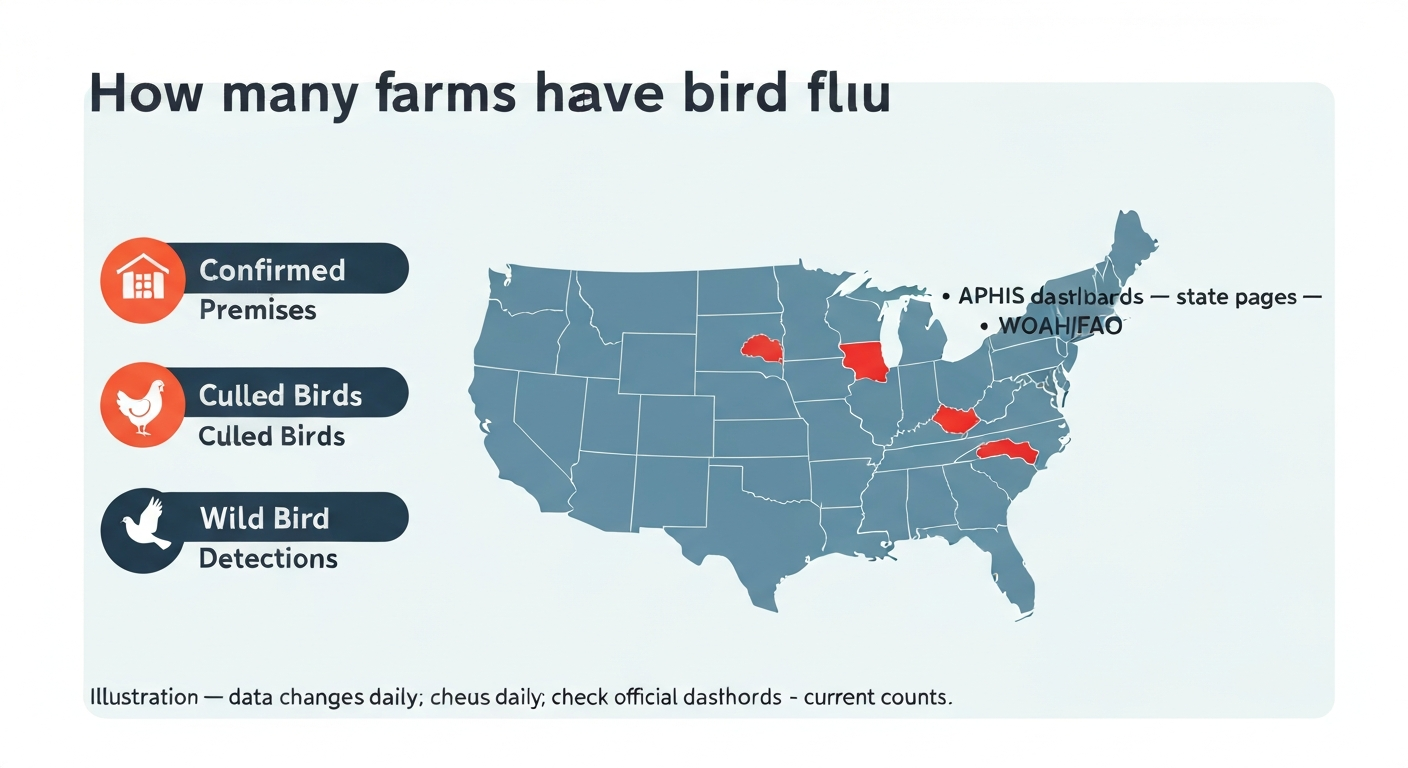
For dairy cattle operations, current USDA guidance emphasizes biosecurity around milking equipment, preventing bird access to feed and water, and testing bulk milk for H5 as an early-warning system. If you are a livestock owner concerned about the scale of current farm-level impacts, tracking how many farms have confirmed HPAI detections in your region is a practical starting point for assessing your own risk. For regional totals and recent confirmed premises, see how many farms have bird flu.
The bigger picture: ecological ripple effects
Bald eagles sit near the top of aquatic food chains. They regulate populations of fish, waterfowl, and small mammals. A sustained reduction in eagle numbers, through HPAI-driven adult mortality and nest failure, would be an ecological signal worth tracking, even if the current population is large enough to absorb losses in the short term. Studies on vulture populations in Europe and Africa have documented similar dynamics with HPAI, including documented mass mortality events. Research published in Emerging Infectious Diseases tracking an H5N1 outbreak in Griffon Vultures used multidisciplinary methods, GPS tracking, carcass surveys, serology, and virological testing, to characterize how HPAI moves through a scavenger population. That kind of detailed monitoring does not yet exist at scale for bald eagles across the full North American range, but the methods and the urgency are well established.
The broader point is that wild bird HPAI is not a background event or a temporary blip. Clade 2.3.4.4b H5 viruses have been circulating continuously in North American wild birds since late 2021, a span of nearly five years as of mid-2026, with no clear signal of disappearance. The virus has expanded its host range, infected mammals, and produced new genotypes through reassortment. For bald eagles, this means the threat is not over. It also means that the data on eagle mortality will continue to accumulate, and the picture of long-term population impact will become clearer in the years ahead.
Key authoritative resources
- USDA APHIS HPAI Detections in Wild Birds dashboard: species-level detection data with dates, locations, and subtypes.
- USGS National Wildlife Health Center (NWHC): wildlife health bulletins, necropsy reports, and research on HPAI in wild species.
- CDC H5 Bird Flu current situation hub: human case counts, risk statements, PPE guidance, and symptom monitoring protocols.
- National Park Service HPAI notices: site-specific advisories for NPS units with confirmed or suspected HPAI detections.
- FAO/WHO/WOAH joint global risk assessments: international situation reports on H5 clade 2.3.4.4b spread and zoonotic risk.
- National Wildlife Rehabilitators Association: directory of licensed rehabilitators trained to handle sick raptors.
- State fish and wildlife agency wildlife disease hotlines: the first contact point for reporting a sick or dead eagle in your area.
FAQ
What confirmed-event data do I need to accurately report that “dozens of bald eagles have died from bird flu”?
Collect primary, date-stamped confirmations: (1) agency incident reports listing number of bald eagle carcasses tested and confirmed positive (USDA APHIS HPAI wild-bird dashboard entries, state wildlife agency press releases, NPS reports); (2) diagnostic laboratory confirmations (NVSL reports or forwarded-confirmation entries) with PCR/subtype (e.g., H5, clade 2.3.4.4b) and dates; (3) necropsy/pathology summaries from USGS NWHC or university diagnostic labs describing lesions and systemic infection; and (4) chain-of-custody/sample metadata (collection date, county, submitting agency). Use these to state how many confirmed deaths vs. suspected or presumptive positives, and when/where they occurred.
Which authoritative sources should be cited and linked in the article?
Primary authoritative sources: USDA APHIS HPAI Detections in Wild Birds dashboard (for species/county/subtype entries); USDA NVSL confirmation methods/reports; USGS NWHC wildlife health bulletins and case reports (necropsy findings); CDC bird-flu guidance and interim recommendations; FAO/WOAH/WHO joint situation updates and risk assessments; state natural resource agency press releases (e.g., NJDEP) for local impacts; peer-reviewed pathology/surveillance studies showing raptor disease (PMC/NCBI and Journal of Virology papers). Link to each specific dataset or report you cite.
What expert inputs should I seek before publishing?
Interview or obtain written review from: (1) diagnostic lab scientists at NVSL or state vet labs for confirmation procedures and limitations; (2) wildlife pathologists at USGS NWHC who performed necropsies; (3) state wildlife agency biologists managing eagle monitoring and nest-survey data; (4) epidemiologists from USDA APHIS or CDC for outbreak context and public-health risk interpretation; (5) avian virologists or academic authors of recent H5 raptor studies for mechanistic and genomic context; and (6) raptor-rehabilitation center veterinarians for clinical presentation and biosecurity implications.
What verification steps are required to ensure accuracy?
Verification checklist: (1) confirm counts with original reporting agencies and cross-check against USDA APHIS and NVSL entries; (2) confirm whether positives are presumptive vs. NVSL-confirmed subtypes and include dates; (3) obtain copies or summaries of necropsy/pathology reports to verify cause-of-death attribution; (4) cross-check peer-reviewed literature cited for consistency with current clade/genotype assignments and sequence accessions (GenBank/GISAID); (5) confirm any quoted quotes or figures with the speaker/agency; (6) flag and clearly label uncertainties or provisional data (e.g., ‘presumptive positive’ vs. ‘confirmed’); and (7) time-stamp all figures and include data-source lines in tables/figures.
What outbreak-context data should be included (wild birds, poultry, farms, mammals) and where to get them?
Include national and recent regional tallies: (1) wild-bird detections by species and county from USDA APHIS HPAI dashboard; (2) poultry premises affected, numbers depopulated, and control measures from USDA APHIS epi reports/interim analyses; (3) mammal detections (e.g., detections in terrestrial mammals or cattle) from USDA, USGS, FAO/WOAH situation reports and peer-reviewed case reports; and (4) global summary (clade 2.3.4.4b distribution and host range) from FAO/WOAH/WHO situation updates. Cite specific documents and include dates for each count.
What virology and pathology details are necessary to explain impact on raptors?
Explain the virus (H5 HPAI, clade 2.3.4.4b), pathogenic mechanisms (systemic infection, neurotropism, encephalitis/neuronal necrosis, multi-organ damage), and necropsy findings documented in USGS/NWHC and peer-reviewed papers. Describe common diagnostic tests and sample types (oropharyngeal/cloacal swabs for PCR, tissue histopathology, brain/liver/spleen sampling), and that positive wild-bird samples are often forwarded to NVSL for confirmation and sequencing.
How Many Farms Have Bird Flu: Current Counts, Risks & Steps
Up-to-date counts and context for bird flu: affected farms, bird and human cases, risks, and official sources.